
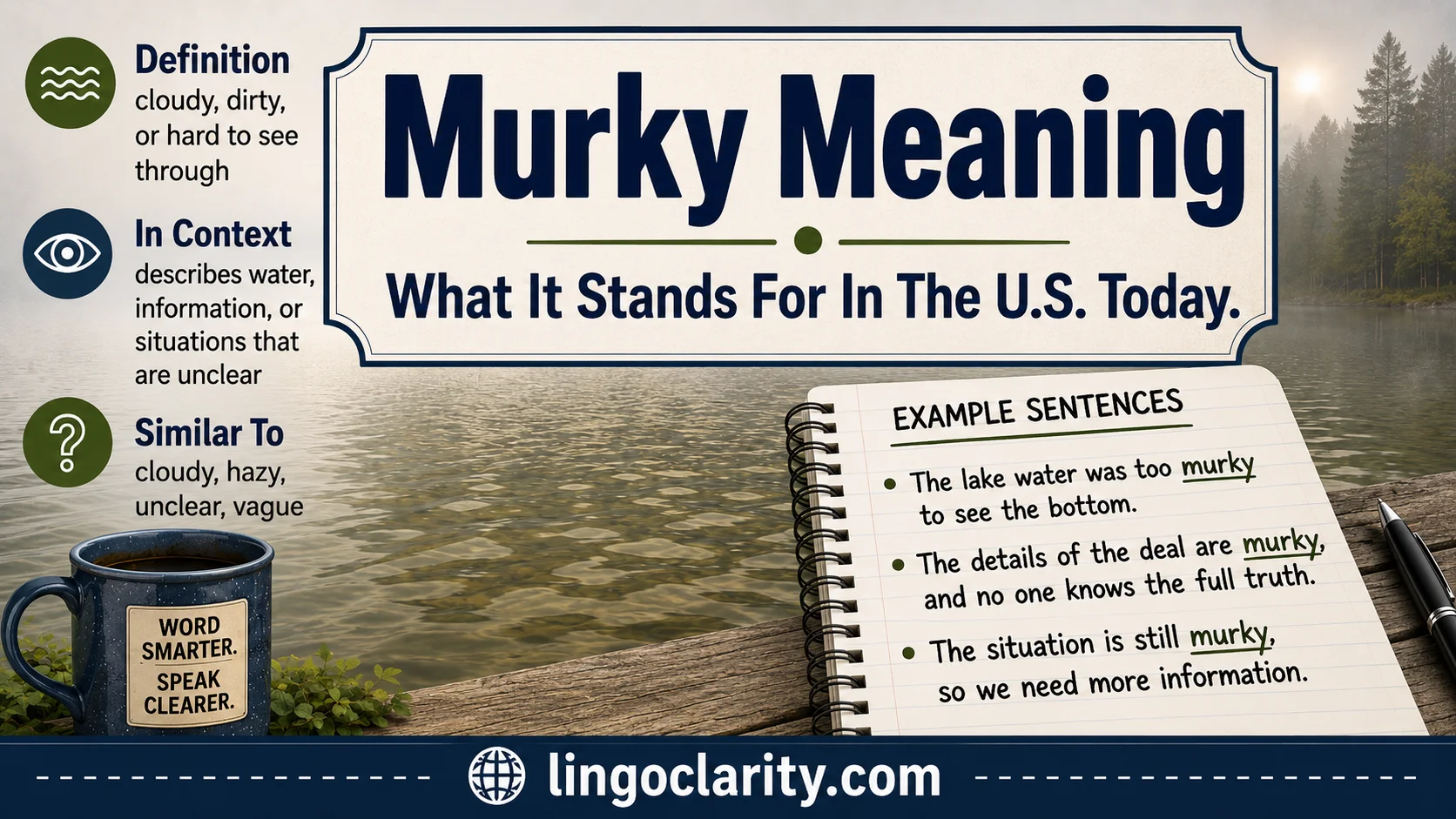
Murky Meaning In English is simple: murky means dark, cloudy, unclear, confusing, or hard to see through. The word can describe real things, such as muddy water, foggy weather, smoke, or dim light. However, it can also describe abstract things, such as unclear rules, confusing details, hidden motives, or a suspicious past.
For example, a pond may look murky after heavy rain because mud has mixed with the water. Likewise, facts in a news story may seem unclear when nobody has explained them fully. In both cases, murky meaning connects to something that is not easy to see, understand, or trust.
Because murky often suggests a lack of clarity, it can sound slightly negative. However, it does not always mean something is dishonest or dangerous. Sometimes, it simply means cloudy, dim, vague, or incomplete.
This guide explains murky meaning with pronunciation, examples, common phrases, synonyms, antonyms, and practical usage tips.
Quick Answer
Murky Meaning In English refers to something dark, cloudy, unclear, confusing, or difficult to understand.
Use murky when something is not clear to the eyes or the mind.
Examples:
- The river looked murky after the storm.
- A murky light filled the old room.
- The reason for the delay is still murky.
- The company’s finances became a murky topic.
- Reporters asked questions about his murky past.
In short, murky can describe physical unclear things, like water or fog. It can also describe unclear information, like details, plans, rules, or explanations.
TL;DR
- Murky is usually an adjective.
- It means cloudy, dark, unclear, confusing, or hard to see through.
- It can describe water, weather, rooms, light, stories, rules, plans, or details.
- In serious contexts, it can suggest something suspicious, hidden, or questionable.
- It is a standard English word, not slang.
What Murky Means In Plain English
Murky means something lacks clarity. That lack of clarity can be physical, mental, or moral.
In a physical sense, murky describes something you cannot see through clearly. For instance, murky water may contain mud, sand, algae, or pollution. As a result, the bottom of the lake or river may be hard to see.
In a visual sense, murky can describe a dark or shadowy place. A hallway, sky, road, or room may feel murky when there is not enough light or when fog, smoke, or mist blocks your view.
In a figurative sense, murky describes information that is not easy to understand. A rule, answer, story, plan, or explanation can be murky if it seems incomplete, vague, or confusing.
Sometimes, murky also suggests suspicion. For example, a murky business deal may involve hidden facts or questionable behavior. However, the word does not prove that something illegal happened. It only suggests that the situation is unclear or hard to trust.
Pronunciation, Part Of Speech, And Word Forms
Murky is pronounced MUR-kee.
The first part sounds like mur in murmur. The second part sounds like key.
Murky is an adjective, so it describes a noun.
Examples:
- murky water
- murky skies
- murky details
- a murky explanation
- a murky past
The comparative form is murkier.
Example:
- The water looks murkier today than it did yesterday.
The superlative form is murkiest.
Example:
- That was the murkiest part of the story.
The noun form is murkiness. The adverb form is murkily, although it is less common.
Main Uses Of Murky
Murky For Water Or Liquids
Most often, murky describes water that is cloudy, muddy, dirty-looking, or hard to see through.
Examples:
- The pond turned murky after the rain.
- We could not see the rocks under the murky water.
- The flood left behind murky brown water.
- Fish moved below the murky surface.
Here, murky is close to cloudy, muddy, or turbid. However, murky often sounds more descriptive because it focuses on how difficult it is to see through the water.
Murky For Weather, Light, Or Places
Murky can also describe dark, foggy, smoky, or shadowy surroundings. In this use, the word suggests poor visibility.
Examples:
- We drove slowly through the murky fog.
- A murky light came from the old lamp.
- The basement felt cold and murky.
- The city disappeared under a murky gray sky.
In these examples, murky does not simply mean dark. Instead, it suggests a mix of dim light, fog, shadow, and uncertainty.
Murky For Details, Rules, Or Explanations
In writing and conversation, murky often describes information that is not clear enough.
Examples:
- The rules are still murky.
- His answer made the issue even murkier.
- The details of the agreement remain murky.
- The timeline of events is somewhat murky.
This meaning is common in school, news, law, business, and workplace writing.
Murky For Suspicious Situations
At times, murky can suggest something secretive or questionable. This use often appears with past, deal, history, finances, or politics.
Examples:
- The investigation revealed a murky financial history.
- He was linked to a murky business deal.
- The group operated in the murky world of illegal trade.
- Her opponent focused on her murky past.
Even so, be careful. Murky suggests uncertainty or suspicion, but it does not directly accuse someone of wrongdoing.
How To Use Murky In A Sentence
Use murky before a noun when you want to describe something unclear, cloudy, dark, or suspicious.
Examples:
- The murky river flowed past the bridge.
- A murky shadow covered the room.
- The report gave a murky explanation of the problem.
- The company had a murky ownership structure.
- The story has a murky ending.
You can also use murky after linking verbs such as is, was, looks, seems, feels, became, or remains.
Examples:
- The water is murky.
- The plan seems murky.
- The situation became murkier after the meeting.
Use murky when the lack of clarity matters. Do not use it as a general replacement for bad, ugly, dirty, or strange.
Common Phrases With Murky
Murky Water
Murky water means water that is cloudy, muddy, or hard to see through.
Example:
- The children stayed away from the murky water near the dock.
Murky Details
Murky details are facts that are unclear, incomplete, or difficult to understand.
Example:
- The murky details of the deal worried investors.
Murky Past
A murky past means someone’s history is unclear, secretive, or possibly suspicious.
Example:
- The candidate’s murky past became a campaign issue.
Murky Area
A murky area is a topic where the rules, facts, or limits are not clear.
Example:
- Online copyright can be a murky area for new creators.
Murky Waters
Murky waters can refer to real cloudy water. Figuratively, it means a confusing, risky, or difficult situation.
Example:
- The lawyer helped them navigate the murky waters of the contract.
Murky Vs Muddy, Cloudy, Dark, Unclear, And Shady
| Word | Best Use | Example |
|---|---|---|
| Murky | Cloudy, dark, unclear, or suspicious | The details are murky. |
| Muddy | Full of mud | His shoes were muddy. |
| Cloudy | Full of clouds or not transparent | The sky is cloudy. |
| Dark | Having little light | The room was dark. |
| Unclear | Not easy to understand | The instructions are unclear. |
| Vague | Not specific enough | She gave a vague answer. |
| Shady | Suspicious or dishonest | That deal sounds shady. |
In comparison, dark focuses on light. Cloudy focuses on clouds or a lack of transparency. Unclear focuses on understanding. Shady is stronger because it suggests dishonesty.
Meanwhile, murky can overlap with all of them. It works best when something feels unclear, difficult to see, confusing, or not fully trustworthy.
Synonyms And Antonyms Of Murky
The best synonym for murky depends on what you are describing. Because the word can refer to water, weather, light, ideas, or suspicious situations, one replacement will not fit every sentence.
When describing water or liquids, good synonyms include cloudy, muddy, dirty, turbid, and opaque.
For weather, light, or places, better choices include dark, dim, foggy, misty, gloomy, shadowy, and hazy.
If you are talking about ideas, rules, or details, use unclear, vague, confusing, obscure, uncertain, or ambiguous.
In more serious contexts, especially when something seems hidden or questionable, synonyms such as shady, suspicious, secretive, questionable, or dubious may fit better.
Common antonyms of murky include clear, bright, clean, transparent, obvious, understandable, honest, and straightforward.
However, not every antonym works in every sentence. Clear or clean works well for water, while bright fits light. For ideas or explanations, choose clear, obvious, or understandable. In business, politics, or legal writing, transparent or straightforward often sounds more natural.
Common Mistakes To Avoid
Do not use murky to mean any bad thing.
Weak:
- The sandwich tasted murky.
Better:
- The sandwich tasted strange.
- The sandwich tasted stale.
Also, do not use murky when dirty is enough.
Weak:
- My shirt is murky.
Better:
- My shirt is dirty.
- My shirt is stained.
In addition, avoid using murky for a person alone.
Weak:
- He is murky.
Better:
- He has a murky past.
- His explanation sounds murky.
- His business history is murky.
Finally, remember that murky usually describes unclear conditions, unclear information, or suspicious details. Therefore, it should connect to something that can be physically, mentally, or morally unclear.
FAQs
What does murky mean?
Murky means cloudy, dark, unclear, confusing, or hard to see through. It can describe real things, such as water or fog, and abstract things, such as rules, plans, details, or explanations.
What is murky water?
Murky water is cloudy, muddy, or dirty-looking water. Because it is not clear, you usually cannot see through it well.
Is murky a negative word?
Murky can be neutral or negative. It is neutral when it describes water, fog, or dim light. However, it sounds more negative when it describes a suspicious deal, unclear history, or hidden information.
What does murky past mean?
A murky past means someone’s history is unclear, secretive, or possibly suspicious. Still, the phrase does not prove that the person did anything wrong.
How do you use murky in a sentence?
You can say, “The lake looked murky after the storm.” You can also say, “The rules are still murky.” In both cases, the word describes something unclear.
What is the opposite of murky?
The opposite of murky depends on what you are describing. Clear or clean works for water, bright works for light, and clear, obvious, or understandable works for ideas.
Is murky slang?
No, murky is not slang. It is a standard adjective used in everyday speech, school writing, news, books, and professional contexts.
Final Thought
Murky meaning is easy to remember when you connect it with unclear conditions. Something can be murky to the eyes, like muddy water, foggy weather, or dim light. Likewise, something can be murky to the mind, like a confusing rule or incomplete explanation. In stronger contexts, it can also suggest hidden or suspicious details.
Use murky when something is hard to see, hard to understand, or not clear enough to trust.
