The words perfect and prefect are easy to confuse because they look almost identical and differ by only one letter. However, they have completely different meanings and are used in different situations.
When you describe something as excellent, accurate, or exactly suitable, you need perfect.
When you refer to a person who has an official duty or leadership position, you need prefect.
Using the wrong word can completely change the meaning of a sentence. For example:
- “She gave a perfect answer.” means her answer was excellent.
- “She was chosen as a prefect.” means she received a leadership role.
Understanding this difference will help you avoid one of the most common spelling mistakes in English.
Quick Answer
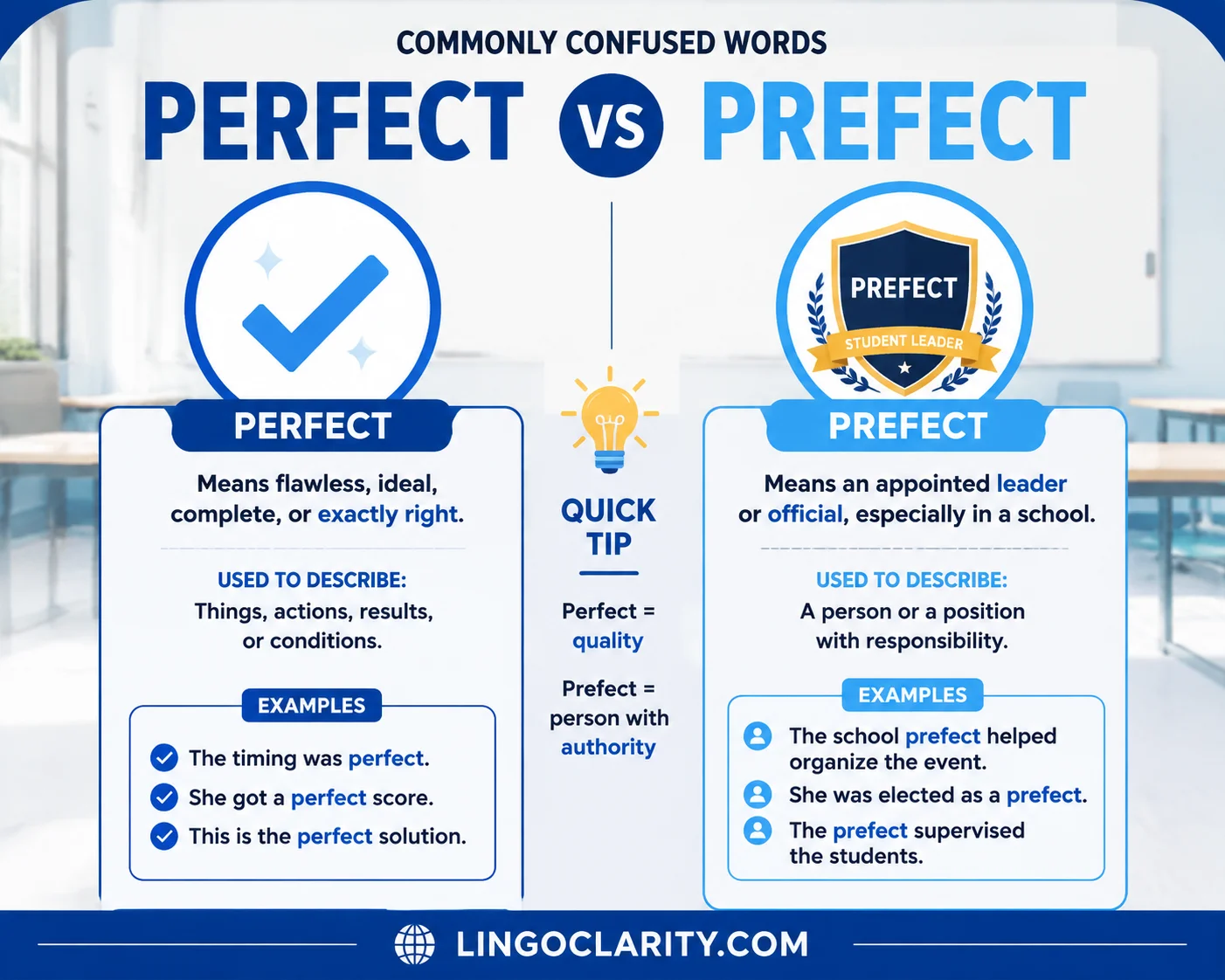
Perfect means flawless, ideal, complete, or exactly right for a situation. It is usually an adjective used to describe things, actions, results, or conditions.
Prefect means an appointed official or leader, especially a student leader in some school systems. It is a noun used for a person with responsibility or authority.
The easiest way to remember the difference is:
Perfect = quality
Prefect = person with power
Perfect vs Prefect: Key Difference
| Word | Meaning | Part Of Speech | Example |
| Perfect | Without faults; ideal; exactly right | Adjective, sometimes verb | The timing was perfect. |
| Prefect | An appointed leader or official | Noun | The prefect helped younger students. |
Meaning Of Perfect
Perfect describes something that reaches a very high standard or fits a situation extremely well.
It can describe:
- Objects
- Ideas
- Actions
- Results
- Timing
- Conditions
Examples:
- The weather was perfect for a picnic.
- She received a perfect score on the exam.
- That is the perfect solution to the problem.
- The timing was perfect for the announcement.
In everyday English, perfect does not always mean something is completely impossible to improve. People often use it to mean “exactly right.”
Example:
“Saturday works perfectly.”
This means Saturday is the ideal choice.
Meaning Of Prefect
Prefect refers to a person who has been given authority or responsibility.
The word is especially common in:
- Schools
- Historical writing
- Administrative contexts
- Some international education systems
Examples:
- The school prefect organized the student meeting.
- The principal appointed new prefects.
- The prefect helped maintain order during the event.
In many American schools, the role of a prefect is less common than in some other countries, so many Americans encounter the word mainly through books, movies, or international school settings.
Grammar Difference Between Perfect And Prefect
Perfect As An Adjective
Most commonly, perfect works as an adjective.
Examples:
- She found the perfect dress.
- This explanation is perfect.
- The performance was perfect.
It describes the quality or condition of something.
Perfect As A Verb
Perfect can also be used as a verb meaning “to improve something until it becomes highly developed.”
Examples:
- He practiced for years to perfect his skills.
- She worked hard to perfect her technique.
Prefect As A Noun
Prefect is normally a noun because it names a person or role.
Examples:
- The prefect checked attendance.
- She became a prefect during her final year.
Pronunciation Difference
Although the spelling is similar, the words have slightly different pronunciation patterns.
Perfect is commonly pronounced:
- PUR-fekt
Prefect is commonly pronounced:
- PREF-ekt
Listening carefully to the vowel sound at the beginning can help distinguish them.
When To Use Perfect
Use perfect when you mean:
- Excellent
- Ideal
- Complete
- Correct
- Without mistakes
- Exactly suitable
Examples:
- This recipe is perfect for beginners.
- He gave a perfect presentation.
- The answer was perfect.
When To Use Prefect
Use prefect when you mean:
- Student leader
- Official representative
- Person with assigned authority
Examples:
- The prefect supervised the hallway.
- The students elected a new prefect.
- The prefect reported the issue to the teacher.
Common Mistakes With Perfect And Prefect
Mistake 1: Using Prefect To Mean Excellent
Incorrect:
- The movie was prefect.
Correct:
- The movie was perfect.
The sentence describes quality, so perfect is correct.
Mistake 2: Using Perfect For A Leader
Incorrect:
- He became the school perfect.
Correct:
- He became the school prefect.
The sentence refers to a person with responsibility.
Mistake 3: Treating Them As Alternative Spellings
Incorrect:
“Perfect and prefect are just different spellings.”
Correct:
They are separate words with different meanings.
Easy Memory Trick
Remember:
Perfect has “perfection” inside it.
If you are talking about something being excellent, choose:
Perfect
If you are talking about a person who leads or has authority, choose:
Prefect
Perfect And Prefect In Everyday Sentences
Examples With Perfect
- The timing was perfect.
- She found the perfect apartment.
- His explanation was perfect.
- This gift is perfect for my sister.
Examples With Prefect
- The prefect helped organize the event.
- The school selected five new prefects.
- The prefect represented the students.
Conclusion
Perfect and prefect may look similar, but they are completely different words.
Use perfect when describing something excellent, ideal, or exactly right.
Use prefect when talking about a person with an official role, leadership duty, or authority.
A simple reminder makes the difference easy:
Perfect describes quality. Prefect describes responsibility.
Once you connect each word with its meaning, you will know which spelling to choose.
Frequently Asked Questions
No. Prefect is not a misspelling of perfect. They are two separate English words with different meanings. Perfect describes quality, while prefect refers to a person with an official role or position of responsibility.
Yes, but this use is uncommon in everyday English. Perfect is usually an adjective, but it can appear as a noun in specialized areas, such as discussions about grammar or philosophy.
Prefect is less common in everyday American English than perfect. Americans are more likely to see prefect in British school settings, international education contexts, historical writing, or fiction.
Think of the first letters:
Perfect = perfection = something excellent
Prefect = person = someone with authority
This quick association helps prevent spelling mistakes.
No. They have similar sounds, but the first syllable differs. Perfect begins with “per,” while prefect begins with “pref.”
Use prefect when referring to a school leader or student official. Use perfect only when describing something as excellent or ideal.
