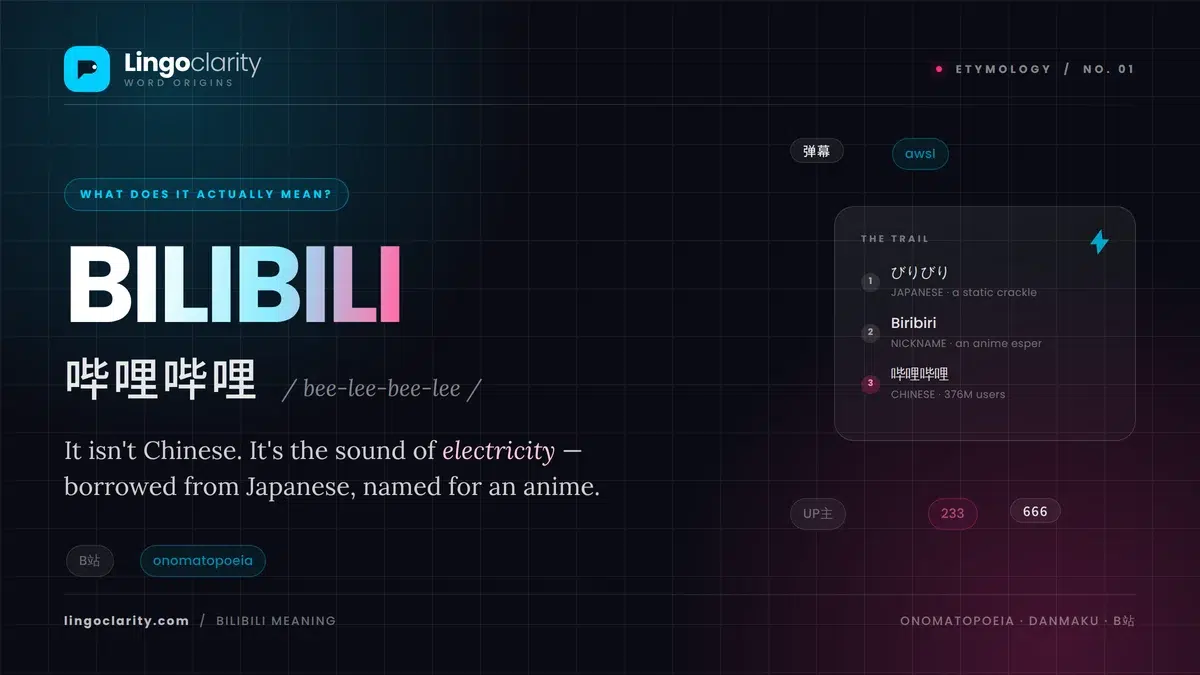
Quick answer: The Bilibili meaning is not what most people assume. “Bilibili” isn’t a Chinese word with a translatable definition — it’s a Chinese respelling of the Japanese onomatopoeia biribiri, the crackle-and-zap sound of electricity. The video platform took the name from an anime character nicknamed for her lightning powers.
What Does “Bilibili” Mean?
Bilibili (proper noun; pronounced bee-lee-bee-lee*, Chinese 哔哩哔哩, pinyin* bìlībìlī*)* is a Chinese video-sharing website and app, known for comments that scroll horizontally across the video instead of sitting in a list underneath.
But if you’re searching for the Bilibili meaning hoping for a tidy translation, there isn’t one. The four syllables are onomatopoeia — a word that imitates a sound, like buzz or sizzle. The characters 哔哩哔哩 were chosen for how they sound, not for what they mean. 哔 (bì) is itself a sound-effect character, roughly the “beep” of an electronic tone.
So the honest answer is: it means a zap. A crackle. The noise of electricity arcing.
That’s a strange name for a video site until you know where it came from.
Where Does the Name “Bilibili” Come From?
The name traces back to A Certain Scientific Railgun, a Japanese anime series whose lead character, Mikoto Misaka, is an electricity-wielding esper. Another character nicknames her “Biribiri” — ビリビリ, the Japanese onomatopoeia for a static shock or an electric crackle.
Carried into Chinese, biribiri becomes bìlībìlī, written 哔哩哔哩. That hop between three languages is why the Bilibili meaning resists a clean translation — you’re chasing a sound effect through two borrowings, not a definition.
The site’s founder, Xu Yi (known online as “⑨bishi”), launched the platform in June 2009 as Mikufans.cn, a community built around the virtual singer Hatsune Miku. It was renamed Bilibili in January 2010. The name was, in other words, an in-joke for anime fans — a nod so specific that most of the site’s 376 million monthly users today have never watched the show it references.
That origin still shapes the place. Bilibili grew out of ACG culture (anime, comics, and games), and the vocabulary its users invented spread across the Chinese internet from there.
Why Do Chinese Users Call It “B站” Instead?
Almost nobody says all four syllables out loud. In everyday Chinese, the site is B站 — B zhàn, literally “B Site” or “B Station.”
The nickname exists because of a rival. An earlier video site called AcFun was already known as A站 (“A Site”), and Bilibili — founded partly by AcFun users — became the B to its A. The letters stuck; the full name now reads as slightly formal, the way “Facebook, Inc.” sounds stiff next to “Facebook.”
Worth knowing if you ever read Chinese comments about the platform: B站 and Bilibili are the same thing.
How Do You Use “Bilibili” in a Sentence?
Because it’s a proper noun, capitalize it and treat it as singular. Some real-world contexts:
- Casual text: “the whole clip is on bilibili if u wanna watch it”
- Professional writing: “Bilibili reported 376 million monthly active users in the first quarter of 2026.”
- Spoken dialogue: “Wait, MrBeast is on Bilibili? Since when?”
- Fan conversation: “I found the full concert on Bilibili, but the danmaku covered half the screen.”
- Explanatory: “Bilibili is often described as China’s YouTube, though the comparison undersells how different the comment culture is.”
One usage note: you’ll see both “on Bilibili” and “on B站” in English-language fan writing. The first is standard; the second signals you’re part of the community.
Is “Bilibili” a Real Word in Any Other Language?
Yes — and this is the part almost every explainer misses.
In Fijian, a bilibili is a traditional bamboo raft, poled along rivers much like a punt. Bilibili rafting is still a well-known cultural activity for visitors to Fiji, promoted by the country’s own tourism board. The two words are unrelated: one is Austronesian, the other a Chinese respelling of Japanese. They simply landed on the same string of letters.
It’s a genuine homograph — same spelling, different origin, different meaning entirely. If a search result about bamboo rafts ever confused you, that’s why.
Common Mistakes and Mix-Ups
“Billibili” or “bilbili” — The double L is the single most frequent misspelling. It’s four syllables of the same two letters: bi-li-bi-li. No doubled consonants anywhere.
Pronouncing it “BILL-uh-billy” — The vowels are closer to bee and lee, not bill and silly. Say it evenly, without hammering the first syllable.
Calling it “the Chinese YouTube” — Useful shorthand, but it flattens the thing that makes Bilibili distinctive. YouTube’s comments sit below the video; Bilibili’s fly across it, timed to the exact second of the clip they’re reacting to. That’s a different viewing experience, not a translated one.
Confusing danmaku with regular comments — Bilibili has both. Danmaku are the scrolling overlay comments. The threaded discussion underneath is separate.
Assuming it’s only for anime — It started in ACG culture, but the platform now carries documentaries, science explainers, cooking, study-with-me streams, and full variety shows.
Bilibili Vocabulary You’ll Run Into
These terms come up constantly, and none translate neatly:
| Term | Written | Roughly Means | How It Differs |
|---|---|---|---|
| B站 | B站 (B zhàn) | “B Site” | The everyday name; Bilibili is the formal one |
| UP主 | UP主 (UP zhǔ) | Creator, uploader | From English “upload” + 主 (owner). Not quite “YouTuber” — carries more community warmth |
| danmaku | 弹幕 (dànmù) | “Bullet curtain” | Comments overlaid on video, not below it. Borrowed into English fandom as-is |
| AcFun / A站 | A站 (A zhàn) | “A Site” | The older rival that gave Bilibili its nickname |
| awsl | 啊我死了 | “I’m dead” (from cuteness) | Closer to English “I can’t” than to literal death |
| 233 | 233 | Laughing | Numeric, from an old forum emoticon. Functions like “lol,” not like a number |
Notice that danmaku is the only one English speakers have actually borrowed. It filled a gap — English had no word for a comment that flies across a video — so it came over intact, the way emoji and anime did before it.
The Bilibili Meaning, in One Line
The Bilibili meaning comes down to a sound, not a definition: a Japanese electric crackle, borrowed into Chinese, borrowed from an anime nickname, attached to a video site that has since outgrown the joke. If you want to sound like you know the platform, call it B站 — and don’t double the L.
Frequently Asked Questions
Not in English, and not as a standard Chinese vocabulary word either. The Chinese 哔哩哔哩 is onomatopoeia — sound-imitating characters chosen for their pronunciation rather than their meaning. Separately, bilibili is a genuine Fijian word for a bamboo raft, which is a coincidence of spelling rather than a shared origin.
Say it bee-lee-bee-lee, four even syllables. The vowels are long, closer to see and tree than to sit and silly. Chinese speakers render it bìlībìlī in pinyin; Japanese speakers say the source word as biribiri.
On its own, nothing translatable. The Bilibili meaning in Chinese is a sound effect, not a concept: the characters 哔哩哔哩 represent a sound — an electric crackle or beep — rather than an idea. Chinese users mostly say B站 (“B Site”) instead of the full name anyway.
That comparison gets you in the door, but it misses the point. Bilibili’s signature feature is danmaku, comments that scroll across the video in sync with what’s happening on screen. Watching a popular clip means watching thousands of strangers react in real time, layered over the footage.
Because a rival site, AcFun, was already nicknamed A站 (“A Site”). Bilibili became the B. The shorthand caught on so completely that the full four-syllable name now sounds formal in casual Chinese conversation.
UP主 (UP zhǔ) is Bilibili’s word for a content creator — the English word “upload” fused with the Chinese 主, meaning owner or host. It’s the closest equivalent to “YouTuber,” though it carries a warmer, more community-insider tone.
