
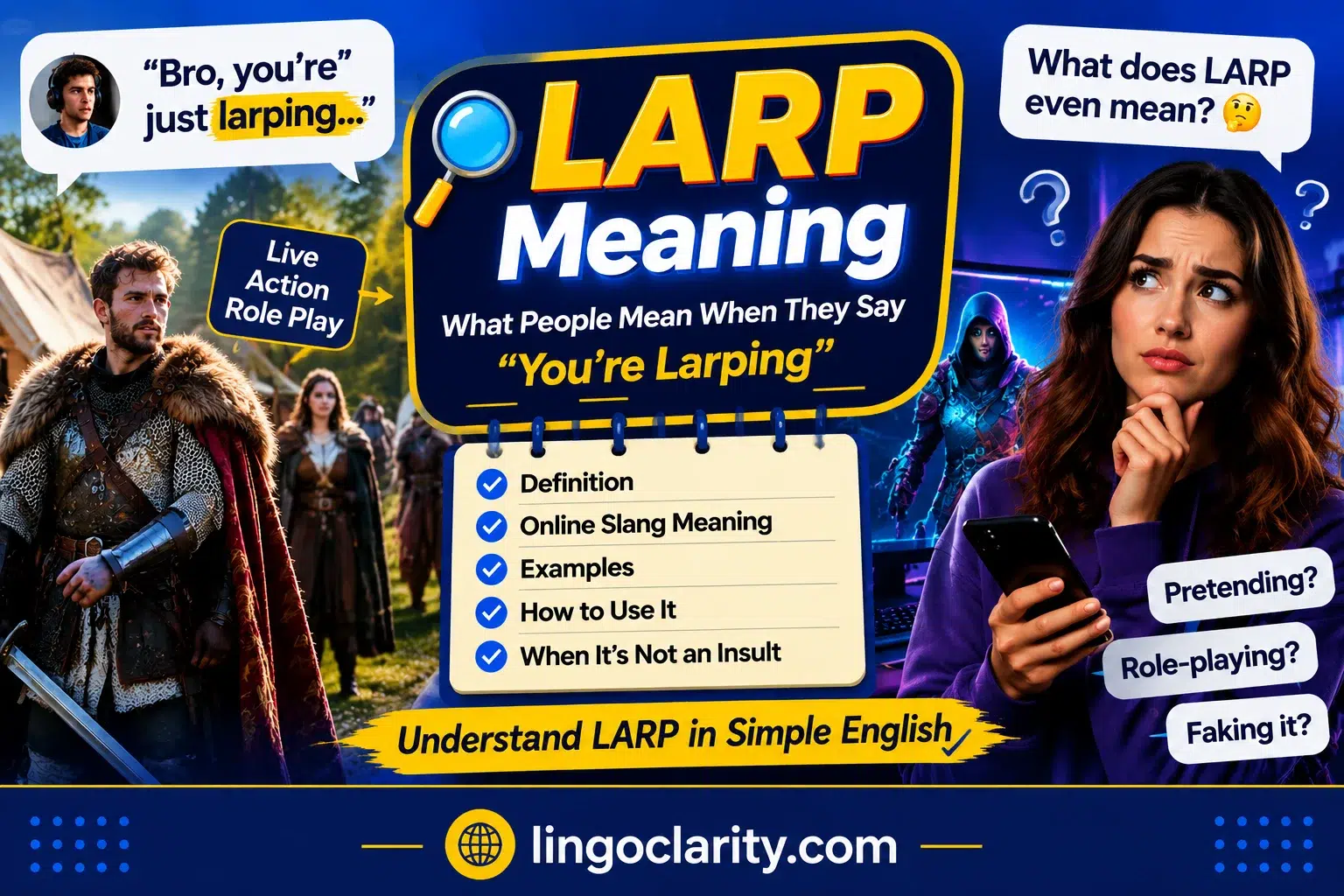
Quick answer: LARP stands for live-action role-playing, a game where players act out characters in real life. Online, larping means something looser: performing a role you haven’t earned — faking expertise, wealth, toughness, or fandom. Calling someone a larper says their whole persona is a costume.
Both meanings are alive right now, and which one you’re hearing depends entirely on who’s talking.
What Does LARP Mean?
LARP (pronounced larp, rhyming with harp) works as a noun and a verb. It’s an acronym for live-action role-playing, and it has three usable senses in American English today.
| Sense | What it means | Who uses it |
|---|---|---|
| 1. The hobby | A live-action role-playing game where people costume up and act out a fictional scenario in real time | Gamers, event organizers, tabletop and fantasy communities |
| 2. The accusation | Performing an identity you don’t actually have — faking the knowledge, the lifestyle, or the commitment | Anyone on TikTok, Reddit, X, or in a group chat |
| 3. The hoax | A story invented for attention, usually on a forum: “the whole thread was a larp” | Message-board regulars |
Merriam-Webster records the gaming sense as both noun and verb, with the inflected forms larped, larping, and larper [link to Merriam-Webster LARP entry]. Dictionary.com now lists the second sense too, defining it as enacting “a role, identity, conflict, or worldview in a stylized or theatrical way” [link to Dictionary.com larp entry] — dictionary confirmation that the slang use has stuck.
Capitalization is genuinely split. LARP in all caps reads as the acronym and suits the hobby. larp, lowercase, is standard for the slang, and Nordic larp communities have treated it as an ordinary word rather than an abbreviation for years. Either is defensible; just stay consistent inside one piece of writing.
Where Did the Word LARP Come From?
The activity came first. Live-action role-playing grew out of the tabletop scene that Dungeons & Dragons built in the 1970s, when players started acting out in a field what they’d been rolling dice for at a table. Groups in North America, Europe, and Australia appear to have arrived at the idea independently in the late 1970s and early 1980s, so there’s no single inventor to credit.
The acronym followed. Merriam-Webster dates the first known use of LARP to 1990, which lines up with the term hardening into the standard label — it beat out rivals like LRP and interactive literature.
How Did LARP Turn Into an Insult?
The jump from hobby to insult is a jump in scope. Larping in a park is bounded: everyone agreed to the fiction, and it ends when the weekend does. The slang sense strips out the consent. If you’re larping as a chef, nobody agreed to the game — you’re the only one who knows it’s a costume.
That reframing spread through internet forums during the 2000s and 2010s, where “he’s larping” became shorthand for a poster whose war stories or credentials didn’t hold up. Platform by platform, it widened. By the mid-2020s it was general-purpose, and through 2026 it’s been one of TikTok’s favorite put-downs — aimed at World Cup fans who only watched the clips, at tactical-gear collectors who’ve never served, at influencers renting the private jet.
Then it softened. A word that started as a charge has become something people cheerfully admit to: I’m larping as a runner, I’ve been twice. That self-deprecating turn is recent, and it matters for how you use the word — more on that below.
How Do You Use “Larping” in a Sentence?
Five examples, across the contexts you’ll actually meet it in:
- Text message: “He’s never been on a boat in his life. He’s just larping as a sailing guy for the photos.”
- Group chat, about yourself: “I’ve watched two matches all season — I’m fully larping as a fan at this point.”
- Spoken dialogue: “You’re larping.” — “I’m curating.”
- The original hobby sense: “We larp every other weekend at a state park outside Austin. My character is a disgraced knight.”
- Forum comment: “That confession thread was a larp. The details didn’t match.”
Notice that only one of those five uses the gaming meaning. That ratio is roughly what you’ll find in the wild now.
Is It Rude to Call Someone a Larper?
Usually, yes — and competitors’ articles tend to skip this part.
Aimed at another person, larper is an accusation of fraud. It says the identity is fake and you’re not buying it, which lands harder than poser did in the 2000s because it implies an audience is being played. Two groups hear it worst: actual LARP hobbyists, for whom the word was never an insult, and anyone whose claim is real but unverifiable to you.
The tone flips in two situations. Applied to yourself, it’s a joke and reads as charming modesty. Applied to a public figure’s public performance — a politician larping as a populist, say — it’s ordinary criticism, since the persona is the thing being reviewed.
Here’s the register in short:
- Fine: self-deprecating use, criticism of a public persona, describing the hobby.
- Risky: aimed at a friend’s genuine interest, or at anyone who might be a hobbyist.
- Wrong: any formal writing. In an essay, cover letter, or report, write pretending to be, posturing, or misrepresenting himself. The slang sense has no place in professional prose yet, though the gaming sense is perfectly reportable.
Common Mistakes and Mix-Ups With LARP
| The mistake | The fix |
|---|---|
| “He’s such a larp.” | The person is a larper. Larp is the game or the act, not the human. |
| “larpping,” “larped it up,” “L.A.R.P.ing” | Single p: larping, larped. Periods in the acronym look dated. |
| Using it for cosplay | Costume alone isn’t larping. Larping needs a scenario and improvised action. |
| Using it for catfishing | Catfishing targets a specific person with a fake identity to deceive them. Larping is a public performance with no single mark. |
| Assuming it’s always an insult | Millions of people larp as a hobby and use the word with pride. |
| Dropping it in formal writing | Save it for texts, chats, and social posts. |
The cosplay confusion is the one people make most, and it’s easy to settle: cosplay is about looking like the character, larping is about doing what the character does.
Larping vs. Cosplay vs. Posing: What’s the Difference?
| Term | Core idea | Shade of meaning |
|---|---|---|
| Larping | Acting out a role you haven’t earned | Mocking but often affectionate; can be self-applied |
| Cosplaying | Dressing as a fictional character | Neutral, and a respected craft; only an insult when borrowed for slang |
| Posing / poser | Faking membership in a subculture | Harsher, older, and now slightly dated |
| Performative | Doing something for the audience, not the belief | More political, more serious, harder to laugh off |
| Catfishing | Building a fake identity to deceive a person | Not a joke — implies real harm |
| Method acting | Staying in character off-stage | Ironic when used online, usually about someone committing too hard |
| Cringe | Embarrassing to witness | Judges the effect, not the honesty |
Larping sits in a sweet spot the others miss: it accuses without quite condemning. That’s why it spread.
LARP FAQs
Yes. Merriam-Webster and Dictionary.com both have entries for it, with the first known use dated to 1990. Dictionary.com also records the informal sense — enacting an identity in a stylized or theatrical way.
Aimed at another person, usually yes — you’re saying their identity is fake. Aimed at yourself, it’s a joke, and that’s how it’s most often used now.
Cosplay is dressing as a character. Larping is playing one inside a scenario. Costume without action isn’t larping.
Not the slang sense. Use posturing or pretending to be instead. The gaming sense is fine in any context where you’d name a hobby.
It filled a gap. Online life rewards performing an interest more than having one, and larping names that gap in one syllable
Watch which sense your reader will hear before you type it. Say “I larp on weekends” to the wrong crowd and you’ve accidentally called yourself a fraud; say “you’re larping” to the right one and you’ve made a joke instead of an accusation. The word is doing two jobs at once, and the fun of it is that both are true.
