
English Punctuation Made Clear: A Practical Guide to Commas, Semicolons, Colons, and Dashes
Punctuation is an essential part of clear English writing. Words communicate ideas, but punctuation shows readers how those ideas connect. In addition, it helps separate information, signal questions, introduce explanations, and prevent confusion. As a result, correct punctuation makes writing clearer and easier to understand.
Consider these two sentences:
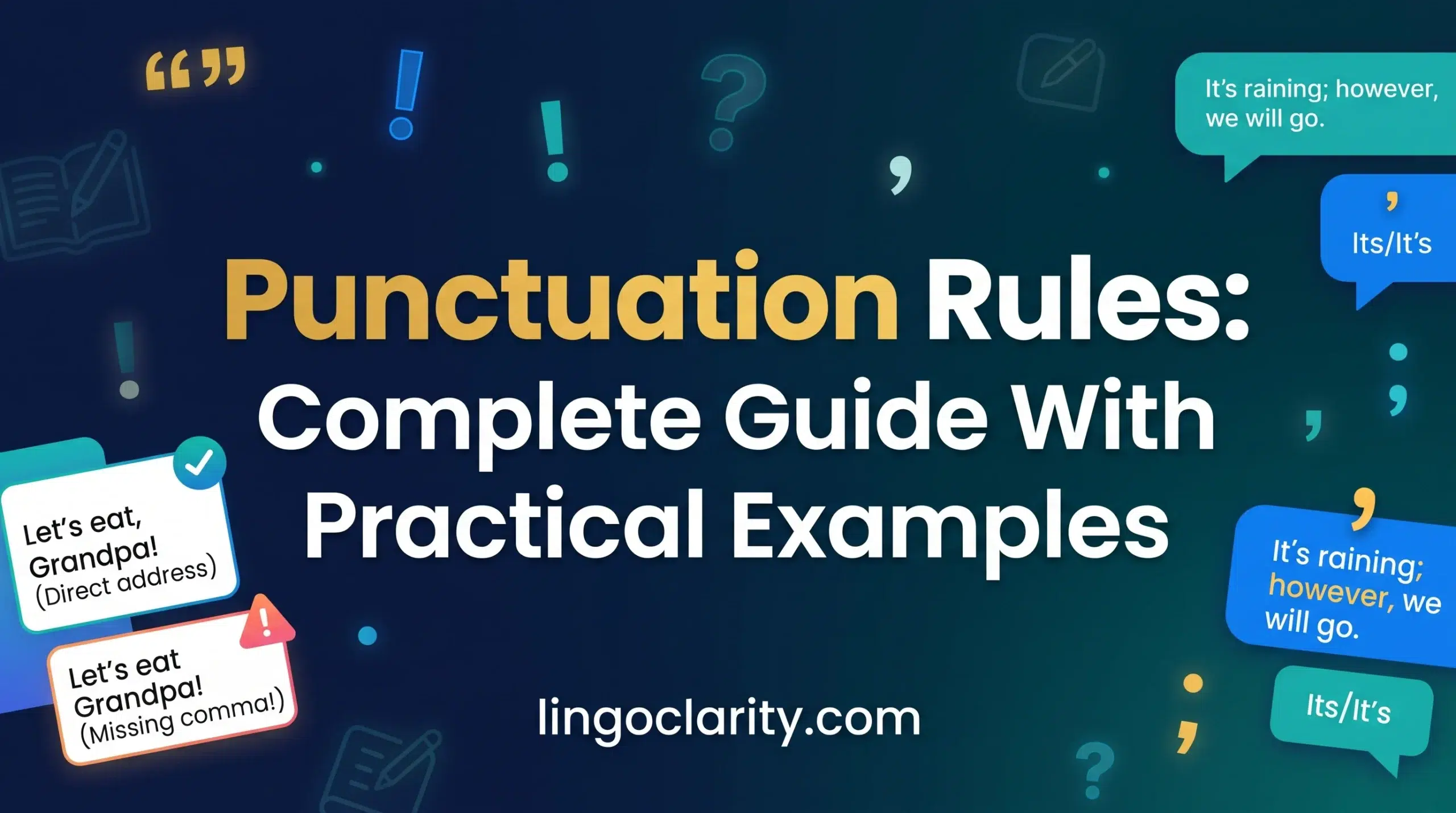
Example 1: Let’s eat, Grandma!
Example 2: Let’s eat Grandma!
The only difference is a comma; however, the meaning changes dramatically. The first sentence invites Grandma to eat, whereas the second suggests eating Grandma. Therefore, this simple example shows why punctuation matters.
Punctuation is particularly important in academic assignments, professional emails, reports, articles, and everyday communication. This guide explains the main punctuation marks, shows how to use them correctly, and identifies common mistakes. Each rule includes practical examples so that learners can apply it confidently.
Common English Punctuation Marks and Their Uses
| Punctuation Mark | Name | Main Use | Example |
|---|---|---|---|
. | Period | Ends a statement. | The meeting starts at nine. |
, | Comma | Separates items and introductory elements. | We bought pens, notebooks, and folders. |
; | Semicolon | Connects closely related independent clauses. | The deadline is near; we must finish today. |
: | Colon | Introduces a list or explanation after a complete clause. | We need three supplies: pens, paper, and folders. |
? | Question mark | Ends a direct question. | When does the class begin? |
! | Exclamation point | Expresses strong emotion or emphasis. | What a great result! |
' | Apostrophe | Shows possession or omitted letters. | The student’s book is here. |
" " | Double quotation marks | Enclose direct quotations. | She said, “The results are ready.” |
' ' | Single quotation marks | Enclose a quotation within another quotation. | He said, “Mia called it ‘excellent.'” |
( ) | Parentheses | Enclose additional information. | The meeting begins at noon (Eastern Time). |
[ ] | Brackets | Add clarification within quoted material. | She wrote, “They [the researchers] confirmed the results.” |
{ } | Braces | Group items in mathematics and programming. | The set is 8. |
- | Hyphen | Joins words in compound terms. | It was a well-written report. |
– | En dash | Indicates a range or connection. | Read pages 12–18. |
— | Em dash | Adds emphasis or sets off information. | The answer was clear—it needed no explanation. |
... | Ellipsis | Shows omitted words or a trailing thought. | “I thought we could…” She stopped speaking. |
Note: In American English, periods and commas generally go inside closing quotation marks. An en dash (–) indicates a range or connection, while an em dash (—) adds emphasis or sets off information within a sentence. Punctuation conventions may vary by style guide and context.
Full Stops and Question Marks
A full stop (.) marks the end of a complete statement. It tells readers that one idea has finished.
Examples:
- The research team collected data from three universities.
- Students must submit their reports before Friday.
- Clear instructions improve workplace communication.
A question mark (?) comes at the end of a direct question.
Examples:
- When will the survey begin?
- Have you checked the final report?
- Which method is suitable for this study?
Do not use a question mark after an indirect question.
Incorrect: The researcher asked where was the meeting.
Correct: The researcher asked where the meeting was.
An indirect question forms part of a statement, so it normally ends with a full stop.
Commas: Separating Information Clearly
A comma (,) creates a short pause and separates parts of a sentence. However, it should follow grammatical rules rather than every natural pause in speech.
A. Commas in Lists
Use commas to separate three or more items.
Example: The report includes charts, tables, interview findings, and recommendations.
In American English, a comma before the final item in a list is called the serial comma. It is often recommended because it can prevent confusion.
Potentially unclear:
The workshop invited lecturers, researchers and students from Lahore and Karachi.
Clearer:
The workshop invited lecturers, researchers, and students from Lahore and Karachi.
The serial comma does not solve every possible ambiguity, but it often improves readability.
B. Commas After Introductory Elements
Use a comma after an introductory phrase or clause when it helps readers identify where the main statement begins.
Examples:
- After reviewing the results, the team revised its recommendations.
- Before the lecture began, the students completed a short quiz.
- Although the deadline was approaching, the researcher checked the references carefully.
The comma separates the introductory information from the main clause.
C. Commas with Coordinating Conjunctions
When a coordinating conjunction connects two independent clauses, a comma normally appears before the conjunction. Independent clauses can each form a complete sentence.
Example:
The survey was completed, but the analysis required more time.
- Both parts can stand alone:
- The survey was completed.
The analysis required more time.
The conjunction but connects the contrasting ideas.
However, a comma is usually unnecessary when the conjunction connects only words or phrases.
Correct:
The team collected and analysed the responses.
Here, the conjunction connects two verbs with the same subject, not two independent clauses.
D. Commas Around Extra Information
Use commas around nonessential information that can be removed without changing the sentence’s main meaning.
Example: The principal, who joined the university in 2020, welcomed the new students.
The information about the principal’s joining date adds detail, but the sentence remains complete without it.
Compare this with:
Example: Students who submit incomplete forms must revise them.
The clause who submit incomplete forms identifies which students must revise their forms. It is essential to the meaning, so commas are not normally used.
E. Avoiding Comma Splices
A comma splice occurs when a comma incorrectly joins two independent clauses without a suitable connecting word.
Incorrect:
The internet connection failed, the students could not upload their assignments.
Correct:
The internet connection failed, so the students could not upload their assignments.
Other solutions include using a full stop or semicolon:
- The internet connection failed. The students could not upload their assignments.
- The internet connection failed; the students could not upload their assignments.
Choose the version that best expresses the relationship between the ideas.
F. Commas in Direct Address
Use a comma when directly addressing someone by name or title. The comma separates the person’s name from the rest of the sentence.
Examples:
- Maria, please review the final report.
- Thank you, Professor, for your helpful feedback.
- Could you help me, James?
The comma makes it clear who is being addressed. Without it, a sentence may become harder to read.
G. Commas Between Coordinate Adjectives
Use a comma between coordinate adjectives when they independently describe the same noun. You can often place and between them or reverse their order without changing the meaning.
Examples:
- The team presented a clear, persuasive argument.
- We reviewed the lengthy, detailed report.
A useful test is to insert and between the adjectives. If the sentence still sounds natural, a comma may be appropriate.
Do not normally use a comma between cumulative adjectives, which build on one another.
Example:
- She bought a small wooden desk.
Here, small describes the desk’s size, while wooden identifies its material. The adjectives work together, so no comma is needed.
H. Commas in Dates and Locations
In American English, commas separate the day from the year in a month-day-year date. When the date appears within a sentence, place another comma after the year if the sentence continues.
Examples:
- The conference begins on September 15, 2026.
- On September 15, 2026, the conference will begin.
- The company is based in Austin, Texas.
Use a comma between a city and a state when writing them together. If the sentence continues after the state name, place a comma after it as well.
Example:
- Austin, Texas, attracts businesses from many industries.
I. Commas After Introductory Transition Words
Use a comma after an introductory transition word or phrase when it helps separate that expression from the main clause.
Examples:
- However, the results were inconclusive.
- Therefore, the team repeated the experiment.
- For example, students can practise punctuation by editing short paragraphs.
- In addition, the report includes recommendations for future research.
The comma helps readers recognize the transition before they process the main idea.
J. Commas Around Nonessential Names, Titles, and Appositives
Use commas around a name, title, or explanatory phrase when it adds information but is not necessary to identify the person or thing being discussed.
Examples:
- Our department chair, Dr. Lewis, approved the proposal.
- Maya Patel, the lead researcher, presented the findings.
- The report, a summary of the year-long study, was published in June.
The extra information can be removed without changing the sentence’s main meaning.
However, do not use commas when the information identifies which person or thing you mean.
Example:
- The researcher Dr. Lewis approved the proposal.
Here, the title identifies which researcher approved the proposal, so commas are not required.
Semicolons: Connecting Closely Related Ideas
A semicolon (;) connects two closely related independent clauses. It creates a stronger separation than a comma but maintains a closer relationship than a full stop.
Example:
The first method produced reliable results; the second method produced inconsistent findings.
Both parts are complete sentences, and the semicolon shows that they belong together.
Semicolons are useful when two statements share a clear connection.
Example:
The deadline was extended; several students had experienced technical problems.
The semicolon is suitable because the two ideas are related. However, a full stop would also be grammatically correct.
Semicolons in Complex Lists
Use semicolons to separate list items that already contain commas. This helps readers identify where one item ends and another begins.
Example:
The research team included Ayesha Khan, a linguist; Bilal Ahmed, a data analyst; and Sara Malik, a project coordinator.
Ordinary commas would make the list harder to read because each person’s name is followed by a description.
Important rule:
A semicolon normally connects independent clauses or separates complex list items. It should not be used simply because a sentence feels long.
Incorrect:
The students completed the survey; because the teacher explained the instructions.
Correct:
The students completed the survey because the teacher explained the instructions.
The second part of the incorrect example is a dependent clause, so the semicolon is not appropriate.
Colons: Introducing Explanations and Examples
A colon (:) tells readers that something important follows. It can introduce a list, explanation, example, or statement that develops the preceding idea.
A. Introducing a List
Use a colon after a complete introductory statement.
Example:
The proposal has three main objectives: improving access, reducing costs, and increasing student participation.
The words before the colon form a complete statement.
Avoid placing a colon directly between a verb and its objects.
Incorrect:
The researcher collected: interviews, questionnaires, and observation notes.
Correct:
The researcher collected interviews, questionnaires, and observation notes.
Alternatively:
Correct:
The researcher collected three types of evidence: interviews, questionnaires, and observation notes.
The second version uses a complete introductory statement before the colon.
B. Introducing an Explanation
A colon can introduce information that explains the preceding statement.
Example:
The experiment was postponed for one reason: the equipment was not ready.
The second part explains the reason for the postponement.
C. Introducing an Important Statement
A colon can also introduce a statement that develops or emphasizes an idea.
Example:
The project manager repeated one instruction: every figure had to be checked before publication.
In academic and professional writing, use a colon when the relationship between the introductory statement and the following information is clear.
Colon vs. Semicolon vs. Dash: Key Differences
Colons, semicolons, and dashes help organize sentences, but each mark serves a different purpose. Choosing the right one makes your writing easier to understand.
| Punctuation Mark | Main Purpose | Grammatical Rule | Example |
|---|---|---|---|
| Colon (:) | Introduces a list, explanation, or example | Place it after a complete clause that introduces the following information. | The team needs three items: a laptop, a projector, and a screen. |
| Semicolon (;) | Connects closely related independent clauses | Both sides should normally be able to stand alone as complete sentences. | The deadline is approaching; the team must finish the report. |
| Em dash (—) | Adds emphasis or sets off extra information | Use it to interrupt a sentence with additional information or emphasize a point. | The team had one concern—the results were incomplete. |
| Hyphen (-) | Joins words or word parts | Often joins words that work together as a compound modifier before a noun. | The team prepared a well-organized report. |
| En dash (–) | Shows a range or connection | Commonly connects numbers, dates, or related terms. | The workshop runs from September 12–15. |
Hyphen vs. En Dash vs. Em Dash
A hyphen, an en dash, and an em dash look similar, but they are not interchangeable.
- Hyphen (-): Joins words, as in a five-page report.
- En dash (–): Indicates a range, as in pages 10–20.
- Em dash (—): Adds emphasis or sets off information, as in The answer was simple—the data was incomplete.
Quick tip: Use a hyphen to join words, an en dash to connect a range, and an em dash to create a strong break in a sentence. Follow your required style guide when punctuation conventions differ.
5. Apostrophes: Possession and Contractions
An apostrophe (‘) has two main functions: showing possession and marking missing letters in contractions.
A. Showing Possession
For most singular nouns, add apostrophe plus s.
Examples:
- The student’s assignment
- The teacher’s feedback
- The company’s policy
For plural nouns ending in s, add an apostrophe after the final s.
Examples:
- The students’ assignments
- The teachers’ meeting
The researchers’ findings
For irregular plural nouns that do not end in s, add apostrophe plus s.
Examples:
- The children’s books
- The men’s department
For singular names ending in s, styles may differ. For example, both James’s report and James’ report appear in published writing. Follow the style guide required by your institution or publication.
B. Using Contractions
An apostrophe shows that letters have been omitted.
Examples:
- do not → don’t
- cannot → can’t
- it is → it’s
- they are → they’re
Contractions are common in conversation and informal communication. In formal academic writing, writers often prefer full forms unless the required style permits contractions.
C. Distinguishing Its and It’s
This is a frequent source of confusion.
- Its shows possession: The company changed its policy.
- It’s means it is or it has: It’s important to check the figures.
A useful test is to replace it’s with it is. If the sentence still makes sense, the apostrophe is appropriate.
Incorrect:
The university updated it’s website.
Correct:
The university updated its website.
Quotation Marks: Presenting Exact Words
Quotation marks (” “) show the exact words spoken or written by someone. They are commonly used for direct quotations.
Example: The lecturer explained, “Clear writing helps readers understand complex ideas.”
The quoted words reproduce the lecturer’s statement directly.
Compare direct and indirect speech:
Direct: The lecturer said, “Submit the report tomorrow.”
Indirect: The lecturer said that students should submit the report the following day.
Quotation marks are not normally used for indirect speech because the speaker’s exact words are not being reproduced.
In American English, commas and full stops generally appear inside closing quotation marks. Other English style conventions may differ, so follow the required publication or institutional style consistently.
Example: The report describes the results as “encouraging.”
Use quotation marks carefully. They should not replace clear explanation or be used to suggest doubt without a reason. When quoting academic sources, provide the required citation and preserve the original wording accurately.
Dashes, Hyphens, and Parentheses
These marks look similar or serve related purposes, but their functions are different.
A. Dashes
An em dash (—) can emphasize an interruption, add extra information, or introduce a final point.
Example: The team had one major concern—the results could not be reproduced.
An em dash can also set off additional information.
Example: The final report—which had been revised twice—was submitted on Monday.
Commas or parentheses might work in the second example, too. Dashes generally create stronger emphasis.
Use them sparingly in formal writing. Too many dashes can make sentences feel disorganized.
B. Hyphens
A hyphen (-) joins words or word parts. It is often used in compound modifiers before a noun.
Examples:
- A well-designed questionnaire
- A five-page report
- A user-friendly website
Compare:
With a hyphen:
The team designed a user-friendly website.
Without a hyphen:
The website is user friendly.
Hyphenation depends on the phrase and the style guide. Some compound expressions change as usage develops, so consult a reliable dictionary when uncertain.
Do not confuse a hyphen with a dash. A hyphen joins words; a dash separates or emphasizes information.
C. Parentheses
Parentheses ( ) enclose additional information that is useful but not central to the sentence.
Example: The participants completed the questionnaire online (using the university portal).
The sentence remains complete without the information inside parentheses.
Use parentheses for brief explanations, dates, abbreviations, or supporting details. If the enclosed information is essential to the main point, integrate it into the sentence instead.
British vs. American Punctuation Differences
British and American English share most punctuation rules, but they differ in quotation mark styles and punctuation placement.
| Feature | American English | British English |
|---|---|---|
| Primary quotation marks | Double: “hello” | Often single: ‘hello’ |
| Periods and commas | Generally inside quotation marks | Often placed according to meaning |
| Date format | September 15, 2026 | 15 September 2026 |
Examples:
- American: She called the results “promising.”
- British: She called the results ‘promising’.
American English generally places periods and commas inside closing quotation marks. British English often places them inside only when they belong to the quoted material. However, conventions vary by publisher and style guide.
Tip: Since this article targets U.S. readers, follow American English punctuation conventions consistently.
Common Punctuation Mistakes and How to Correct Them
Punctuation errors can change a sentence’s meaning, interrupt its flow, or make writing harder to understand. The following examples show common mistakes and how to fix them.
Part 1: Common Punctuation Mistakes (1–8)
| # | Incorrect Sentence | Correct Sentence | Reason |
|---|---|---|---|
| 1 | The report is clear, it is also detailed. | The report is clear, and it is also detailed. | Use a conjunction to join two independent clauses. |
| 2 | The project includes: planning and testing. | The project includes planning and testing. | Do not place a colon between a verb and its objects. |
| 3 | The students assignment is ready. | The student’s assignment is ready. | Use an apostrophe to show singular possession. |
| 4 | Its raining outside. | It’s raining outside. | It’s means it is; its shows possession. |
| 5 | The researcher said that, the results were useful. | The researcher said that the results were useful. | Do not place an unnecessary comma after that. |
| 6 | The well designed tool is effective. | The well-designed tool is effective. | Hyphenate a compound modifier before a noun. |
| 7 | Where is the nearest library. | Where is the nearest library? | Use a question mark after a direct question. |
| 8 | Please submit the form, by Friday. | Please submit the form by Friday. | Do not separate a verb from its essential information with a comma. |
Part 2: More Punctuation Mistakes (9–15)
| # | Incorrect Sentence | Correct Sentence | Reason |
|---|---|---|---|
| 9 | After the meeting ended the team reviewed the notes. | After the meeting ended, the team reviewed the notes. | Use a comma after an introductory dependent clause. |
| 10 | We need pencils notebooks and folders. | We need pencils, notebooks, and folders. | Use commas to separate items in a list. |
| 11 | She said “I will call tomorrow.” | She said, “I will call tomorrow.” | Use a comma to introduce a direct quotation. |
| 12 | The manager’s reviewed the budget. | The managers reviewed the budget. | Do not use an apostrophe to form a regular plural. |
| 13 | The deadline is near, we must finish today. | The deadline is near; we must finish today. | Use a semicolon to join closely related independent clauses. |
| 14 | Bring three items a pen, a notebook, and a folder. | Bring three items: a pen, a notebook, and a folder. | Use a colon to introduce a list after a complete clause. |
| 15 | The results were promising however, more testing is needed. | The results were promising; however, more testing is needed. | Use a semicolon before however and a comma after it when joining independent clauses. |
How to Avoid These Mistakes
- Check that every sentence ends with appropriate punctuation.
- Look for comma splices and separate independent clauses correctly.
- Review apostrophes for possession and contractions.
- Check lists, introductory clauses, and direct quotations.
- Use colons, semicolons, and dashes only when their grammatical purpose is clear.
Careful proofreading helps you catch punctuation errors before submitting an assignment, sending a professional email, or publishing an article.
Punctuation in Academic and Professional Writing
Different writing situations require different levels of formality, but clarity remains essential.
In academic assignments, punctuation helps present arguments, explain evidence, and distinguish a writer’s claims from quoted material. Professional emails use punctuation to clarify requests, deadlines, and next steps. Meanwhile, technical reports rely on clear punctuation to make instructions and information easier to follow.
Compare these examples:
Unclear:
Please review the attached report the figures may contain errors send your comments by Thursday.
Clear:
Please review the attached report. However, the figures may contain errors, so send your comments by Thursday. The revised version separates the main request from the explanation and deadline. In addition, check punctuation when editing lists, headings, quotations, dates, and references. Finally, maintain one accepted punctuation style throughout the document for consistency.
A Practical Editing Method
Punctuation becomes easier to manage when writers check it systematically rather than trying to correct everything at once.
Use the following method when reviewing a paragraph:
- Identify complete sentences. Check that each statement has an appropriate ending mark.
- Check clause connections. Look for comma splices and confirm that conjunctions connect ideas correctly.
- Review lists and introductions. Make sure commas separate list items and colons follow complete introductory statements.
- Check possession and contractions. Distinguish students’ from student’s and its from it’s.
- Review quotations and extra information. Confirm that quotation marks, parentheses, and dashes are used consistently.
- Read the revised text again. Ask whether each punctuation mark helps readers understand the intended meaning.
Consider this paragraph:
Before editing:
The students collected survey responses, they entered the data into a spreadsheet the lecturer checked the results, and the team prepared a report.
After editing:
The students collected survey responses and entered the data into a spreadsheet. The lecturer checked the results, and the team prepared a report.
The revision corrects the comma splice and, as a result, makes the sequence of actions easier to follow. It also avoids unnecessary repetition by combining actions performed by the same subject.
Additionally, a final read-through is valuable because punctuation errors can remain even after spelling and grammar checks. Although automated tools may identify possible problems, writers must judge whether a suggested change preserves the intended meaning.
Conclusion
Punctuation is not merely a collection of marks placed between words. It is a practical system that helps readers understand relationships between ideas. Full stops and question marks signal sentence endings; commas separate information; semicolons connect closely related clauses; and colons introduce explanations or lists. Apostrophes show possession and contractions, while quotation marks identify exact words. Dashes, hyphens, and parentheses serve different purposes and should not be treated as interchangeable.
The most effective way to improve punctuation is to study sentence structure, examine clear examples, and practise editing real writing. When reviewing a sentence, ask what each punctuation mark contributes. Does it separate complete ideas, introduce an explanation, identify possession, or prevent confusion? If the mark has a clear grammatical purpose, it is more likely to be correct.
Consistent practice will help learners write more clearly and confidently. Accurate punctuation strengthens academic assignments, professional emails, reports, and everyday communication.

2 thoughts on “Punctuation Rules: Complete Guide With Practical Examples”
Comments are closed.