
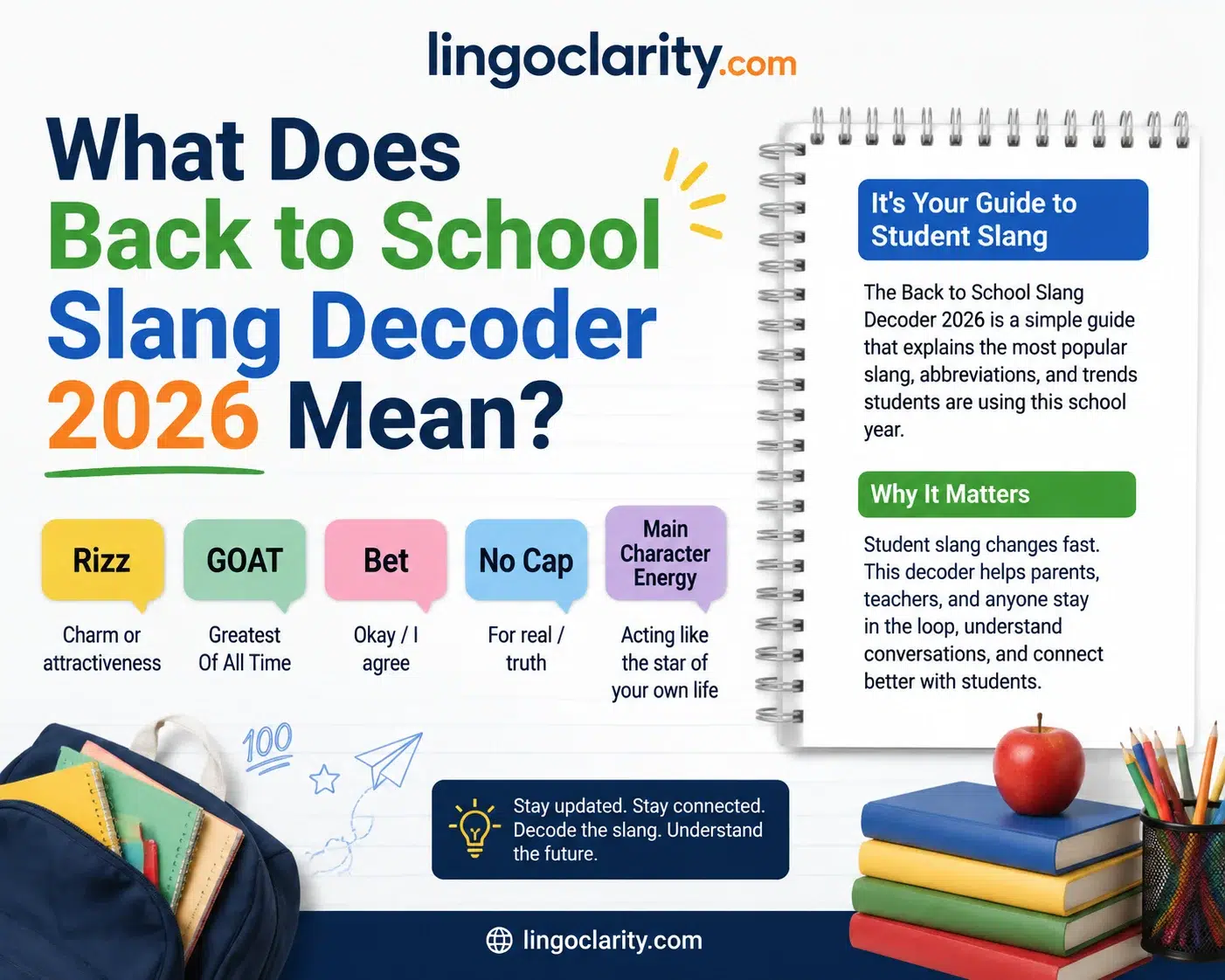
Quick Answer:
A back to school slang decoder 2026 is a guide that explains the casual words, abbreviations, and internet phrases students may use in classrooms, group chats, and social media. It helps parents, teachers, and students understand current slang without confusing informal language with formal writing.
Introduction
A new school year often brings more than fresh notebooks and schedules. It also brings new words.
Students create, remix, and spread language quickly through platforms such as TikTok, gaming chats, messaging apps, and online communities. A phrase that feels normal in a group chat may sound strange in a classroom presentation.
The back to school slang decoder 2026 helps explain these expressions in plain American English. This guide focuses on what students may say, where these terms appear, and how to understand the difference between casual slang and standard communication.
Slang is not “wrong” language. It is simply language with a specific audience and purpose. The key is knowing when it works and when another word would communicate better.
Why Does School Slang Change So Quickly?
School slang changes because young speakers constantly experiment with language. Online spaces allow phrases to spread across cities and communities within days.
Some expressions come from gaming, music, memes, and social platforms. Others come from older slang that receives a new meaning from younger users.
The same word can also change meaning over time. For example, a phrase that once sounded negative may become playful among friends.
Merriam-Webster tracks many informal words because slang can become part of everyday English when enough speakers use it. The Oxford English Dictionary also records language changes, including many modern expressions.
Which Back to School Slang Terms Should You Know in 2026?
The following table explains common types of slang students may encounter.
| Slang Type | Meaning | Example |
|---|---|---|
| No cap | Seriously; no lie | “That test was hard, no cap.” |
| Rizz | Charm or ability to attract someone | “He has good rizz.” |
| Delulu | Playfully unrealistic thinking | “I’m being delulu about my chances.” |
| Bet | Okay; agreement | “Bet, I’ll send the notes.” |
| Sus | Suspicious | “That excuse sounds sus.” |
| W | A win or something positive | “Getting extra credit was a W.” |
| L | A loss or disappointment | “Missing the bus was an L.” |
What Do Popular Student Slang Terms Mean?
No Cap
No cap means “I am telling the truth” or “I am not exaggerating.”
Students often use it to emphasize honesty.
Example:
“That movie was actually amazing, no cap.”
This phrase fits casual conversations but usually does not belong in academic writing.
Rizz
Rizz describes charm, confidence, or social skill, especially when someone is trying to impress another person.
Example:
“Her presentation skills have serious rizz.”
The word became widely known through internet culture and is often used humorously.
Delulu
Delulu is a playful shortening of “delusional.” It usually describes someone having unrealistic hopes in a joking way.
Example:
“I’m delulu if I think I can finish this project in one hour.”
The tone is usually light, but it can sound insulting if used toward someone who does not understand the joke.
Bet
Bet means agreement or confirmation.
Example:
“Can you share the homework page?”
“Bet.”
It works well in texts and casual speech.
How Do You Know When Slang Is Appropriate?
The meaning of slang depends heavily on the situation.
| Situation | Slang Use | Better Choice |
|---|---|---|
| Group chat | Usually acceptable | Casual phrases work |
| Texting friends | Common | Informal language is normal |
| Teacher email | Avoid most slang | Use polite standard English |
| School essay | Avoid slang unless discussing language | Use formal wording |
| Job interview | Usually avoid slang | Use professional vocabulary |
Here’s the simple rule: use slang where people expect casual conversation.
A student texting a friend and a student writing a scholarship essay have different language goals.
Common Mistakes People Make With School Slang
| Mistake | Why It Happens | Better Approach |
|---|---|---|
| Using slang everywhere | Confusing casual and formal settings | Match language to the audience |
| Copying slang without knowing meaning | Trends spread quickly online | Check the meaning first |
| Using outdated slang | Language changes fast | Follow current usage |
| Treating slang as incorrect English | Confusing style with grammar | Understand the context |
Back to School Slang Decoder 2026 Context Guide
Different groups use different expressions. A phrase popular among teenagers may sound unusual to parents, teachers, or coworkers.
| Group | Typical Language Style | Example |
|---|---|---|
| Friends | Relaxed and playful | “That’s a W.” |
| Classroom discussion | More controlled | “That was successful.” |
| Online gaming | Fast abbreviations | “GG” |
| Professional writing | Formal language | “Excellent result.” |
Related Words and Modern Language Trends
Slang connects with several areas of language study.
Colloquial language means everyday speech used in normal conversation.
Internet language includes words shaped by online communities.
Abbreviations shorten longer phrases, especially in texting.
Neologisms are newly created words or meanings that enter a language.
These categories help explain why school slang changes so often.
Key Takeaways
- The back to school slang decoder 2026 explains current student expressions in simple terms.
- Slang depends on audience, situation, and relationship.
- Online platforms strongly influence modern school vocabulary.
- Informal language can be creative while still needing proper timing.
- Understanding slang improves communication between different age groups.
Frequently Asked Questions
What is a back to school slang decoder 2026?
A back to school slang decoder 2026 explains modern student slang, abbreviations, and online expressions used during the school year.
Is school slang bad English?
No. School slang is informal English. It becomes a problem only when it is used in situations that require formal language.
Why do students create new slang?
Students create slang to build identity, express humor, and communicate quickly with their communities.
Can teachers use student slang?
Teachers can understand slang, but using it depends on the classroom relationship and personal style.
Should students use slang in essays?
Most school essays require standard English unless the assignment discusses slang, culture, or language.
How often does slang change?
Slang can change quickly because online communities create and spread new expressions constantly.
