Quick Answer
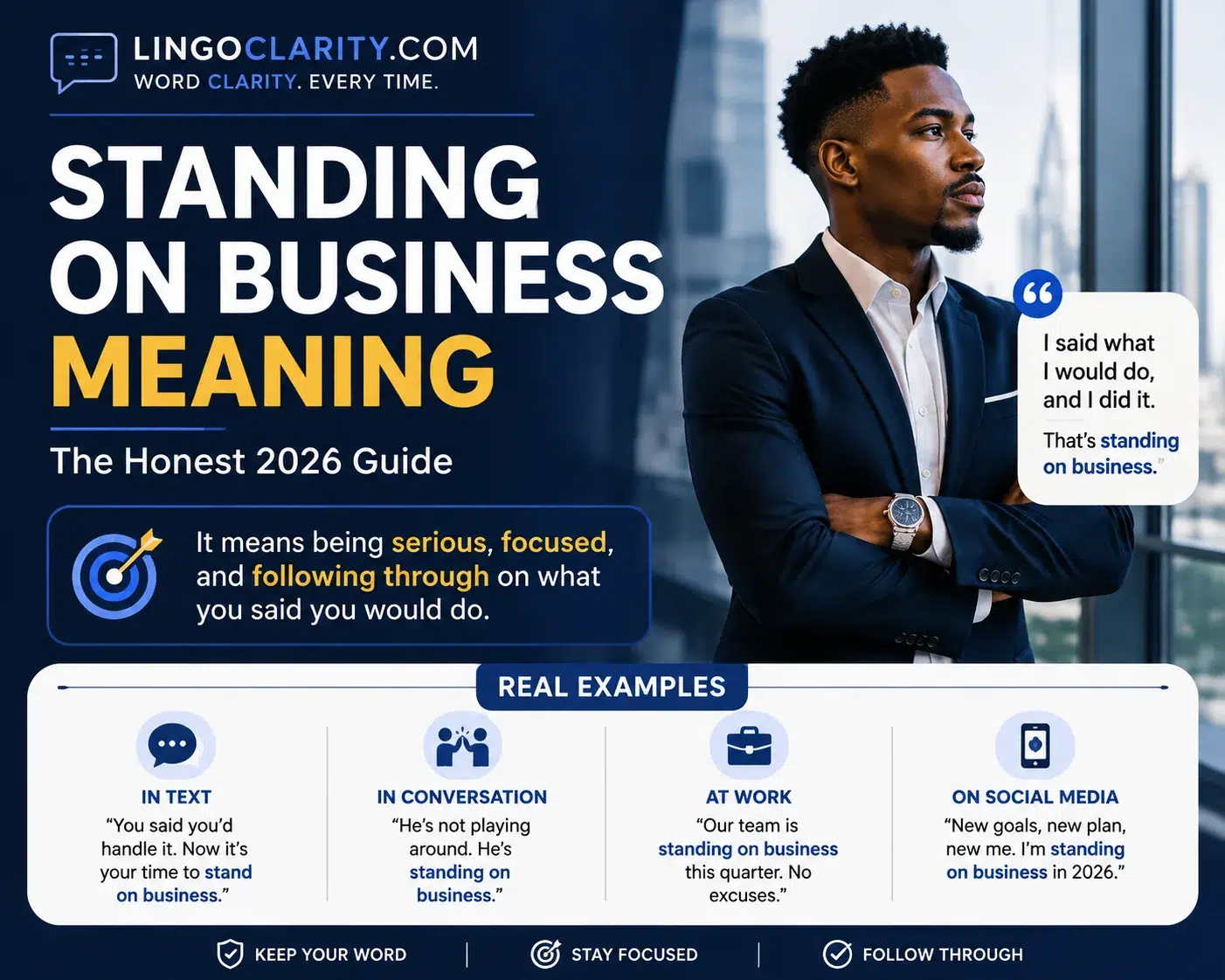
Standing on business meaning refers to keeping your word, following through on your promises, and staying firm when someone challenges your decision. The phrase does not mean running a company. Instead, it means handling your responsibilities, protecting your boundaries, and proving your actions match your words.
What Does Standing on Business Meaning Really Mean?
The phrase standing on business meaning is simple: you do what you said you would do, even when it becomes difficult.
When someone says they are “standing on business,” they usually mean they are serious about a decision, commitment, or personal boundary. They are not just making statements; they are showing action.
The word business in this phrase does not refer to a company or workplace. It uses the older everyday meaning of “business” as a person’s own matters, responsibilities, or concerns.
For example:
- Someone says they will finish a fitness goal and actually follows the plan.
- A person sets a boundary in a relationship and does not change it under pressure.
- An employee promises to complete a task and delivers it on time.
In each case, the person is “standing on business” because their actions support their words.
The phrase became widely popular through online culture, social media, and modern slang conversations. Today, many younger speakers use it to describe confidence, accountability, and determination.
Where Did “Standing on Business” Come From?
The phrase standing on business comes from African American Vernacular English (AAVE), a variety of English with its own grammar, vocabulary, and expressions.
The exact first person who created the phrase is not clearly documented. However, the expression existed in Black American speech before becoming widely recognized online.
The phrase gained major attention through social media platforms, music, podcasts, and viral clips. During the 2020s, it moved from a community expression into mainstream internet language.
Popular culture helped spread the phrase, but no single celebrity can be credited with creating it.
This pattern is common with slang. A phrase may exist within a community for years before a wider audience discovers it.
What Is the Difference Between Standing on Business and Minding Your Business?
Many people confuse these two phrases because they share the word “business.” However, their meanings are completely different.
| Phrase | Meaning | Example |
|---|---|---|
| Standing on business | Following through on your own decisions and responsibilities | “I said I would finish the project, and I’m standing on business.” |
| Minding your business | Staying out of other people’s affairs | “Don’t worry about them. Just mind your business.” |
The first phrase is about commitment and action. The second phrase is about privacy and boundaries.
How Do You Use “Standing on Business” Correctly?
The phrase is usually used in casual conversations, texts, captions, and social media posts.
Here are natural examples:
In a Text Message
“I told them I was saving money this year, and I’m standing on business.”
Meaning: The person is staying committed to their goal.
In Everyday Conversation
“She said she wanted the promotion, and she’s standing on business.”
Meaning: She is working seriously toward what she wants.
On Social Media
“New goals. New habits. Standing on business this year.”
Meaning: The person is showing dedication and discipline.
About Someone Else
“He stood on business and kept his promise.”
Meaning: He followed through with his commitment.
In a More Serious Situation
“I made my decision, and I’m standing on business.”
Meaning: The person will not easily change their position.
Is “Standing on Business” Professional?
The phrase is not rude, but it is informal slang.
Whether you should use it depends on the situation.
| Situation | Should You Use It? | Reason |
|---|---|---|
| Texting friends | Yes | The phrase fits casual communication |
| Social media captions | Yes | Common online slang usage |
| Casual conversation | Usually | Depends on the people involved |
| Workplace chat | Maybe | Match your workplace culture |
| Client emails | No | Use clearer professional wording |
| Job interviews | No | Explain the idea instead |
In professional writing, replace “standing on business” with clearer phrases such as:
- “I follow through on my commitments.”
- “I remain committed to my decision.”
- “I take responsibility for my actions.”
The meaning stays the same, but the tone becomes more appropriate.
Common Misunderstandings About Standing on Business
1. It Does Not Mean Owning a Business
A common mistake is thinking the phrase relates to entrepreneurship.
It does not.
Someone does not need to own a company to stand on business. The phrase is about personal responsibility.
2. It Does Not Mean Being Aggressive
Standing on business is not automatically about fighting, arguing, or acting tough.
A person can calmly stand on business by keeping a promise or maintaining a boundary.
3. It Does Not Mean You Are Always Right
Standing firm does not guarantee your decision is correct.
A person can be committed and still need to admit a mistake.
4. It Is Not the Same as Being Stubborn
There is a difference between confidence and refusing to listen.
Standing on business means respecting your commitments, not ignoring good advice.
Say This, Not This
| Avoid Saying | Better Usage |
|---|---|
| “I’m standing on my business.” | “I’m standing on business.” |
| “I’m standing on businesses.” | “I’m standing on business.” |
| “I’m standing in business.” | “I’m standing on business.” |
| “I’m standing on business because I’m angry.” | “I’m standing on business because I’m keeping my word.” |
The fixed phrase is standing on business. Adding extra words can change the meaning.
Who Uses “Standing on Business”?
The phrase is especially common among younger internet users, including Gen Z speakers, social media communities, and online creators.
You may see it in:
- TikTok videos
- Instagram captions
- X posts
- Music lyrics
- Casual conversations
However, slang changes quickly. A phrase that is popular online may not fit every audience.
The best rule is simple: understand the setting before using it.
Similar Phrases and Their Differences
Several expressions carry a similar idea but have slightly different meanings.
| Phrase | Meaning |
|---|---|
| Keeping your word | Doing what you promised |
| Walking the walk | Showing actions match your claims |
| Taking care of business | Completing responsibilities |
| Putting your money where your mouth is | Proving words through action |
| Holding your ground | Refusing to give up a position |
“Standing on business” is closest to “keeping your word” and “holding your ground,” but it has a stronger slang and confidence-based tone.
Key Takeaways
- Standing on business meaning is about following through on your promises and responsibilities.
- The phrase does not refer to owning or managing a company.
- It comes from African American Vernacular English and became widely popular through online culture.
- The expression works best in casual conversations, texts, and social media.
- Professional writing usually needs a clearer alternative.
Frequently Asked Questions
What does standing on business mean in simple words?
Standing on business means doing what you said you would do. It describes someone who follows through, keeps promises, and stays firm when facing pressure.
Is standing on business slang?
Yes. Standing on business is an informal slang phrase. It is common in online conversations, social media, and casual speech.
Is standing on business rude?
No, the phrase itself is not rude. However, the tone and situation can make it sound confident, playful, or overly aggressive depending on how someone uses it.
Can I use standing on business at work?
You can use it in casual workplace conversations if the culture allows slang. However, it is better to avoid it in formal emails, interviews, and professional documents.
Is standing on business AAVE?
Yes. The phrase is associated with African American Vernacular English and later spread into wider internet culture.
What is another way to say standing on business?
Formal alternatives include “keeping my word,” “following through,” “staying committed,” and “taking responsibility.”
Conclusion
The standing on business meaning is about action matching words. It describes someone who keeps commitments, protects boundaries, and stays serious about their goals.
Use the phrase naturally in casual settings, but choose clearer professional wording when writing for work, school, or formal audiences.
