
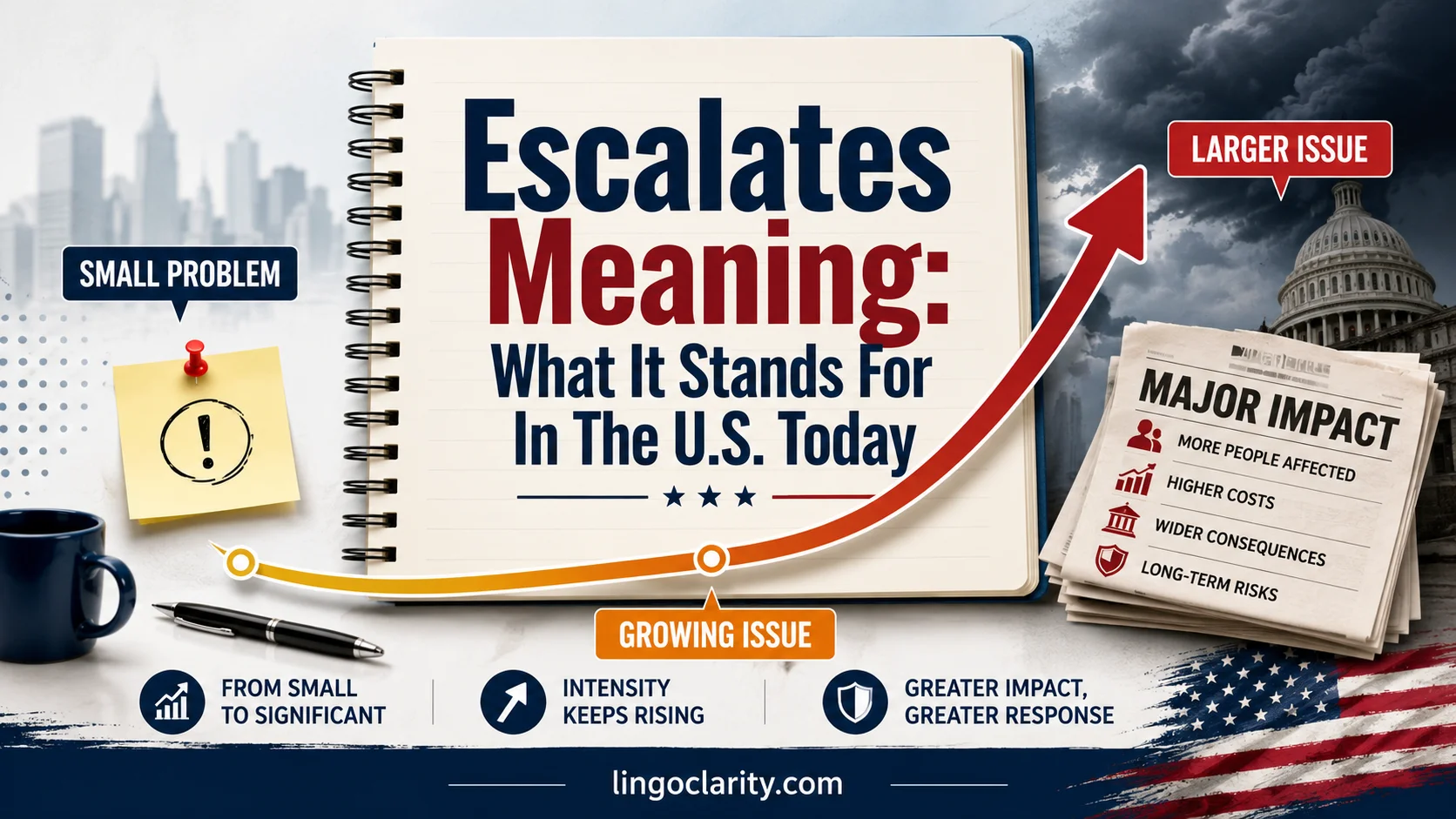
Escalates meaning is simple: it means something becomes bigger, stronger, worse, or more serious. You may see escalates in news reports, school essays, work emails, customer service chats, and everyday conversations. Usually, it appears when a problem, conflict, price, risk, or feeling grows beyond its original level.
This word matters because it often sounds formal or serious. Therefore, it is useful when you want to explain that a situation is growing beyond its original level. For example, a small argument can escalate into a fight. Likewise, a simple complaint can escalate to a manager.
In this guide, you will learn escalates meaning in simple English. You will also see its grammar, pronunciation, common uses, examples, mistakes, and related words.
Quick Answer
Escalates means becomes greater, stronger, worse, or more serious. It is the present-tense verb form used with he, she, it, or one singular noun.
Example: The argument escalates when both people start yelling.
In business, escalates can also mean sends an issue to a higher person, team, or level of authority.
Example: The agent escalates the complaint to a supervisor.
TL;DR
Escalates means something becomes bigger, stronger, worse, or more serious.
It is a verb form.
Also, it is used with a singular subject.
Problems, costs, risks, emotions, and conflicts can escalate.
In business, escalates can mean sends an issue to a higher level.
Finally, the closest opposite is de-escalates.
What Escalates Means In Plain English
In plain English, escalates means gets bigger, gets worse, becomes stronger, or becomes more serious.
It often describes a situation that starts small and then grows into something more difficult to control.
Examples:
The disagreement escalates into a serious argument.
The cost escalates during the final month of the project.
The tension escalates after the announcement.
The noise escalates when the crowd arrives.
However, escalates does not always mean disaster or danger. It simply shows that something is increasing in level, force, size, seriousness, or intensity. Still, the word often has a negative feeling because people usually use it for problems, conflicts, costs, risks, and pressure.
Part Of Speech And Pronunciation
Escalates is a verb. More exactly, it is the third-person singular present tense form of the verb escalate.
Use escalates with:
He
She
It
One person
One thing
One singular noun
Examples:
He escalates every small complaint.
She escalates the issue to her manager.
The problem escalates quickly.
The price escalates every year.
Pronunciation: ES-kuh-layts
The last part sounds like layts, similar to plates without the p. Therefore, avoid saying it with too many heavy syllables.
Escalates Grammar
The base verb is escalate. The form escalates is used only in the simple present tense with singular subjects.
| Verb Form | Example | Use |
|---|---|---|
| escalate | Problems escalate quickly. | Plural subject or base form |
| escalates | The problem escalates quickly. | Singular subject |
| escalated | The problem escalated yesterday. | Past tense |
| escalating | The problem is escalating now. | Continuous form |
Use escalates when the subject is one thing.
Correct: The issue escalates fast.
Incorrect: The issues escalates fast.
Instead, write:
Correct: The issues escalate fast.
How Escalates Works In A Sentence
Escalates can work in two main ways. First, it can describe something that becomes more serious by itself. Second, it can describe someone or something causing a situation to become more serious.
Escalates Without An Object
Sometimes the subject itself becomes bigger, worse, or more serious. In this use, escalates does not need an object.
Examples:
The situation escalates quickly.
The conflict escalates overnight.
The pressure escalates before the deadline.
The pain escalates after the injury.
In these sentences, the situation, conflict, pressure, and pain are changing by themselves. As a result, no object is needed after the verb.
Escalates With An Object
Sometimes a person, action, or event causes something to become more serious. In this use, escalates takes an object.
Examples:
His angry reply escalates the argument.
The delay escalates customer frustration.
The new fee escalates the total cost.
Her public comment escalates the dispute.
In these sentences, one action makes the problem stronger, bigger, or more serious.
Escalates To Vs. Escalates Into
Many learners confuse escalates to and escalates into. However, the difference is simple.
Use escalates into when one situation becomes another, more serious situation.
Examples:
The argument escalates into a fight.
The protest escalates into violence.
The small complaint escalates into a legal issue.
On the other hand, use escalates to when something reaches a higher level, amount, stage, person, or department.
Examples:
The case escalates to a manager.
The problem escalates to the legal team.
The cost escalates to $5,000.
The warning escalates to a full emergency alert.
Here is the easy rule:
Escalates into = becomes something more serious.
Escalates to = reaches a higher level or goes to a higher person.
Common Contexts For Escalates
Escalates is common in formal, serious, or semi-formal writing. For example, you may see it in news, reports, essays, business messages, and customer service conversations.
| Context | Example | Meaning |
| Conflict | The dispute escalates. | The conflict becomes more serious. |
| Price | The rent escalates yearly. | The rent goes up. |
| Risk | The danger escalates at night. | The risk becomes greater. |
| Emotion | Her anxiety escalates. | The feeling becomes stronger. |
| Health | The pain escalates. | The pain gets worse. |
| Business | The agent escalates the ticket. | The agent sends it to a higher team. |
In casual speech, many people say gets worse or goes up instead. However, in formal writing, escalates often sounds more precise.
Business And Customer Service Meaning
In business English, escalates often has a special meaning. It can mean sends a problem to someone with more authority, skill, or responsibility.
This does not always mean the problem becomes worse. Instead, it can simply mean the issue needs a manager, expert, senior team, or higher department.
Examples:
The support agent escalates the ticket.
She escalates the complaint to her supervisor.
The system escalates urgent cases first.
The employee escalates the issue to the security team.
The company escalates unresolved complaints after 48 hours.
In this context, escalates means the issue moves upward in the process. Therefore, it is very common in customer service, tech support, management, and workplace communication.
Everyday Examples Of Escalates
Here are natural examples of escalates in different situations.
The joke escalates into an uncomfortable argument.
The group chat escalates when rumors spread.
Traffic escalates near the stadium after the game.
Stress escalates when deadlines keep changing.
The puppy’s barking escalates during thunderstorms.
The rent escalates every year.
The cough escalates after a few days.
The meeting escalates when both sides refuse to compromise.
The small mistake escalates into a major delay.
The complaint escalates to the manager.
Each sentence shows a movement from a lower level to a higher or more serious level. Therefore, the word is useful when you want to show growth, pressure, or worsening.
Escalates Vs. Similar Words
Escalates is close to words like increases, rises, worsens, and intensifies. However, these words are not always equal.
| Word | Best Use | Example |
| escalates | Problems, conflict, risk, complaints | The argument escalates. |
| increases | Numbers, amounts, general growth | Sales increase in December. |
| rises | Prices, levels, temperatures | The temperature rises. |
| worsens | Bad situations | His condition worsens. |
| intensifies | Feelings, pressure, conflict | The pressure intensifies. |
Choose escalates when the change feels serious, upward, or harder to control.
For numbers or amounts, increases is usually simpler and clearer.
When the main meaning is “gets worse,” worsens is the better choice.
Finally, use intensifies when something becomes stronger in force, emotion, or pressure.
Synonyms For Escalates
Good synonyms depend on the sentence. Therefore, do not replace escalates with the same word every time.
Strong synonyms include:
Increases
Intensifies
Worsens
Rises
Grows
Expands
Mounts
Heightens
Strengthens
Becomes more serious
Examples:
The cost escalates.
The cost rises.
The pressure escalates.
The pressure intensifies.
The situation escalates.
The situation worsens.
The number of complaints escalates.
The number of complaints increases.
Antonyms For Escalates
The closest opposite of escalates is de-escalates.
De-escalates means a situation becomes calmer, smaller, less serious, or less intense.
Examples:
The conflict de-escalates after both sides agree to talk.
The officer tries to de-escalate the situation.
The manager de-escalates the complaint by offering a solution.
Other opposites include:
Decreases
Lessens
Reduces
Lowers
Calms
Settles
Eases
Use de-escalates for conflict, tension, crisis, or emotional situations. However, use decreases or lowers for numbers, prices, and levels.
Common Mistakes With Escalates
Using Escalates With A Plural Subject
Incorrect: The problems escalates quickly.
Correct: The problems escalate quickly.
Correct: The problem escalates quickly.
Use escalates with one thing. In contrast, use escalate with more than one thing.
Using Escalates When A Simpler Word Is Better
Weak: The temperature escalates in the afternoon.
Better: The temperature rises in the afternoon.
Escalates can work for serious increases. However, rises is more natural for normal temperature changes.
Confusing Escalates To And Escalates Into
Incorrect: The argument escalates to a fight.
Better: The argument escalates into a fight.
Correct: The complaint escalates to a manager.
Use into for transformation. Meanwhile, use to for a level, amount, person, or department.
Thinking Escalates Always Means Violence
Escalates can describe violence, but it can also describe prices, stress, pain, risk, complaints, and work issues.
Examples:
The cost escalates.
The pain escalates.
The complaint escalates.
The pressure escalates.
So, the word is not only about fights or danger.
Mini Quiz
Choose the correct answer.
- Which sentence is correct?
A. The problem escalates quickly.
B. The problems escalates quickly.
Answer: A
- What does escalates mean in this sentence?
The cost escalates every month.
A. The cost goes down.
B. The cost goes up.
Answer: B
- Which sentence is correct for business English?
A. She escalates the complaint to a supervisor.
B. She escalates into the complaint to a supervisor.
Answer: A
- Which phrase is better?
A. The argument escalates into a fight.
B. The argument escalates to a fight.
Answer: A
- What is the closest opposite of escalates in a conflict?
A. De-escalates
B. Repeats
Answer: A
FAQs
What does escalates mean?
Escalates means becomes bigger, stronger, worse, or more serious. For example, tension, conflict, prices, risks, emotions, and complaints can escalate.
Example: The tension escalates after the meeting.
Is escalates a verb?
Yes. Escalates is a verb form. More specifically, it is the third-person singular present tense form of escalate.
Example: The issue escalates when no one responds.
What is a simple sentence with escalates?
A simple sentence is:
The argument escalates quickly.
This means the argument becomes more serious in a short time.
Does escalates always mean something bad?
No, but it often describes an unwanted increase. For example, problems, costs, danger, tension, and conflict often escalate. However, for neutral increases, words like rises or increases may sound more natural.
What does escalates mean in business?
In business, escalates can mean sends an issue to a higher person, team, or department. For example, a support agent may escalate a ticket to a senior technician.
What is the difference between escalates and escalate?
Escalates is used with a singular subject.
Example: The problem escalates.
Escalate is used with plural subjects or after words like to, will, can, and may.
Example: Problems escalate when ignored.
What is the difference between escalates and escalated?
Escalates is present tense.
Example: The issue escalates today.
Escalated is past tense.
Example: The issue escalated yesterday.
What is the opposite of escalates?
The closest opposite is de-escalates. It means becomes calmer, smaller, or less serious.
Example: The conflict de-escalates after both sides agree to talk.
Can prices escalate?
Yes. Prices, rent, costs, and expenses can escalate. This means they rise or increase, often in a way that feels serious or hard to manage.
Example: Housing costs escalate in busy cities.
Should I say escalates to or escalates into?
Use escalates into when one situation becomes another situation.
Example: The disagreement escalates into a fight.
However, use escalates to when something reaches a higher level, amount, person, or department.
Example: The complaint escalates to a manager.
Conclusion
Escalates meaning is simple: something becomes greater, stronger, worse, or more serious. It can describe conflicts, costs, risks, emotions, health symptoms, pressure, and workplace complaints.
Use escalates with a singular subject, such as the problem escalates or the complaint escalates. However, use escalate with plural subjects, such as the problems escalate.
Finally, remember the business meaning too. In customer service or workplace English, escalates can mean sending an issue to a higher person, team, or level of authority. The closest opposite is de-escalates, which means a situation becomes calmer or less serious.
