
Quick Answer: What Does Resilient Mean for Kids?
Resilient means being able to recover, keep trying, and stay positive when something difficult happens. A resilient child does not give up easily. Instead, they learn from mistakes, solve problems, and continue working toward their goals.
Introduction
Children experience challenges every day. They may struggle with a difficult school subject, lose a game, make mistakes, or face changes in friendships. These moments can feel frustrating, but they also create opportunities to learn and grow.
The word resilient describes someone who can handle problems and bounce back after difficult experiences. When children understand the resilient meaning for kids, they learn that mistakes and challenges are not the end of the story.
Resilience does not mean a child never feels sad, nervous, or disappointed. Instead, it means they can recognize those feelings, find solutions, and try again.
Learning this word helps children develop important character traits such as patience, confidence, determination, and a positive mindset. Parents and teachers can use resilience as a way to teach children that improvement comes through effort and practice.
Children can also explore related vocabulary skills through topics like confidence meaning and other character-building words that help explain emotions and personal growth.
TL;DR: Resilient Meaning for Kids
- Resilient means recovering after difficulties and continuing to try.
- A resilient child learns from mistakes instead of giving up.
- Resilience helps children build confidence and problem-solving skills.
- Everyday examples include practicing a skill, handling disappointment, and trying again.
- Parents and teachers can teach resilience through encouragement and support.
What Does Resilient Mean for Kids?
The word resilient means being able to recover after something difficult happens. For kids, it means having the ability to keep going even when things do not work out the first time.
A resilient child understands that failure is not a permanent problem. Instead, mistakes are chances to learn.
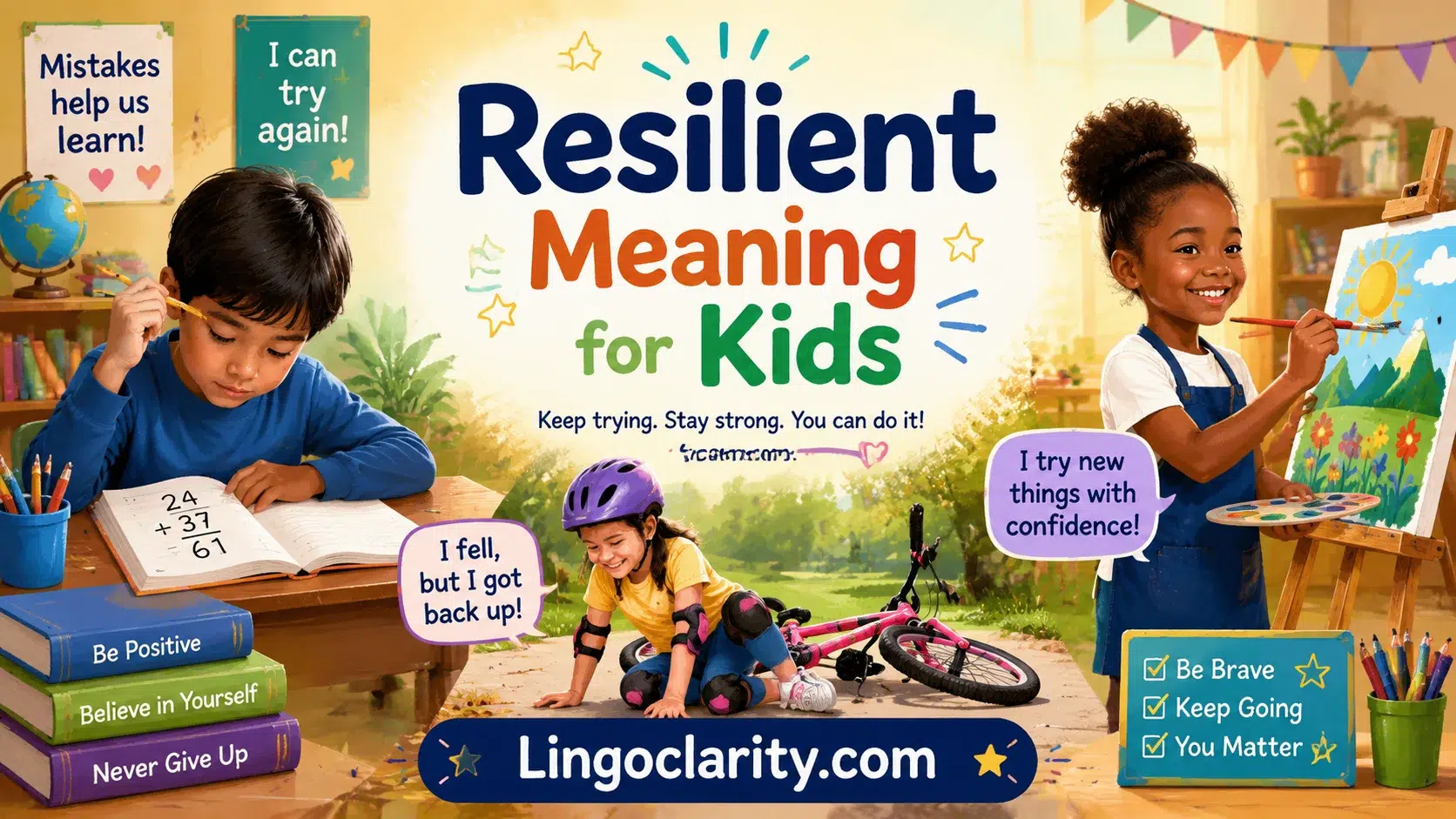
For example, imagine a child learning to ride a bike. The child may fall several times and feel frustrated. A child who gives up immediately may stop trying. However, a resilient child takes a break, learns what went wrong, and tries again.
That ability to continue after a setback is resilience.
In simple words:
Resilient means “I can face something difficult, learn from it, and try again.”
Simple Explanation of Resilience for Children
Teachers and parents can explain resilience with a simple comparison:
A rubber band can stretch and return to its original shape. In a similar way, resilient people can experience challenges and recover.
However, resilience does not mean ignoring problems. Everyone has difficult emotions sometimes. A resilient child may feel disappointed or upset, but they find healthy ways to handle those feelings.
For children, resilience can look like:
- Asking for help when work feels hard
- Practicing after making mistakes
- Staying patient while learning something new
- Trying again after losing
- Finding solutions instead of quitting
Resilient Meaning Explained in Simple Words
The easiest way to explain resilient meaning for kids is:
A resilient person is someone who gets back up after facing a problem.
Think about learning a new skill. Nobody becomes perfect immediately. Whether it is reading, playing sports, drawing, or learning math, improvement usually requires practice.
A resilient child says:
- “I can try again.”
- “I can learn from this mistake.”
- “I can ask someone for help.”
- “I can improve with practice.”
This attitude connects closely with a growth mindset, which teaches children that abilities can improve through effort and learning.
Parents who want to teach positive character traits can also explore topics like kindness meaning for kids because emotional skills often work together.
Examples of Resilience in Everyday Life
Children show resilience in many ordinary situations. It is not only something used during major problems. Small daily challenges help children practice this important skill.
Learning a Difficult Subject
A student may struggle with multiplication, reading, or writing. Instead of deciding “I cannot do this,” a resilient student practices, asks questions, and keeps improving.
Example:
Mia found math difficult at first, but she practiced every day. Her effort helped her become more confident.
Trying Again After Making Mistakes
Mistakes are a normal part of learning. A resilient child does not view mistakes as proof that they cannot succeed.
Example:
Jake made several spelling mistakes, but he used feedback from his teacher and improved.
Losing a Game
Nobody wins every time. A resilient child learns how to handle disappointment while continuing to enjoy the activity.
Example:
After losing a soccer game, Ava congratulated the other team and practiced for the next match.
Making New Friends
Starting at a new school or joining a new group can feel uncomfortable. Resilient children slowly build confidence by trying new social experiences.
Example:
Noah felt nervous on his first day at a new school, but he introduced himself and made new friends.
Learning a New Skill
Whether learning music, art, sports, or technology, children need patience.
Example:
Lily practiced piano every week until she could play her favourite song.
Why Being Resilient Is Important for Children
Resilience is an important life skill because children face challenges while they grow. Learning how to handle difficulties helps children become more confident and prepared for new situations.
A resilient child understands that problems can be solved. Instead of thinking, “I cannot do this,” they begin to think, “I can learn how to do this.”
Resilience can help children develop:
- Confidence when facing challenges
- Patience during difficult situations
- Problem-solving skills
- Independence
- The ability to learn from mistakes
- A positive mindset
However, resilience does not mean children must handle everything alone. Support from parents, teachers, and friends plays an important role. A child becomes stronger when they know they can ask for help when needed.
How Kids Can Become More Resilient
Resilience is not something children are simply born with. It is a skill that can be practiced and improved over time.
Parents and teachers can help children build resilience by encouraging healthy habits and positive thinking.
Keep Trying Even When Things Are Difficult
One of the biggest parts of resilience is persistence. Children learn resilience when they continue working toward a goal even after facing difficulties.
Example:
A student who struggles with reading can practice a little each day and slowly improve.
Small efforts repeated over time can create big improvements.
Learn From Mistakes
Mistakes are a natural part of learning. Instead of seeing mistakes as failures, resilient children learn to ask:
- What can I learn from this?
- What can I do differently next time?
- How can I improve?
This approach helps children develop a growth mindset.
Ask for Help When Needed
Being resilient does not mean doing everything alone. Strong learners know when to ask questions and seek support.
For example:
A child who does not understand a homework problem can ask a teacher, parent, or classmate for guidance.
Asking for help shows courage and responsibility.
Practice Positive Thinking
Positive thinking helps children approach challenges with hope.
Instead of saying:
“I am bad at math.”
A resilient child can say:
“Math is difficult for me right now, but I can improve with practice.”
This simple change in thinking encourages learning and confidence.
Set Small Goals
Large goals can feel overwhelming. Breaking them into smaller steps makes challenges easier.
Example:
Instead of:
“I want to become a great writer.”
A child can start with:
“I will write five sentences today.”
Small achievements help children feel successful and motivated.
Resilient vs Strong: What Is the Difference?
Many people think resilient and strong mean the same thing. Although these words are related, they describe different qualities.
Word Meaning Example Resilient Able to recover after problems and continue trying Emma fell while learning to skate but practiced again. Strong Having physical, mental, or emotional power Liam stayed strong during a difficult situation. A strong person may have the ability to handle challenges, while a resilient person focuses on recovering after challenges.
For children, resilience is about bouncing back.
A child does not need to be perfect, fearless, or never upset to be resilient. They simply need to learn how to recover and move forward.
Resilient Sentences Examples for Kids
Here are simple sentences showing how the word resilient is used:
- Emma was resilient because she practiced until she learned how to ride a bike.
- A resilient student keeps trying after making mistakes.
- Jack showed resilience when he learned from losing the competition.
- The resilient puppy recovered quickly after getting tired.
- Mia was resilient when she moved to a new school and made new friends.
- A resilient athlete practices even when training feels difficult.
- The resilient child solved the puzzle after several attempts.
- Ben was resilient because he did not give up on his project.
- Resilient people learn important lessons from challenges.
- Sarah became more resilient by practicing patience and problem-solving.
Common Mistakes About the Word Resilient
Understanding a word also means knowing what it does not mean.
Thinking Resilient Means Never Feeling Sad
A common misunderstanding is that resilient people never feel unhappy or disappointed.
That is not true.
Everyone experiences difficult emotions. A resilient child can feel sad but still find ways to recover and continue.
Thinking Resilient and Strong Mean Exactly the Same Thing
Although these words are connected, they are not identical.
Strength often describes having power or ability.
Resilience describes recovering after a challenge.
Example:
A child may not feel strong after failing a test, but they can still be resilient by studying and trying again.
Thinking Resilience Is Only for Adults
Children can develop resilience too.
In fact, childhood is an important time to practice resilience because children experience many new challenges:
- Learning new subjects
- Making friends
- Trying activities
- Handling changes
Teaching resilience to children helps them develop useful skills for everyday life.
Resilient Meaning in School and Friendships
School and friendships provide many opportunities for children to practice resilience.
Resilience During Homework
Homework can sometimes feel frustrating. A resilient student does not immediately quit when an assignment becomes difficult.
Instead, they:
- Take a short break
- Review instructions
- Ask questions
- Try another method
Resilience During Tests
A test result may not always match a child’s expectations.
A resilient student understands that one grade does not define their ability.
They use the result as feedback and prepare better next time.
Resilience When Friendships Change
Friendships can sometimes change as children grow. A resilient child learns how to handle disappointment while staying kind and respectful.
They understand that difficult social moments can teach valuable lessons about communication and empathy.
Children can also explore related character vocabulary through Empathy Meaning for Kids to better understand emotions and relationships.
Dictionary-Style Explanation of Resilient
Word:
Resilient
Part of Speech:
Adjective
Definition:
Resilient describes someone or something that can recover quickly after difficulty, damage, stress, or change.
For children, resilient means being able to handle problems, learn from experiences, and continue moving forward.
Pronunciation:
Resilient: /ri-ZIL-yuhnt/
The word sounds like:
ri-ZIL-yuhnt
Word Origin:
The word resilient comes from the Latin word resilire, meaning “to jump back” or “bounce back.”
Over time, English speakers began using resilient to describe people who recover after difficult experiences.
Synonyms of Resilient:
- Strong
- Adaptable
- Flexible
- Determined
- Persistent
- Tough
Difference Between Similar Words
Resilient vs Determined
A determined person keeps working toward a goal.
A resilient person recovers after setbacks and continues.
Resilient vs Flexible
A flexible person adjusts to changes.
A resilient person adjusts and recovers after challenges.
Teaching Resilience to Children: Tips for Parents and Teachers
Children learn resilience through everyday experiences. Parents and teachers do not need to remove every challenge from a child’s life. Instead, they can guide children through challenges and help them develop confidence.
Here are practical ways adults can encourage resilience:
Encourage Effort Instead of Perfection
Children often worry about making mistakes. Instead of only praising perfect results, adults can recognize effort and improvement.
For example:
Instead of saying:
“You are so smart.”
Try saying:
“You worked hard and improved because you kept practicing.”
This teaches children that growth comes from effort.
Allow Children to Solve Problems
When children face small challenges, giving them time to think and find solutions helps them become independent.
For example:
If a child forgets a school item, parents can ask:
- “What could you do next time?”
- “How can you solve this problem?”
This encourages problem-solving skills.
Be a Positive Example
Children often learn by watching adults. When parents and teachers handle difficulties calmly, children learn healthy ways to respond to challenges.
A child may notice:
- How adults handle mistakes
- How they respond to frustration
- How they continue after setbacks
Celebrate Progress
Small improvements matter. Recognizing progress helps children understand that learning happens step by step.
A child who improves from reading one page to reading five pages has developed perseverance and confidence.
Parents can also explore related vocabulary topics such as Perseverance Meaning for Kids to help children understand similar character traits.
Internal linking strategy:
Frequently Asked Questions About Resilient Meaning for Kids
Resilient means being able to recover after something difficult happens and continue trying. A resilient child learns from mistakes, handles challenges, and does not give up easily.
You can explain resilience by saying:
“Being resilient means getting back up after something hard happens and trying again.”
For example, a child learning to ride a bike shows resilience by practicing after falling
A resilient child might struggle with a school subject but continue practicing, ask for help, and improve over time.
Another example is a child who loses a game but stays positive and works harder next time.
Resilience helps students handle challenges in school. It encourages patience, confidence, problem-solving, and learning from mistakes.
No. Strong and resilient are related but different.
Strong often means having power or ability. Resilient means recovering after difficulties and continuing forward.
Parents can teach resilience by allowing children to solve problems, encouraging effort, supporting healthy risk-taking, and helping children learn from mistakes.
Examples of resilient behaviors include:
Trying again after failure
Asking for help
Staying calm during problems
Learning from mistakes
Setting goals
Adjusting to change
Resilient Meaning for Kids Quiz
Test your understanding of the word resilient.
Question 1:
What does resilient mean?
A) Never making mistakes
B) Recovering after difficulties
C) Always winning
D) Avoiding challenges
Correct Answer: B
Explanation:
A resilient person can face problems, recover, and continue trying.
Question 2:
Which child shows resilience?
A) A child who quits after one mistake
B) A child who refuses to learn
C) A child who practices after making mistakes
D) A child who avoids difficult tasks
Correct Answer: C
Explanation:
Practicing after mistakes shows determination and resilience.
Question 3:
Does being resilient mean you never feel sad?
A) Yes
B) No
C) Only adults can be resilient
D) Only athletes are resilient
Correct Answer: B
Explanation:
Resilient people can feel difficult emotions but learn how to recover.
Question 4:
Which word is closely related to resilience?
A) Giving up
B) Avoiding problems
C) Perseverance
D) Laziness
Correct Answer: C
Explanation:
Perseverance means continuing to work toward a goal, which connects closely with resilience.
Question 5:
A student gets a low test score and studies harder for the next test. What does this show?
A) Fear
B) Resilience
C) Carelessness
D) Confusion
Correct Answer: B
Explanation:
Learning from setbacks and improving is an example of resilience.
Conclusion: Resilient Meaning for Kids
The word resilient describes the ability to recover, keep trying, and move forward after challenges. For children, resilience means understanding that mistakes and difficulties are part of learning.
A resilient child is not someone who never struggles. Instead, it is someone who learns from problems, asks for help when needed, and continues working toward improvement.
Parents and teachers can help children develop resilience by encouraging effort, teaching problem-solving, and creating a supportive environment. Small moments—such as practicing a difficult skill, handling disappointment, or trying again after a mistake—help children become more confident.
Learning the resilient meaning for kids gives children an important word for understanding courage, growth, and personal development. Every challenge is an opportunity to learn and become stronger.
