
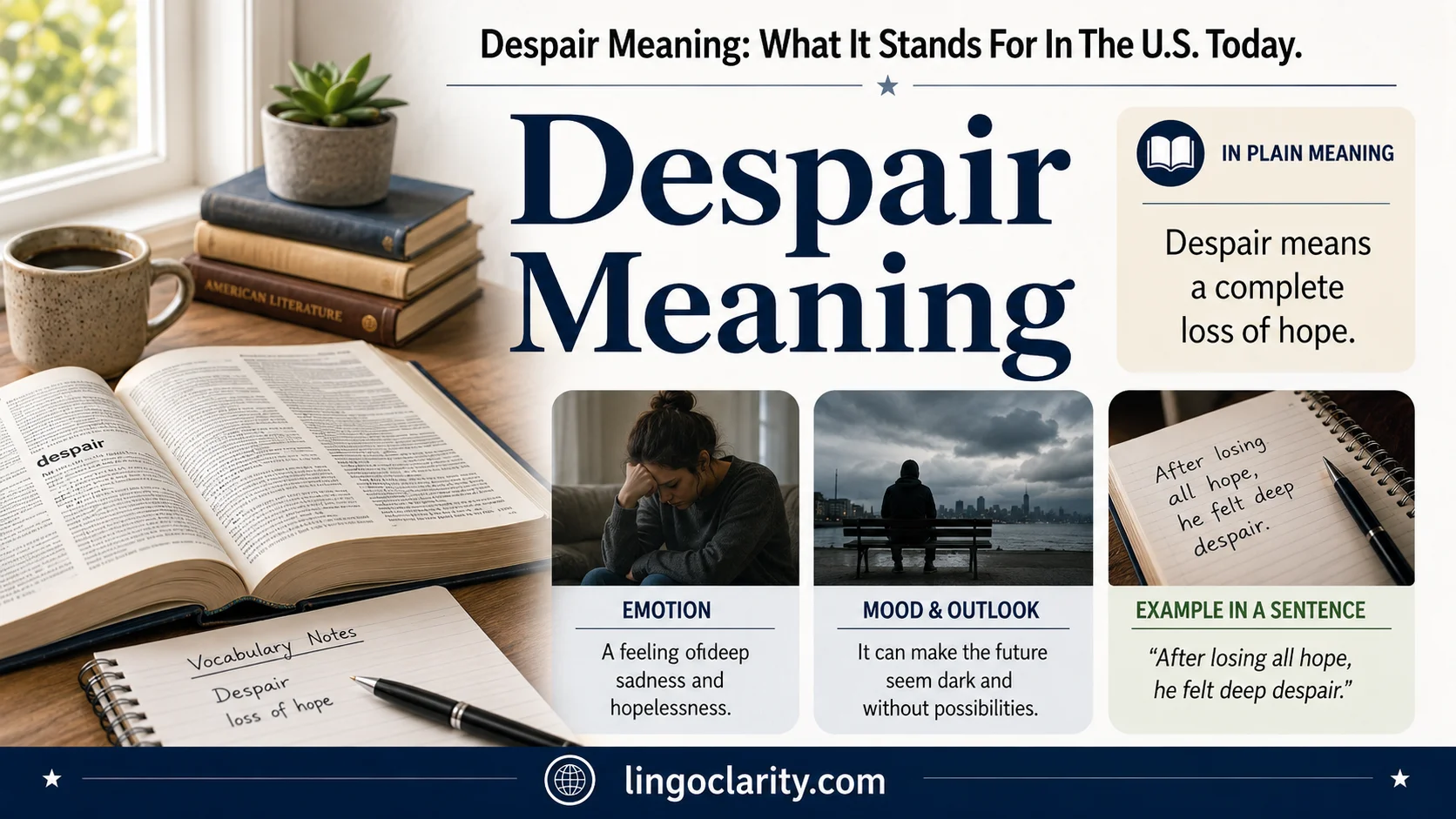
Despair meaning is simple: despair means a deep feeling of having no hope left. It can describe a painful emotional state, or it can be used as a verb when someone loses hope that a situation will improve.
The word is stronger than sadness or disappointment. Sadness can pass quickly. Disappointment can happen when something does not go your way. Despair feels heavier because it suggests that a person sees no good outcome.
In everyday English, you may hear phrases like in despair, a cry of despair, the depths of despair, or don’t despair. The word is not slang. It is a serious, clear word for a strong loss of hope.
Quick Answer
Despair means the feeling of losing all hope, especially when a situation feels impossible to fix.
A simple example is:
She felt despair after months of failed job interviews.
This means she felt deeply hopeless because the situation seemed unlikely to improve.
As a noun, despair names the feeling:
He was filled with despair.
As a verb, despair means to lose hope:
Don’t despair; there may still be another option.
So, the main idea is hopelessness. The word can sound emotional, serious, literary, or formal depending on the sentence.
What Does It Mean?
Despair means a strong loss of hope. It often appears when someone feels trapped, defeated, or unable to see a way forward.
For example, a person may feel despair after a major loss, a long failure, or a difficult problem that keeps getting worse. In writing, the word often adds emotional weight. It tells the reader that the feeling is not mild.
However, despair does not always mean someone has given up forever. In the sentence “Don’t despair,” the speaker is telling someone not to lose hope. That use is common, direct, and encouraging.
The word can describe both a feeling and an action.
Definition in Plain English
Despair means deep hopelessness.
It is the feeling that things are so bad that they may not get better. It can also mean the act of losing hope.
Use despair when the emotion is serious. Do not use it for small annoyances unless you are being dramatic on purpose.
For example:
I was in despair after losing my wallet.
This sounds serious because the person felt truly hopeless or overwhelmed.
I was in despair because my coffee was cold.
This sounds exaggerated unless the speaker is joking.
The word comes from older forms connected to the idea of being without hope. That background still fits the modern meaning.
How It Is Used
Despair is commonly used as a noun:
The family waited in despair for news.
It is also used as a verb:
Many fans began to despair when the team fell behind.
As a verb, it often appears with of:
They despaired of finding an affordable apartment.
This means they started to believe they would never find one.
It can also appear with at or over:
She despaired at the lack of progress.
He despaired over the repeated delays.
These forms are natural in standard English, though despair of is especially common when the sentence means “lose hope about.”
Tone, Context, and Formality
Despair is a serious word. It is not casual slang. It fits emotional writing, news, stories, personal essays, speeches, and thoughtful conversation.
In daily speech, many Americans may choose simpler words such as hopeless, crushed, discouraged, or heartbroken. Still, despair is easy to understand and useful when the feeling is intense.
The word can sound dramatic if the situation is small. For example, “I’m in despair because my phone battery is low” may sound humorous or exaggerated.
Use the word carefully when talking about real people. It can suggest deep emotional pain, not just a bad mood.
Pronunciation and Part of Speech
In standard US English, despair is pronounced di-SPAIR. It rhymes with repair and care. The stress is on the second syllable.
The word has two main parts of speech.
As a noun, it means a feeling of hopelessness:
A sense of despair filled the room.
As a verb, it means to lose hope:
Please don’t despair.
The adjective form is despairing, as in a despairing look. The adverb form is despairingly, as in She looked despairingly at the damage.
Synonyms and Antonyms
Good synonyms for despair include hopelessness, desperation, despondency, misery, and gloom. These words are close, but they are not always exact matches.
Hopelessness is the plainest match. Desperation often suggests urgent action. Despondency sounds more formal and means deep discouragement. Misery focuses more on suffering than on lost hope.
Clear antonyms include hope, hopefulness, optimism, and confidence. The closest opposite is hope, because despair means hope is gone or fading.
Use synonyms based on the sentence, not just the dictionary list.
Common Mistakes (and Quick Fixes)
Do not use despair when you only mean mild sadness. The word is stronger than that.
Quick fixes:
- Use sadness for a general unhappy feeling.
- Use disappointment when something fails to meet expectations.
- Use discouragement when someone loses energy or confidence.
- Use despair when the main idea is deep loss of hope.
Another mistake is treating despair as only a noun. It can also be a verb.
Correct: She was in despair.
Correct: She began to despair.
Also, avoid forcing the word into light situations unless the tone is joking or dramatic.
Everyday Examples
| Context | Best Use | Why |
|---|---|---|
| Personal setback | He felt despair after losing the case. | The feeling is serious and tied to lost hope. |
| Encouragement | Don’t despair; we still have time. | The speaker tells someone not to give up hope. |
| Long struggle | They despaired of finding a solution. | The verb shows hope slowly fading. |
| Emotional writing | A wave of despair passed through her. | The word adds strong emotional weight. |
| Public issue | The news left many people in despair. | The word fits a serious situation. |
Dictionary-Style Word Details
Pronunciation
Despair is pronounced di-SPAIR in standard US English. It has two syllables, and the stress falls on the second syllable. Pronunciation is fairly straightforward.
Part of Speech
Despair is both a noun and an intransitive verb in standard modern English. It is not commonly used as a transitive verb in everyday standard English.
Definition
As a noun, despair means a deep feeling of having no hope. As a verb, it means to lose hope that something will improve or happen.
Usage
Use despair for serious hopelessness, not small frustration. Common forms include in despair, don’t despair, despair of, despair at, and despair over.
Synonyms
The closest plain alternatives are hopelessness, desperation, despondency, misery, and gloom. Hopelessness is usually the closest match.
Antonyms
The clearest antonyms are hope, hopefulness, optimism, and confidence. Hope is the strongest direct opposite.
Example Sentences
She sat in despair after hearing the final decision.
Don’t despair; we can still try again tomorrow.
The coach refused to let the team fall into despair.
They despaired of ever finding the missing file.
His voice carried a note of despair.
Word History
Despair came into English through older French forms and traces back to a Latin idea connected with being without hope. The history supports the modern meaning, but the useful point for today is simple: despair is about lost hope.
Phrases Containing
Common phrases include in despair, a cry of despair, the depths of despair, don’t despair, despair of something, to the despair of someone, and a counsel of despair.
Conclusion
Despair means deep hopelessness or the act of losing hope. It is stronger than sadness, disappointment, or discouragement.
Use it when a situation feels serious and the main feeling is that things may not improve. As a noun, it names the feeling. As a verb, it shows someone losing hope.
The clearest everyday meaning is:
Despair is the painful feeling that hope is gone.
That simple idea will help you use the word naturally in sentences, stories, conversations, and serious writing.
