
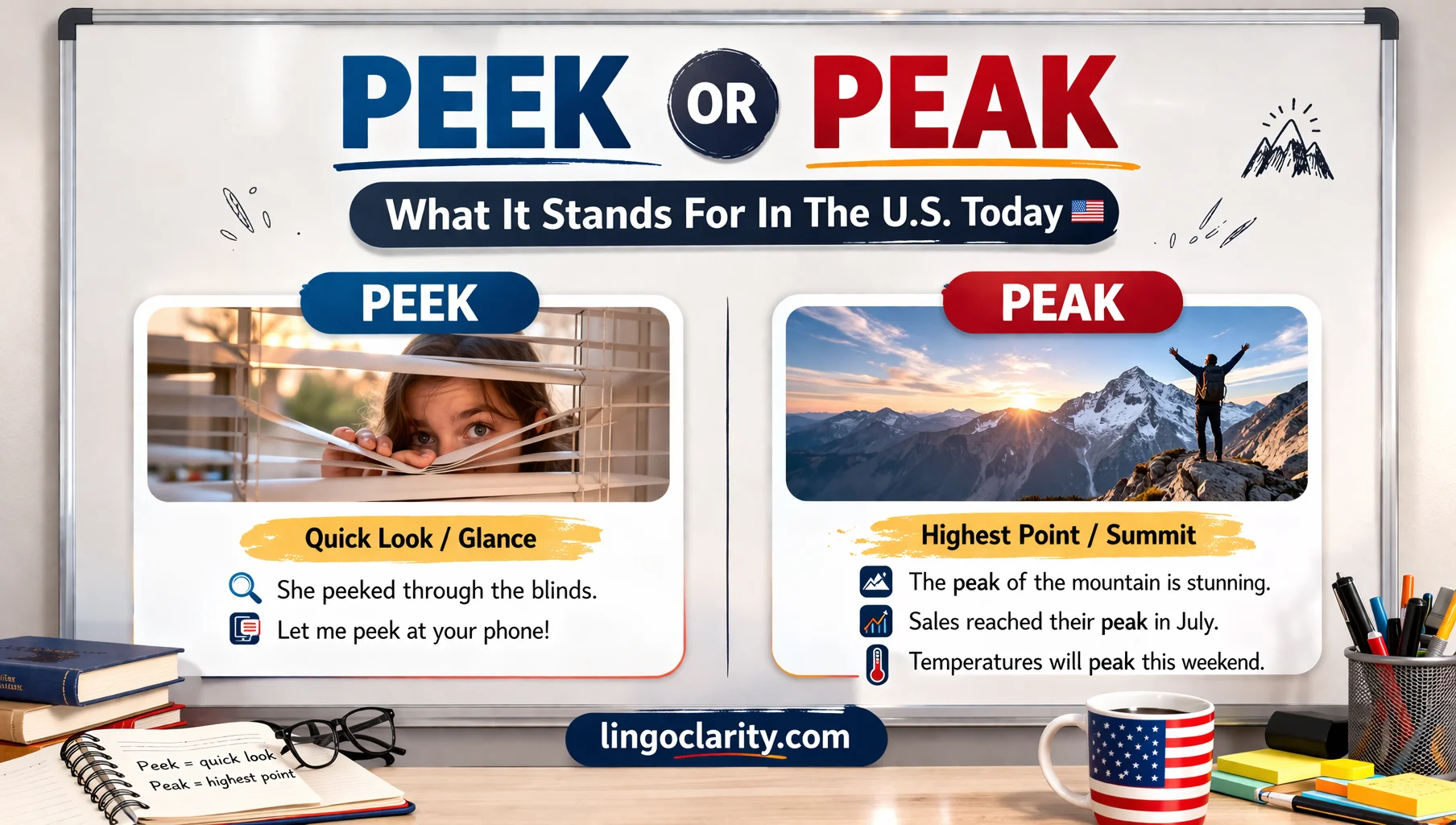
Peek means a quick look. Peak means the highest point. And there is a third homophone that trips up more writers than either of them: pique, which means to stir up interest. If you have ever written sneak peak or that peaked my interest, this is the page that fixes it in about four minutes.
Quick Answer
- Peek — a quick or secret look. She took a peek at the guest list.
- Peak — the highest point, or to reach it. Traffic peaked the day after launch.
- Pique — to arouse interest or irritation. The headline piqued my curiosity.
The correct phrases are sneak peek, take a peek, peak season, and piqued my interest. There is no such thing as a sneak peak or a peaked interest.
Peek Vs Peak Vs Pique At A Glance
| Peek | Peak | Pique | |
|---|---|---|---|
| Core idea | Looking | The top | Provoking interest |
| Parts of speech | Verb, noun | Noun, verb, adjective | Verb, noun |
| Past tense | peeked | peaked | piqued |
| Typical phrases | sneak peek, take a peek, peek behind the curtain | peak season, at its peak, off-peak, peak performance | pique your interest, a fit of pique |
| Memory hook | Two e‘s, like two eyes | The a points up like a mountain | que — it makes you question |
| Example | Don’t peek at your gift. | Sales peak in December. | That trailer piqued my interest. |
Why These Three Words Get Mixed Up
They are homophones — all three are pronounced /peek/. When you write quickly, your brain reaches for the sound before it reaches for the spelling, and any of the three will feel right in the moment.
The bigger problem is that spellcheck cannot save you. As the MLA Style Center points out, peak is a perfectly legitimate word, so no red underline ever appears. The error sails through drafts, gets published, and then sits on a homepage for two years. Rhyme makes it worse: sneak and peak look like a matched pair on the page, which is exactly why sneak peak is the most reproduced spelling mistake of the three.
Voice dictation and AI writing tools have added a new failure point. Dictation software picks a spelling from probability, not from your intent, and a rushed draft that came out of a speech-to-text app will often contain the wrong one. The word is spelled correctly, so nothing flags it.
What Peek Means
Peek is about the eyes. It means to look quickly, briefly, or from a hidden position — usually through a small opening or when you are not supposed to be looking at all.
As a verb: He peeked around the corner before crossing.
As a noun: Give me a peek at the design before the meeting.
The word is old. Merriam-Webster traces the verb to Middle English piken in the 1300s; the noun form did not appear in print until 1636. That six-century head start is why peek dominates the vocabulary of looking: peekaboo, peek in, peek out, peek behind the curtain.
Common Phrases With Peek
- take a peek
- sneak peek
- peek in on someone
- peek out from behind
- peek behind the curtain
- peekaboo
Peek In Practice
- Subject line: A sneak peek at what ships Monday.
- The listing photos give buyers a peek at the renovated kitchen.
- I peeked at the scoreboard between innings.
What Peak Means
Peak is about height, whether that height is physical or figurative. It works as three parts of speech, which is one reason it feels usable everywhere.
As A Noun
The top of something, or the maximum level of something.
- They reached the peak just after sunrise.
- Enrollment hit its peak in 2019.
- Whip the cream until it forms soft peaks.
As A Verb
To reach the highest point, then typically level off or decline.
- Streaming numbers peaked in the first week.
- Her form peaked at exactly the right time.
As An Adjective
This is the sense the average article skips. Peak modifies nouns constantly in business and everyday writing:
- peak season, peak hours, off-peak fares
- peak performance, peak capacity, peak demand
Merriam-Webster also records a newer adjective sense: peak meaning the height of something’s popularity or cultural moment — peak Wes Anderson, peak 2020, peak streaming. If you use that construction online, it is peak, never peek.
Peak In Practice
- Rates are lower if you travel off-peak.
- The team was operating at peak capacity through Q4.
- Support tickets peak every Monday morning.
What Pique Means And Why It Belongs Here
Pique comes from the French piquer, “to prick” — and that origin explains everything about how it behaves. Something pricks at you: your curiosity, or your pride.
As A Verb
To arouse, stimulate, or provoke.
- The teaser piqued interest without revealing the plot.
- His tone piqued her, and she stopped replying.
As A Noun
A brief flash of wounded pride or irritation, almost always in the phrase a fit of pique.
- He quit in a fit of pique and regretted it by Thursday.
There is also piqué, with an accent — a ribbed cotton fabric, the material of a classic polo shirt. Same French root, different word, and it is the one place the accent mark matters.
Sneak Peek Or Sneak Peak?
Sneak peek is correct. Always.
A sneak peek is an early or unofficial look at something before its full release. The phrase grew out of sneak preview, the film-industry practice of screening a movie for a limited audience before general release, documented from the 1930s onward. The “sneak” part is about seeing something early. Seeing requires peek.
Sneak peak would mean a mountain summit that is behaving furtively. That is the whole test — read the wrong version literally and it collapses.
- ❌ Here’s a sneak peak of the spring collection.
- ✅ Here’s a sneak peek of the spring collection.
This is worth a targeted check before anything ships. Search your document for “peak” and read each hit in context; on marketing copy, the hit rate is higher than most writers expect.
Piqued My Interest Or Peaked My Interest?
Piqued my interest is correct.
Interest does not climb to a summit — something pricks at it and wakes it up. That is pique.
- ❌ The job description peaked my interest.
- ❌ The job description peeked my interest.
- ✅ The job description piqued my interest.
The same applies to piqued my curiosity and piqued his attention. The only time peak belongs near the word interest is when you are describing a maximum level of it: Interest in the stock peaked in March, then fell off. Note what changed there — interest became the subject reaching a high point, not the thing being poked.
The Three-Second Substitution Test
Read your sentence and swap in a plain replacement:
- If “look” or “glance” fits → peek
- If “top,” “highest point,” or “maximum” fits → peak
- If “sparked” or “stirred up” fits → pique
Run it on a real sentence:
The trailer ___ my interest and I took a quick ___ at the reviews before deciding.
“Sparked my interest” works, so the first blank is piqued. “A quick look at the reviews” works, so the second is peek. Neither blank accepts “top.” Done.
Peeked, Peaked, Or Piqued?
Past tense is where mixed-up drafts show up most, because all three forms are real words:
- peeked — looked. She peeked at the answer key.
- peaked — reached a maximum. Costs peaked in July.
- piqued — stirred up. The rumor piqued everyone’s curiosity.
Peaked: One Spelling, Three Different Words
Peaked is worth its own paragraph, because it is not one word.
- Peaked (one syllable, PEEKT) — past tense of peak. Attendance peaked on Saturday.
- Peaked (one syllable, PEEKT) — an adjective meaning pointed. A peaked roof. Peaked lapels.
- Peaked (two syllables, PEE-kid) — an adjective meaning pale, drawn, or unwell, recorded since 1804. You’re looking a little peaked.
That third one surprises people. If someone says you look peaked and pronounces it in two syllables, they are not commenting on your career trajectory.
Peek, Peep, Glance, Or Glimpse?
Once the spelling is settled, the next question is whether peek is even the best word:
- Peek — deliberate and usually brief; often through or around something. He peeked through the blinds.
- Peep — the same idea, slightly more furtive and more British in flavor. She peeped over the fence.
- Glance — a quick, open look at something in plain view. He glanced at his watch.
- Glimpse — what you catch, not what you do on purpose. I caught a glimpse of her in the crowd.
The distinction that matters: you peek on purpose, you glimpse by accident.
Peak, Summit, Apex, Or Climax?
- Peak — the general-purpose word for a high point, literal or figurative.
- Summit — the physical top of a mountain, and the standard word for high-level meetings.
- Apex — the highest point of a structure, curve, or career; more formal.
- Climax — the most intense moment of a narrative or sequence of events.
Common Mistakes And Quick Fixes
| Wrong | Right | Why |
|---|---|---|
| We got a sneak peak of the show. | We got a sneak peek of the show. | An early look, not a summit |
| That peaked my interest. | That piqued my interest. | Interest is provoked, not maximized |
| The band is at the peek of its success. | The band is at the peak of its success. | Highest point |
| Sales usually peek in December. | Sales usually peak in December. | Reaching a maximum |
| Take a peak at this. | Take a peek at this. | A quick look |
| He peaked into the room. | He peeked into the room. | Looking, not climbing |
| Book off-peek fares. | Book off-peak fares. | Outside maximum-demand hours |
A Note On British Slang
If you spend time online, you will run into peak used as slang meaning “unfortunate” or “rough” — that’s peak, mate. This is British, mainly London, and it is not standard US usage. It does not change anything above; if you write for a US audience, treat it as the same word wearing a costume.
Quick Practice Test
Fill in the blank:
- The teaser ___ my curiosity. → piqued
- Hikers reached the ___ before noon. → peak
- Don’t ___ at your presents. → peek
- Website traffic ___ two hours after the email went out. → peaked
- He canceled the whole trip in a fit of ___. → pique
- Here’s a sneak ___ at next season’s lineup. → peek
Five or six correct means you have it. Anything lower, reread the substitution test — that one section does most of the work.
FAQs
What is the difference between peek and peak?
Peek is about looking — a quick or secret glance. Peak is about height — the top of something or the act of reaching a maximum. They are pronounced identically, which is why the error is so common in fast writing, but they share no meaning at all.
Is it sneak peek or sneak peak?
Sneak peek. The phrase means an early look at something, and looking requires peek. It descends from sneak preview, the practice of screening films to limited audiences before release. Sneak peak would literally describe a furtive mountaintop.
Should I write peaked my interest or piqued my interest?
Piqued my interest. Pique comes from the French piquer, “to prick,” and that is exactly what happens — something pricks your curiosity awake. The only correct use of peaked near interest is describing interest hitting a maximum and then falling: Interest peaked in March.
Can peak be an adjective?
Yes, and this sense is heavily used in business writing: peak season, peak hours, peak performance, peak capacity, off-peak. Merriam-Webster also records a newer sense meaning the height of something’s cultural moment, as in peak Wes Anderson.
What does peaked mean when someone says you look peaked?
Pronounced as two syllables, PEE-kid, it means pale, drawn, or unwell, and it has been used that way since 1804. It is unrelated to reaching a high point, even though it is spelled the same as the past tense of peak.
Why doesn’t spellcheck catch sneak peak?
Because peak is a real, correctly spelled English word. Standard spellcheckers verify spelling, not meaning, so nothing gets flagged. Some grammar tools now catch it contextually, but the reliable fix is to search finished documents for “peak” and check each instance by hand.
What is the fastest way to remember peek, peak, and pique?
Peek has two e‘s, like two eyes. The a in peak points upward like a mountain. Pique ends in que, and it is what makes you question something.
Conclusion
Three words, one sound, three completely separate jobs. Peek belongs to the eyes, peak belongs to the top of the chart or the mountain, and pique belongs to whatever just made you curious. Attach each spelling to its idea once and the choice stops requiring thought — which matters, because this is a mistake that lives forever in published copy. Spellcheck will not catch it, autocorrect will not catch it, and dictation software will confidently pick the wrong one. You are the last line of defense, and now you have the test that takes three seconds: look, top, or spark.

1 thought on “Peek Vs Peak: The Difference, Plus The Third Word Most People Forget”
Comments are closed.