
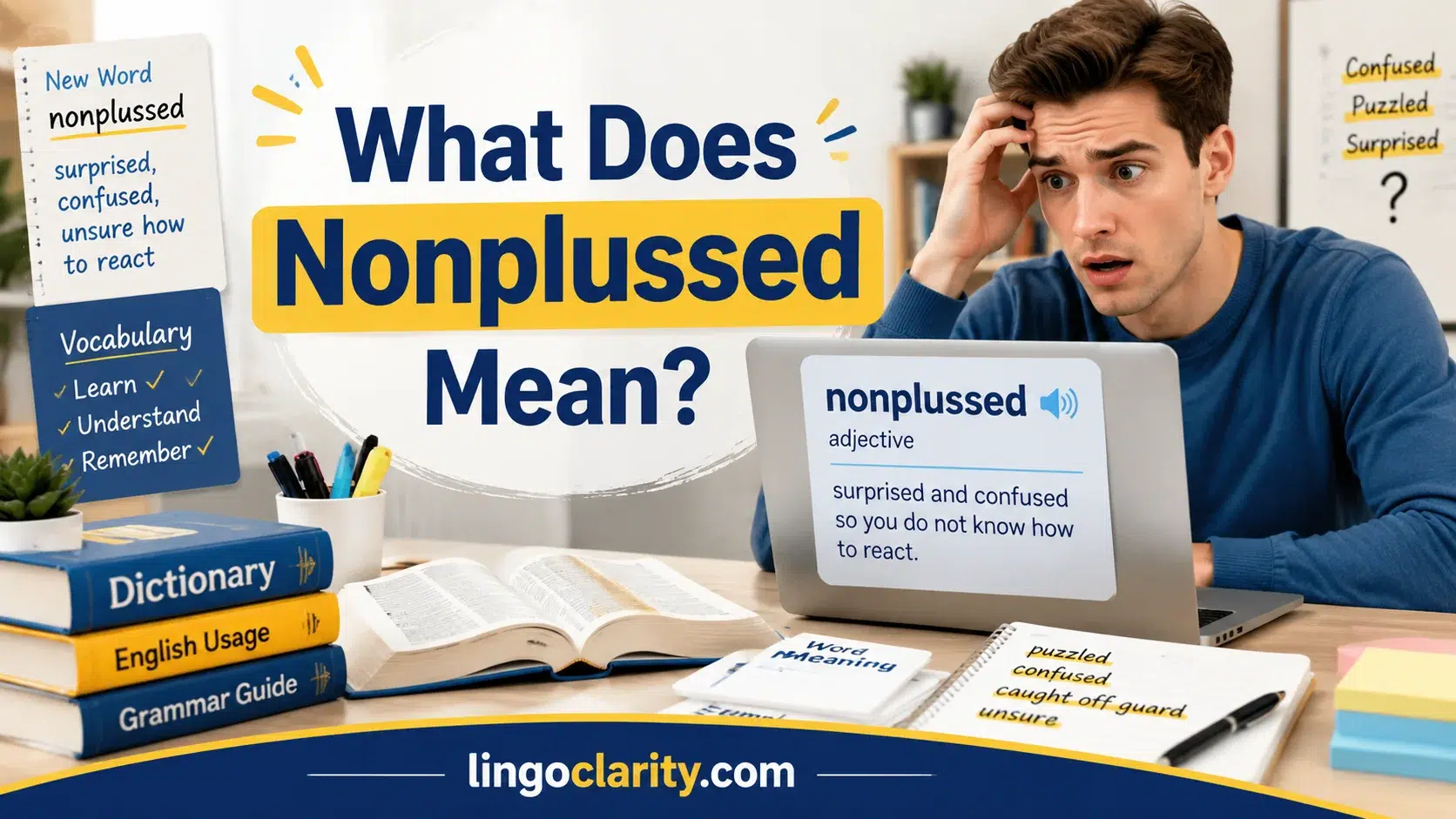
Have you ever seen the word nonplussed and wondered what it actually means? What does nonplussed mean is a common question because this word looks like it should mean “not bothered,” but its traditional meaning is quite different. In standard English, nonplussed means surprised, confused, or unsure how to react.
The confusion happens because many people interpret nonplussed as “unfazed” or “unimpressed,” especially in modern American usage. However, the original and widely accepted meaning describes a person who feels puzzled, speechless, or caught off guard by something unexpected.
In this guide, we will explain what does nonplussed mean, how to use it correctly, why people confuse its meaning, and provide clear examples in everyday US English.
Quick answer: Traditionally, nonplussed means so surprised or confused that you don’t know how to react. In American English it has also picked up the opposite sense — unbothered, unimpressed. Merriam-Webster lists both, but labels the second one chiefly US and notes it’s still widely treated as an error.
Table of Contents
- So What Does “Nonplussed” Really Mean?
- Where Did “Nonplussed” Come From?
- Why Does “Nonplussed” Have Two Opposite Meanings?
- The Two Senses at a Glance
- How Do You Use “Nonplussed” in a Sentence?
- Common Mistakes and Mix-Ups
- Should You Use “Nonplussed” at All?
- Words That Say It More Clearly
- Quick FAQ
So What Does “Nonplussed” Really Mean? {#so-what-does-nonplussed-really-mean}
The settled meaning is bewildered. If something nonplusses you, it stops you cold — you’re so taken aback that you can’t think of what to say or do next. That’s the sense you’ll find first in every major dictionary, and it’s the one careful editors still expect.
Here’s the wrinkle, and it’s why you probably searched for what “nonplussed” really means in the first place: plenty of Americans use the word to mean the exact opposite — calm, unfazed, unimpressed. Both uses are out there. Only one of them is safe everywhere.
Part of speech: adjective (from the verb to nonplus) Pronunciation: non-PLUST — /nän-ˈpləst/ Standard spelling: nonplussed, with two s’s
The verb still exists, though it’s rarer: the question nonplussed her. You’ll also see the noun in older writing — at a nonplus meant stuck, out of options.
Where Did “Nonplussed” Come From? {#where-did-nonplussed-come-from}
The word is Latin in two pieces: non plus, “no more, no further.” Picture a debate where one speaker has nothing left to say. That’s the original image.
English borrowed it as a noun in the 1580s, meaning a state in which you can’t proceed. The verb followed in the 1590s, and the past-participle adjective nonplussed appeared around 1600 (Merriam-Webster dates its first known use to 1606). So the “confused” meaning isn’t a preference or a style rule. It’s baked into the word’s parts.
That etymology also explains the most common misreading, which we’ll get to shortly.
Why Does “Nonplussed” Have Two Opposite Meanings?
Nobody voted on it. The second sense seems to have grown out of a reasonable guess.
Non- looks like a negative prefix — nonstop, nonfat, nonrefundable. A reader who doesn’t know the Latin can easily decode nonplussed as “not plussed,” meaning not moved, not affected, not impressed. The guess is wrong about the word’s history but perfectly logical about English, and it spread.
Merriam-Webster traces printed examples of the newer sense back to the early twentieth century, citing a 1930 newspaper use, and points out that it now turns up in well-regarded, heavily edited publications. Their dictionary entry lists it as sense 2 with the label chiefly US, along with a usage note saying it continues to be widely regarded as a mistake. Usage commentators such as Bryan Garner have made the same point for years: common, and still risky.
That combination puts nonplussed in a small club of English words that carry contradictory meanings — sometimes called contronyms or Janus words, like sanction, cleave, and dust. The difference is that most contronyms are sorted out by context. This one often isn’t.
The Two Senses at a Glance
| Sense 1 (traditional) | Sense 2 (newer, chiefly US) | |
|---|---|---|
| Meaning | Bewildered; at a loss for how to react | Unbothered; unfazed; unimpressed |
| In dictionaries | Listed first, no label | Listed second, labeled chiefly US, with a usage note |
| Age | In English since about 1600 | Printed examples from the early 1900s |
| Register | Neutral; fine in formal writing | Informal; contested in edited prose |
| Safe to use? | Yes | Only where your reader can’t misread it |
How Do You Use “Nonplussed” in a Sentence?
These examples show the traditional sense in different settings, plus one that illustrates the newer sense so you can recognize it when you read it.
- Text message: “I told her I got the job and she just said ‘cool.’ Honestly nonplussed.”
- Professional email: “The committee was nonplussed by the auditor’s request for records that, under our own retention policy, no longer exist.”
- Fiction or dialogue: He set the ring on the table. She looked at it, then at him, nonplussed.
- Verb form: Nothing in the briefing nonplussed the veteran negotiator; she’d seen every version of that argument before.
- Newer sense, as you’d meet it in the wild: “Investors were nonplussed by the earnings miss, and the stock closed flat.” Here the writer clearly means unbothered — the flat close gives it away.
Notice how much work context does in that last one. Strip out the stock price and the sentence could mean either thing.
Common Mistakes and Mix-Ups
Reading “non-” as “not”
There’s no such word as plussed, so “not plussed” has nothing to be the opposite of. The non plus here is a single Latin phrase meaning “no further,” not an English prefix stuck onto a root.
Writing a sentence that could go either way
The manager was nonplussed by the news. Did she freeze up, or shrug? A reader can’t tell, and half your audience will pick the wrong one. Rewrite it or replace the word.
Misspelling it
The standard American spelling doubles the s: nonplussed. The one-s form nonplused shows up occasionally in US sources, but the double-s spelling dominates edited writing and is what most dictionaries show. Skip the hyphen in non-plussed, and watch for the typo nonpulsed, which isn’t a word at all.
Confusing it with similar-sounding calm words
Nonchalant means casually unconcerned and shares two syllables’ worth of sound, which may be part of why the two blur together. Unfazed and unflappable both mean steady under pressure. None of them is a synonym for the traditional nonplussed — they’re closer to sense 2.
Treating it as a synonym for “underwhelmed”
Underwhelmed is specifically about disappointed expectations. Even under the newer reading, nonplussed is broader: not affected, one way or the other.
Should You Use “Nonplussed” at All?
Here’s the practical rule most articles about this word leave out. Split the decision by what you’re doing:
- You mean bewildered, and you’re writing something edited — an essay, a report, a published article. Use it. You’re on solid ground, and the word does something confused doesn’t: it carries the sense of being stopped, not just puzzled.
- You mean unbothered — pick a different word. Unfazed costs you nothing and can’t be misread. Save yourself the email from a reader.
- You’re texting or talking to friends — use whichever sense you grew up with. Speech has tone and follow-up questions to clear things up.
- You’re reading someone else’s sentence — don’t assume. Look for the evidence around it, the way the flat stock price settled that earnings example. If the surrounding facts don’t decide it, the writer left it genuinely ambiguous.
The honest summary: this is a word that has become harder to use than it’s worth in about half the situations you’d reach for it. That’s not a failure on your part. It’s what happens when a word splits.
Words That Say It More Clearly
- Perplexed — puzzled, still working on it. Milder than nonplussed, and it doesn’t imply you’ve stalled.
- Bewildered — confused and a little lost. The closest everyday match for sense 1.
- Flummoxed — thoroughly baffled, with a lighter, more informal tone.
- Taken aback — surprised into a pause. Best when the surprise is sudden and brief.
- Unfazed — the clean replacement for sense 2. Calm, unaffected, no ambiguity.
- Nonchalant — unbothered and visibly casual about it. Adds an attitude that unfazed doesn’t.
Match the word to the beat you want. Taken aback is a moment; bewildered is a state.
Quick FAQ
Yes. It has been in English since about 1600 and appears in every major dictionary, including Merriam-Webster and the Oxford English Dictionary. The debate is about which of its two meanings is correct, not about whether the word exists.
Traditionally it means confused — so surprised you don’t know how to react. The “unbothered” sense is a newer American development that dictionaries record but still flag. If you need to be understood without ambiguity, assume your reader expects “confused.”
It’s not wrong enough to be called an error in casual speech, and it appears in edited publications. In formal writing, though, many readers and most usage guides will treat it as a mistake, so the safer choice is “unfazed” or “unimpressed.”
They’re near opposites under the traditional definitions. Nonplussed means thrown off balance; unfazed means not affected at all. Because the newer sense of nonplussed overlaps with unfazed, using unfazed is the clearer option whenever you mean calm.
The double-s spelling, nonplussed, is standard and by far the most common in American edited writing. The one-s form turns up occasionally in US sources, but there’s no reason to prefer it.
The Short Version
Two senses, one word, and only one of them travels everywhere safely. If you mean bewildered, nonplussed is precise and worth keeping; if you mean unbothered, unfazed will get you there without the argument. When you meet the word in someone else’s writing, read the sentence around it before you decide which one they meant.

1 thought on “What Does “Nonplussed Mean”?”
Comments are closed.