
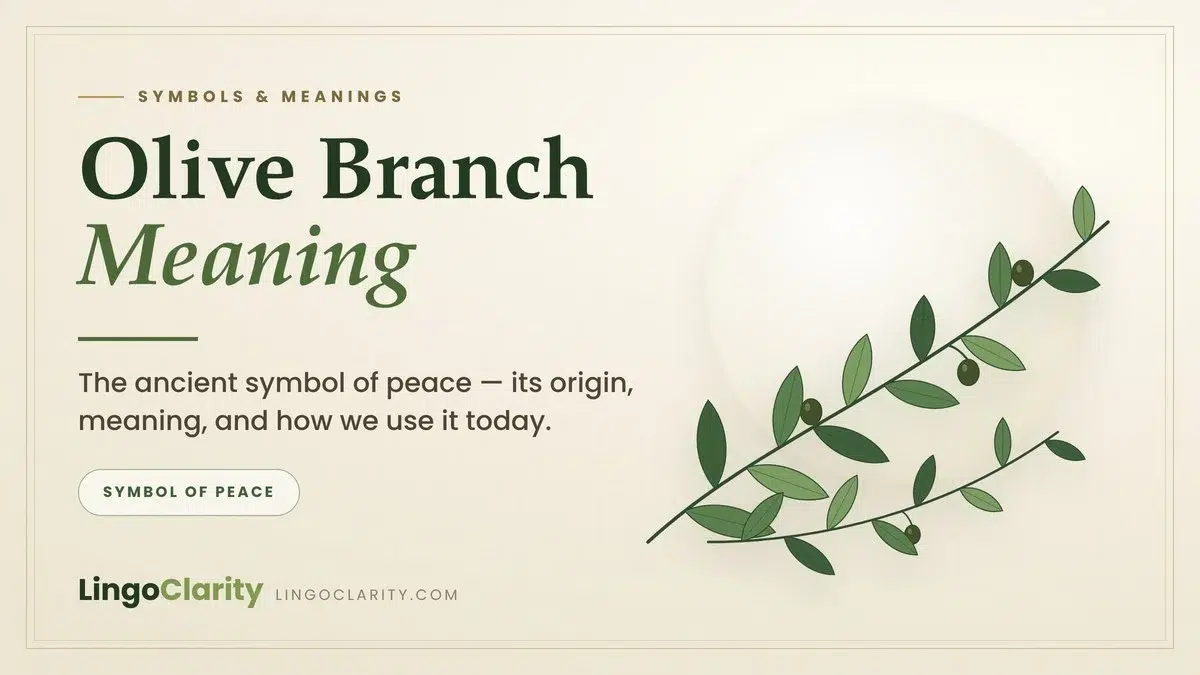
Quick answer: An olive branch is a gesture of peace, apology, or goodwill offered to someone you’re at odds with. It works as a noun and as an idiom, usually in the phrase “extend an olive branch.” The image traces back to Greek and Roman peacemaking and to the dove in the Genesis flood story.
You’ll meet the olive branch in three places: a real tree limb, a symbol on flags and seals, and a phrase people use when a fight is winding down. This guide covers all three, plus the mistakes that trip up otherwise careful writers.
What Does “Olive Branch” Mean?
Part of speech: noun (countable). Plural: olive branches. Pronunciation: AH-liv branch — /ˈɑ·lɪv ˌbræntʃ/.
Two senses are in active use, and Merriam-Webster records both:
- Literal. A branch cut from an olive tree (Olea europaea), especially one carried or displayed as a peace symbol.
- Figurative. An offer or gesture of conciliation and goodwill — the sense you’ll see in almost every headline.
The second sense is the one that carries the weight. When a senator extends an olive branch, nobody is holding foliage. Cambridge Dictionary defines it the same way, and marks it as an idiom.
There’s no verb form in standard English. You don’t olive branch someone; you extend, offer, or hold out an olive branch to them.
Capitalization is a useful signal. Lowercase means the phrase or the plant. Capitalized, Olive Branch is usually a proper noun — the city in Mississippi outside Memphis, or the Olive Branch Petition that the Continental Congress sent to King George III in 1775.
Where Did the Olive Branch Symbol Come From?
The olive tree is slow. It can take years to bear a useful crop, and a grove only reaches that point if nobody burns it down first. A standing olive grove is therefore evidence of a long stretch of peace — the explanation most often given for why the olive branch became the symbol it is. Treat that as the widely repeated account rather than a documented origin.
What the record does show is a long chain of use:
- Ancient Greece. Suppliants and heralds carried olive branches, often bound with wool, to signal that they came without weapons. Athena’s gift of the olive tree to Athens sits at the center of the city’s founding myth.
- Ancient Rome. Envoys carried olive branches as tokens of peace, a practice associated with the Pax Romana.
- The Genesis flood story. A dove returns to Noah carrying olive greenery, which readers came to treat as the sign that the waters had receded and the quarrel between heaven and earth was over.
- The Great Seal of the United States. Adopted in 1782, it shows an eagle gripping an olive branch with thirteen olives and thirteen leaves in one talon and thirteen arrows in the other — peace and war held in the same pair of hands. See the Great Seal’s history at Britannica.
- The United Nations emblem. Two stylized olive branches wrap a world map, which is how most people alive today first saw the symbol. See the UN emblem and flag.
Merriam-Webster dates the English phrase to the 14th century, so the figurative use is old, not modern slang. One modern moment fixed it in public memory: addressing the UN General Assembly in 1974, Yasser Arafat said he had come “bearing an olive branch and a freedom fighter’s gun” — a line that only lands because everyone already knew what the branch meant.
How Do You Use “Olive Branch” in a Sentence?
Five examples, from a phone screen to a formal report:
- Text message: “she left cookies on my desk lol. i think that was an olive branch”
- Work email: “As an olive branch, we’ve waived the rush fee on the revised order and extended your deadline by a week.”
- News writing: “The governor extended an olive branch to the teachers’ union hours before the strike deadline.”
- Dialogue: “You call that an olive branch? He apologized to the room, not to me.”
- Formal report: “The treaty is best read as an olive branch offered from a position of strength rather than a genuine concession.”
A few grammar points worth pinning down:
- The verbs that pair naturally are extend, offer, hold out, and sometimes wave. You extend an olive branch to someone.
- Use the article: an olive branch. Bare “he extended olive branch” is ungrammatical.
- You can accept, reject, or ignore one. You cannot answer one.
- The plural is olive branches, and it’s fine: “Both sides sent olive branches through intermediaries.”
Is an Olive Branch the Same as Surrender?
No, and mixing them up changes the meaning of a sentence entirely.
A white flag says I’m done fighting; I’m giving up or asking to stop. An olive branch says I want to fix this between us. Surrender flows one direction, from the losing side. An olive branch can come from anyone — and it often comes from the stronger party, which is why journalists reach for the phrase when a powerful figure softens toward a rival.
Register. Neutral and safe almost everywhere. It’s common in news, business writing, diplomacy, and casual speech, and it carries no offensive or generational baggage. It’s a shade more figurative than plain words like apology, so a legal filing or a lab report would likely say “concession” instead.
Tone. The phrase turns skeptical fast. “A so-called olive branch” or “that was no olive branch” signals that the writer thinks the gesture was hollow. Readers hear the doubt in the qualifier, not in the phrase itself.
Common Olive Branch Mistakes and Mix-Ups
| The mistake | Why it’s a problem | The fix |
|---|---|---|
| “He extended a olive branch.” | Wrong article before a vowel sound. | “He extended an olive branch.” |
| “She waved the olive branch and admitted defeat.” | Blends the olive branch with the white flag, so the sentence now means surrender. | Pick one image: an olive branch for reconciliation, a white flag for surrender. |
| “The dove brought an olive branch” (quoting Genesis) | The Hebrew text says a leaf; the branch entered through later translation and centuries of religious art. | Quote it as an olive leaf, or say the dove “is usually pictured with an olive branch.” |
| “olive branchs” / “olive brach” | Misspelled plural and a dropped letter — both slip past spellcheck less often than people expect. | olive branches, olive branch. |
| “He olive branched her after the fight.” | There’s no verb form in standard usage. | “He extended an olive branch to her after the fight.” |
| “Olive branch” capitalized mid-sentence | Signals the Mississippi city or the 1775 petition instead of the gesture. | Keep it lowercase unless you mean a proper noun. |
Olive Branch vs. Peace Offering vs. Truce
Related terms overlap, but each one points somewhere slightly different.
| Term | What it actually means | Use it when |
|---|---|---|
| Olive branch | A gesture inviting reconciliation | Someone makes the first move toward repair |
| Peace offering | A concrete gift or favor given to smooth things over | There’s an actual object or perk involved |
| Truce | A mutual agreement to stop fighting | Both sides have agreed to pause |
| Ceasefire | A formal, often military halt to hostilities | The context is armed conflict or negotiations |
| Concession | Something given up in a bargain | The focus is on cost, not warmth |
| White flag | Surrender or a request to parley | One side is yielding |
| Rapprochement | Renewed friendly relations, usually between nations | You want the formal, diplomatic register |
The line between truce and ceasefire trips up more writers than any of the others; our guide to peace vs. ceasefire breaks that pair down.
Olive Branch FAQ
Is “olive branch” a real idiom?
Yes. Major dictionaries including Merriam-Webster and Cambridge list it, and Merriam-Webster traces the English phrase to the 14th century. It’s standard usage, not slang.
What does it mean to extend an olive branch to someone?
It means making the first move toward peace after a conflict — an apology, a concession, or a friendly gesture meant to reopen the relationship. The other person can accept it or reject it.
Is it an olive branch or an olive leaf in the Bible?
The Hebrew text of Genesis describes an olive leaf. The branch version spread through later translation and Christian art, and it’s now the image nearly everyone pictures.
Can I use “olive branch” in formal writing?
Yes. It appears regularly in journalism, business correspondence, and diplomatic writing. In highly technical or legal documents, a plainer word such as concession usually reads better.
Is it rude to say someone offered an olive branch?
Not at all — it’s a compliment on its own. The insult lives in the qualifier: “a so-called olive branch” or “a token olive branch” tells the reader you found the gesture empty.
Why is the olive branch a symbol of peace?
Olive groves take years of undisturbed peace to produce, and Greek and Roman envoys carried the branches to show they arrived unarmed. Later use on the Great Seal and the UN emblem locked the association in.
The Takeaway
The phrase does one job well: it names the moment somebody chooses repair over winning. Reach for it when the gesture is genuine and the reader should feel the warmth in it — and when you want to question that warmth, let the qualifier do the work, because “olive branch” on its own always reads as sincere.
