
Improve English Reading Skills
Reading English does not always mean understanding it. You may recognize the vocabulary in an email but remain unsure what the sender wants. A short article may seem clear until you try to explain its main point. A long sentence can force you to return to the beginning several times. These common problems have different causes.
Better reading begins with finding out exactly where understanding breaks down. Some readers need faster word recognition. Others need a stronger vocabulary, a clearer grasp of sentence structure, or better ways to follow an argument. This guide examines those difficulties separately and shows how to address them through practical, thoughtful reading. The goal is accurate, independent understanding.
Find Out Why a Text Is Difficult
Before changing your reading habits, identify the problem you are trying to solve. Choose a short passage that is slightly challenging but not overwhelming. Read it once without using a dictionary. Then ask yourself four questions: Can I recognize most words? Can I explain each sentence? Do the sentences connect clearly? What is the writer’s main message?
Your answers reveal where to focus. Slow recognition of familiar words suggests a need to improve reading fluency. When several important words are unfamiliar, build vocabulary through context and regular review. If individual words are clear but sentences remain confusing, examine grammar and sentence structure. Difficulty understanding the full passage, despite understanding each sentence, points to a need to practice identifying connections and the main idea.
For example,
consider: “Although the office reopened on Monday, visitors must still book appointments in advance.” A reader who misses “although” may overlook the contrast. Someone who misunderstands “must” may treat the appointment rule as optional. Another may understand the sentence but forget the instruction.
Choose your practice according to the difficulty you identify.
Reading Problems and Practical Solutions
Choose your starting point.
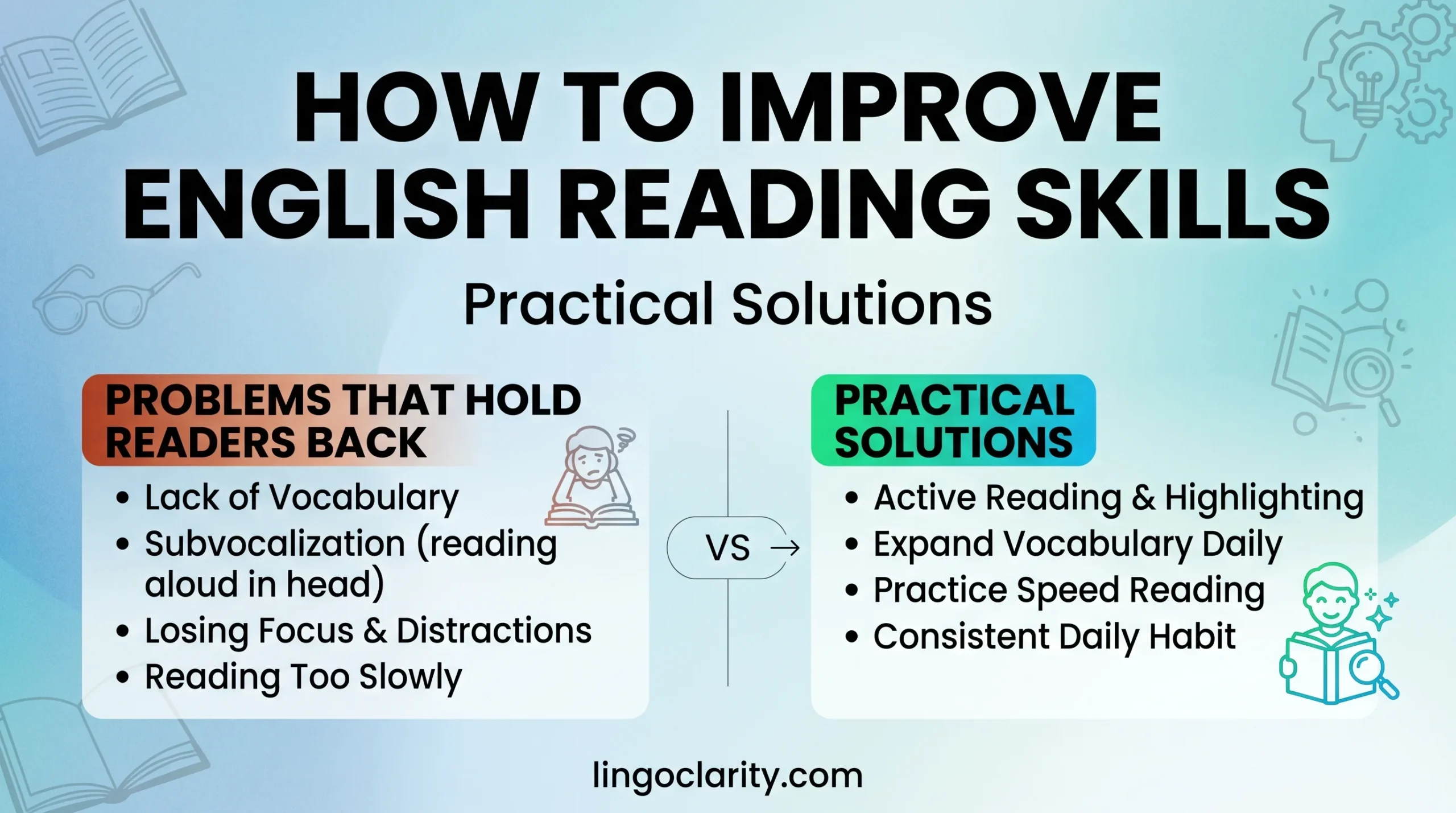
| Common Reading Problem | Practical Solution |
|---|---|
| Familiar words form a sentence you cannot explain. | Identify the main subject and verb, separate extra clauses, and paraphrase the message. |
| Reading feels slow and exhausting. | Practice with accessible paragraphs and recognize familiar phrases as complete units. |
| Unknown vocabulary breaks your concentration. | Use nearby sentences for context clues and check important meanings in a dictionary. |
| Individual sentences make sense, but the paragraph does not. | Trace connecting words and pronouns, then summarize the paragraph in one sentence. |
| You forget the passage immediately. | Close the text and recall its main idea and two supporting details. |
| You translate every word into another language. | Learn common expressions as complete phrases and explain familiar passages in simple English. |
| Notifications interrupt your concentration. | Read one passage without distractions and take breaks between sections. |
| You overlook deadlines, conditions, or exceptions. | Check words such as “must,” “unless,” and “may,” along with dates and required actions. |
| You confuse assumptions with the writer’s claims. | Separate stated facts from inferences and examine the supporting evidence. |
When Recognizing Words Takes Too Much Effor
When recognizing words takes too much effort, little attention remains for meaning.
Start with texts containing mostly familiar language. Read a short paragraph silently, then reread it while paying attention to complete phrases rather than isolated words. Notice familiar groups such as “as soon as possible,” “in addition to,” and “at the end of the month.” Recognizing common expressions as units makes sentences easier to process.
Try reading this sentence in natural groups: “The updated schedule / will be available online / after the final review.” Each group answers a useful question: what, where, and when. Do not force your eyes to move at an artificial speed. Your objective is smoother understanding, not a reading speed record.
If you frequently confuse written words that look alike, slow down and compare them carefully. “Accept” and “except,” for instance, differ by only one letter but have different meanings. Say the words, check their definitions, and read each in a complete sentence.
Increase difficulty gradually as familiar patterns become easier to recognize.
When Vocabulary Interrupts the Meaning
Surrounding sentences often reveal an unfamiliar word’s meaning.
Consider: “The road was blocked by fallen trees, so drivers had to take an alternative route.” Even if “alternative” is new, the blocked road suggests that drivers must use a different way. The second part of the sentence helps explain the first.
Use examples, contrasts, and results as clues. Finish the paragraph, then verify important words.
Still, context cannot solve every vocabulary problem. If a notice says that payment is “nonrefundable,” an uncertain guess could have financial consequences. Look up such words immediately. Also check unfamiliar terms that appear repeatedly or carry the central idea of a passage.
Build a small vocabulary record from your actual reading. Include the word, its meaning in that particular sentence, and one new example of your own. Review groups of related words, such as “apply,” “application,” and “applicant,” rather than collecting unrelated definitions.
Watch for familiar words used in unfamiliar ways. “Issue” may mean a problem, a subject for discussion, or the act of officially providing something. Ask what the word does in this sentence, not simply what it meant the first time you learned it.
When Long Sentences Hide a Simple Message
Long sentences can overwhelm readers because several ideas arrive before the main point becomes clear. The solution is not to memorize every grammar rule. Learn to find the sentence’s central structure and then attach the extra information.
Read this example: “The documents submitted after the deadline, which was extended because of technical problems, will be reviewed next week.”
The central message is simple: “The documents will be reviewed next week.” The remaining words identify which documents and explain why the deadline changed. Once you find the subject and main verb, the sentence becomes easier to manage.
Look for words that introduce relationships. “Because” gives a reason. “Although” signals contrast. “If” introduces a condition. “Unless” often identifies an exception. These small words can be more important than long nouns.
Compare: “You can attend if you register today” and “You cannot attend unless you register today.” Both concern registration, but they express the condition differently. Reading only the obvious words would miss the precise meaning.
When a sentence is difficult, divide it into shorter parts. Identify who or what the sentence is about, what happens, and which conditions apply. Then explain the whole sentence in plain English. Return to the original to make sure you have not removed a warning, exception, or important detail.
When Paragraphs Do Not Fit Together
Understanding every sentence individually is not enough. A paragraph also has a direction. Writers develop an idea by adding evidence, introducing a problem, explaining a cause, or reaching a conclusion.
Consider this passage: “The library added evening classes last year. Attendance was initially low. However, more people began joining after the schedule was shared with local employers. As a result, the library plans to offer additional sessions.”
The passage describes a change over time. “However” marks the shift from low attendance to greater participation. “As a result” connects increased interest with the plan to expand. Without those links, the paragraph becomes a collection of facts rather than a clear explanation.
After reading a paragraph, ask: What point is the writer making? How does each sentence support or change that point? Watch for connecting words, but also follow references such as “this,” “these,” “they,” and “such changes.” Determine exactly what each expression refers to.
At the end of a section, give it a short title in your own words. For example, the library paragraph could be called “How evening classes gained support.” If you cannot create an accurate title, reread the sentences that seem disconnected and trace their relationship.
This helps with longer explanations and arguments.
When You Finish Reading but Cannot Remember
Forgetting a passage immediately does not necessarily mean your memory is weak. You may have recognized the words without processing their importance. You may also have read too much before checking what you understood.
Pause at natural points, such as the end of a paragraph or section. Look away from the page and explain the main idea in one or two sentences. Then return to check whether your explanation is accurate. This simple act makes you retrieve meaning instead of merely seeing familiar text again.
Avoid copying the writer’s sentences as your only form of note taking.
A useful note answers a question.
For a passage about a new school timetable, write what changed, why it changed, and what students must do next. These details are more valuable than a page of highlights.
Try a second check several minutes later. Without reopening the text, write down the central idea and two supporting points. If you remember only isolated words, read again with a clearer purpose.
For longer articles, connect your section summaries into an explanation of the whole text.
When Reading Becomes a Word by Word Translation
Translation can be helpful, especially when a subject is unfamiliar. Problems arise when every English phrase must be converted into another language before it feels understandable. Constant translation interrupts the movement of ideas and may encourage unnatural interpretations of common expressions.
Begin with language you already know well. When you read “Please let me know,” connect it directly with the act of asking for a response. Do not spend time translating each word separately. The same principle applies to “take part in,” “look forward to,” and “keep in mind.” Their meanings belong to the complete expressions.
One exercise is to read a short, accessible paragraph and explain it using simpler English. If you meet a difficult term, try describing its meaning before searching for an equivalent in another language. For example, “postpone” can become “move something to a later time.”
Use translation when accuracy demands it or when English explanations remain unclear. The goal is not to ban a useful learning tool. It is to develop the ability to understand increasingly familiar English directly.
When Attention Disappears Halfway Through
Notifications and open tabs can interrupt comprehension, forcing you to reread what you missed.
Choose one manageable reading task. Close unnecessary tabs, silence alerts when possible, and decide what you need from the text. For a short article, commit to understanding its main claim and evidence. For an instruction page, identify the steps and any warnings.
If your attention drifts, return to the last sentence you understood clearly. Do not automatically restart the entire article. For longer material, use brief breaks between sections and write a short note before leaving your place.
Reading on a screen also requires judgment. Links, advertisements, and suggested articles may pull you away from the main text. Stay with the original passage until you can explain its purpose. Open supporting material only when you have a clear question it might answer.
Learn to Read What the Writer Means, Not Only What Is Stated
Some texts require inference: understanding something that is suggested but not directly announced. Suppose a message says, “We received your request, but additional information is needed before a decision can be made.” The request has not necessarily been rejected. The writer is saying that a decision remains pending.
Keep inference separate from speculation. Ask which words support your interpretation and whether another explanation remains possible. In the example, you can conclude that more information is needed. You cannot conclude that approval is guaranteed once it arrives.
Pay particular attention to degrees of certainty. “May reduce costs” is not equivalent to “will reduce costs.” “Researchers observed a connection” is not the same as “researchers proved a cause.” Such distinctions matter in news, study materials, workplace documents, and public information.
Critical reading adds another question: why should I trust this statement? Check who wrote the text, when it appeared, and what evidence it provides. Separate descriptions of events from opinions about them. When an article says “most people agree,” look for information explaining how that conclusion was reached.
A Complete Example: Reading a Notice Correctly
Consider this short notice:
“Starting next month, customers who receive printed statements will be charged a monthly fee. Customers who switch to electronic statements before the end of this month will not be charged. Existing online account access will remain unchanged.”
Read it first for the central message. The organization is introducing a fee for printed statements, but customers can avoid it by changing their statement preference before the deadline.
Now identify the details that control the meaning. The change begins next month. The fee applies to customers receiving printed statements. The exception concerns customers who switch to electronic statements in time. Access to existing online accounts is not changing.
Notice what the passage does not say. The notice does not specify the fee amount or require customers to close their accounts. It also makes no promise that switching to electronic statements after the deadline will remove a fee that has already been charged.
A useful summary would be: “Printed statements will carry a monthly fee from next month. Customers can avoid the fee by choosing electronic statements before this month ends.”
This example brings several skills together: finding the main idea, reading conditions accurately, noticing missing information, and summarizing without adding assumptions. Apply the same questions to a workplace email, a school message, a product policy, or an appointment letter.
Build a Reading Routine That Solves Real Problems
Practice is most effective when it matches a specific weakness. Set aside twenty minutes on most days, but change what you do within that time. Start with two minutes to preview a suitable text and decide what you need to understand. Read for eight minutes without stopping at every unknown word. Spend five minutes investigating the sentences or expressions that genuinely blocked meaning. Use the final five minutes to summarize the text, answer questions about it, and check your answers.
Vary the material across the week. Use practical messages and notices to practice accuracy. Read short explanations to develop vocabulary and paragraph understanding. Choose narratives to follow events and implied meaning. Read opinion articles to identify claims and evidence. Select texts that are mostly understandable, then gradually add more demanding material.
Once a week, test yourself with a fresh passage rather than one you have already studied. Record whether you understood its main message, found important details, interpreted conditions, and explained unfamiliar language accurately. Speed may improve, but comprehension should remain the primary measure.
When the same reading difficulty appears repeatedly, devote the next few practice sessions to addressing it. For trouble understanding conditions, collect examples using “if,” “unless,” and “provided that.” Losing track of the main point can be addressed by writing a one-sentence summary after each paragraph. If unfamiliar vocabulary continues to block comprehension, review useful words from your own reading.
Progress is not measured by the number of pages completed. It appears when you can read unfamiliar material, identify what matters, explain it clearly, and recognize when you need to check a detail. Reading English becomes easier when practice is guided by evidence of what you understand and what you still need to learn.

1 thought on “How to Improve English Reading Skills: Practical Solutions”
Comments are closed.