
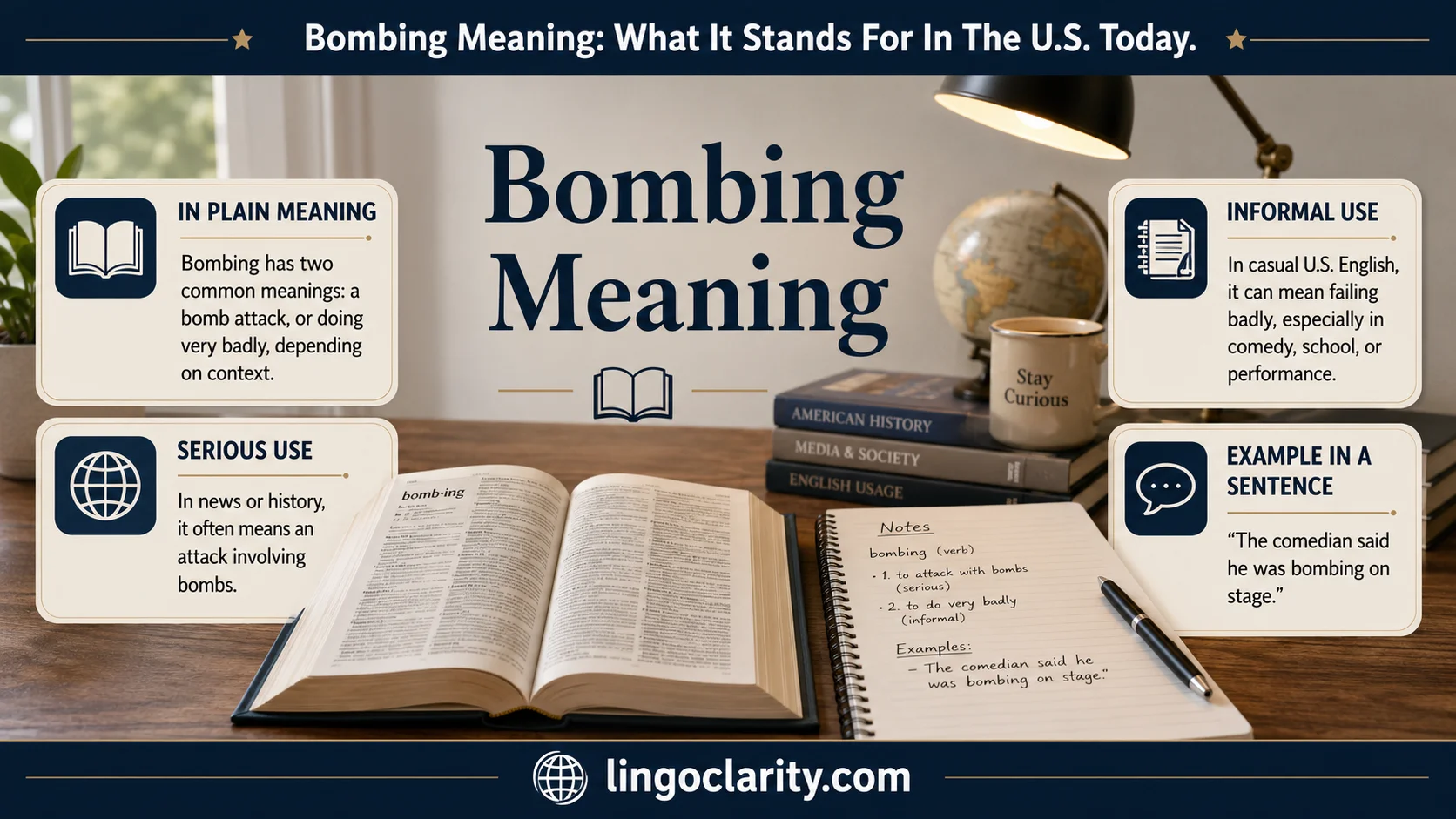
Bombing meaning is simple in serious contexts: it means an attack that uses bombs or explosives. News reports, history books, safety alerts, and war coverage use bombing to describe one explosive attack, repeated attacks, or the act of dropping, placing, or setting off bombs.
The word also has an informal American English meaning. In comedy, school, interviews, entertainment, or public speaking, bombing means failing badly. A comedian may be bombing on stage, and a student may say they are bombing a test. Context tells you whether the word means an explosive attack or a poor performance.
Quick Answer
Bombing means an attack using bombs, or the act of dropping, placing, or exploding bombs. Informally, it means failing badly at something, especially a test, joke, speech, show, audition, interview, or performance.
Example: “The bombing damaged several buildings.”
Informal example: “The comedian was bombing on stage.”
What Does Bombing Mean?
Bombing meaning depends on context. In the most serious and common sense, a bombing is an attack involving bombs. It may happen during war, terrorism, crime, or another violent event.
For example, “a bombing in the city” usually means one explosive attack. “The bombing of the area continued overnight” suggests repeated attacks.
The word also has an informal meaning. In everyday speech, someone may say they are “bombing” a test, speech, audition, joke, or performance. That does not mean explosives are involved. It means the person is doing very badly.
So, the word has two main meanings:
Bombing can mean an explosive attack.
Bombing can also mean failing badly in a casual context.
Plain-English Definition Of Bombing
Bombing means the act of attacking with bombs or causing bombs to explode.
Informally, bombing means doing very badly at something, especially a performance, test, speech, show, joke, or public effort.
A simple definition is:
Bombing means an attack with bombs, or, informally, a serious failure.
The literal meaning is serious and should be used carefully. The informal meaning is casual, but still negative. It usually means something is going very poorly, not just slightly badly.
How To Use Bombing In A Sentence
Use a bombing when you mean one explosive attack.
Example: “Officials investigated the bombing.”
Use bombing without a when you mean the activity in general.
Example: “The area was damaged by bombing.”
Use bombing as a verb form when it comes from the verb bomb.
Example: “Planes were bombing the area.”
Use the informal meaning when the context clearly involves failure.
Example: “I felt like I was bombing the interview.”
Bombing As A Noun And Verb Form
Bombing is most often used as a noun.
Noun example: “The bombing shocked the community.”
It can also be the -ing form of the verb bomb.
Verb-form example: “The military was bombing enemy positions.”
In casual speech, it can describe poor performance.
Informal example: “The actor knew he was bombing when the audience went silent.”
The same spelling works in different grammatical roles, so the sentence around it tells you which meaning is intended.
Bombing In Serious Contexts
In news, history, law, military writing, and public-safety alerts, bombing usually means an explosive attack. This meaning can involve harm, fear, property damage, injury, or death.
Examples:
“The bombing damaged homes near the station.”
“Several roads were closed after the bombing.”
“The documentary covered the bombing of the city during the war.”
“The report described weeks of heavy bombing.”
Because this meaning is serious, avoid using the word loosely when you only mean a loud noise, a fire, or an accidental explosion. If no bomb or attack is confirmed, explosion may be the safer word.
Bombing In Informal American English
In informal US English, bombing can mean failing badly. This use is common in comedy, school, entertainment, public speaking, and business.
Examples:
“The comedian was bombing on stage.”
“I thought I studied enough, but I’m bombing this quiz.”
“The movie bombed with audiences.”
“His joke was bombing, so he changed the subject.”
This meaning is casual. It works in conversation, entertainment writing, and informal commentary. In formal writing, use clearer words like failed, performed poorly, or was unsuccessful.
Bomb Vs. Bombing
Bomb is usually the object or weapon.
Example: “A bomb exploded.”
Bombing is usually the attack, event, or action.
Example: “The bombing damaged the building.”
In informal speech, bomb can also mean a total failure.
Example: “The movie was a bomb.”
However, bombing usually means either an explosive attack or the act of failing badly while something is happening.
Example: “The performer was bombing on stage.”
Bombed Vs. Bombing
Bombed is the past-tense form.
Example: “The city was bombed during the war.”
It can also mean something failed badly.
Example: “The show bombed.”
In slang, bombed can also mean drunk or high, depending on context.
Example: “He was totally bombed at the party.”
Bombing often describes an action in progress.
Example: “The team’s presentation is bombing.”
Use context carefully because these forms can have very different meanings.
Bombing Vs. Explosion
Bombing usually suggests an attack involving a bomb.
Explosion only means a blast. It does not always mean an attack.
Example: “There was an explosion at the factory.”
That sentence does not prove there was a bombing. The explosion could have been accidental.
Example: “The bombing happened near the courthouse.”
That sentence suggests an intentional explosive attack.
In careful writing, do not call something a bombing unless a bomb or explosive attack is confirmed.
Common Phrases With Bombing
Aerial Bombing
Aerial bombing means bombing from the air, usually by aircraft.
Example: “The book describes aerial bombing during the war.”
Bombing Raid
A bombing raid is an organized attack using bombs, often by aircraft.
Example: “The city suffered damage during a bombing raid.”
Bombing Campaign
A bombing campaign means a planned series of bombing attacks over time.
Example: “The report examined the bombing campaign.”
Carpet Bombing
Carpet bombing means dropping many bombs over a wide area. It can also be used figuratively to mean overwhelming someone with messages, ads, or information.
Example: “The company carpet-bombed customers with emails.”
Use the figurative meaning carefully because the literal meaning is violent.
Review Bombing
Review bombing means flooding a website, app store, product page, movie page, or game page with many negative reviews, often as part of a campaign.
Example: “The app was hit by review bombing after the update.”
Love Bombing
Love bombing means overwhelming someone with intense affection, praise, attention, or gifts in a way that may be manipulative.
Example: “At first it felt romantic, but later she worried it was love bombing.”
This phrase belongs to relationship and emotional-abuse discussions, not military or news writing.
Yarn Bombing
Yarn bombing is a playful phrase for covering public objects with knitted or crocheted decorations.
Example: “The park benches were decorated through yarn bombing.”
This phrase is not violent in meaning.
Tone, Context, And Formality
The literal meaning of bombing is serious, formal, and often connected to news, war, crime, terrorism, safety, or history. Use it with care.
The informal failure meaning is casual.
Natural casual sentence: “I’m bombing this presentation.”
More formal sentence: “I am performing poorly in this presentation.”
The figurative meanings vary. Review bombing is common in digital media. Love bombing is common in relationship discussions. Carpet bombing can be literal or figurative, but it still carries a harsh tone.
Always let the context guide the meaning.
Pronunciation Of Bombing
Bombing is pronounced BAH-ming in standard American English.
The b at the end of bomb is silent. Do not pronounce it like “bomb-bing.”
Syllables: bomb-ing
US-style pronunciation: BAH-ming
Synonyms For Bombing
The best synonym depends on the meaning.
For the literal meaning:
Attack
Bomb attack
Bombardment
Airstrike
Explosion
Raid
Assault
These words are not always interchangeable.
Attack is broader and does not always involve bombs.
Explosion describes a blast, but not always an intentional attack.
Bombardment often suggests heavy or repeated attack.
Airstrike usually means an attack from the air.
For the informal failure meaning:
Failing
Flopping
Doing badly
Falling flat
Performing poorly
Crashing
Not landing
Example: “The joke was bombing” can become “The joke was falling flat.”
Antonyms For Bombing
There is no single perfect antonym for bombing because the word has more than one meaning.
For the attack meaning, possible opposites include:
Peace
Ceasefire
Safety
Protection
Defense
For the informal failure meaning, useful opposites include:
Succeeding
Doing well
Performing well
Winning
Killing it
Landing well
Example: “The comedian was bombing” is the opposite of “The comedian was killing it.”
Common Mistakes With Bombing
Mistake 1: Using Bombing For Any Explosion
Incorrect: “There was a bombing at the factory,” when the cause is unknown.
Better: “There was an explosion at the factory.”
Use bombing only when a bomb or explosive attack is involved or clearly reported.
Mistake 2: Treating Bombing Only As Slang
Bombing is not only slang. The attack meaning is standard English.
Correct: “The bombing caused major damage.”
The failure meaning is the informal one.
Correct informal use: “I was bombing the interview.”
Mistake 3: Confusing Bombing With The Bomb
The bomb can mean something excellent in slang.
Example: “That pizza is the bomb.”
Bombing usually means attacking or failing.
Example: “The joke was bombing.”
These expressions have opposite emotional meanings in casual speech.
Mistake 4: Using Informal Bombing In Formal Writing
Too casual: “The product launch bombed.”
More formal: “The product launch failed.”
Best formal version: “The product launch did not meet expectations.”
Mistake 5: Forgetting The Article A
Use a bombing for one event.
Example: “A bombing occurred downtown.”
Use bombing for the general action or repeated activity.
Example: “The neighborhood was damaged by bombing.”
Natural Examples Of Bombing
“The bombing damaged several nearby buildings.”
“Officials are investigating the bombing.”
“The museum exhibit explains the bombing of the city.”
“Many residents left the area because of continued bombing.”
“The report described the bombing campaign in detail.”
“The comedian kept talking even though his jokes were bombing.”
“I studied all week, but I still felt like I was bombing the test.”
“The speaker realized she was bombing halfway through the presentation.”
“The movie was review bombed before many people had seen it.”
“The company’s ad campaign bombed with customers.”
“He confused the crowd and started bombing during the audition.”
“The phrase love bombing does not mean a real bomb; it refers to overwhelming attention that may be manipulative.”
When Should You Use Bombing?
Use bombing when the sentence involves bombs, explosive attacks, war, crime, public safety, military history, or serious damage.
Use the informal meaning when the sentence clearly involves failure, performance, entertainment, school, business, or audience reaction.
Good serious use: “The article reported on the bombing.”
Good informal use: “The joke was bombing.”
Poor use: “The meeting was a bombing.”
Better: “The meeting went badly.”
FAQ
What does bombing mean in simple words?
Bombing means an attack using bombs. Informally, it can also mean failing badly at something, such as a test, joke, speech, show, or performance.
Is bombing a noun or a verb?
Bombing can be a noun or the -ing form of the verb bomb. As a noun, it means an explosive attack. As a verb form, it means attacking with bombs or failing badly in informal speech.
What does bombing mean in comedy?
In comedy, bombing means performing badly. If a comedian is bombing, the jokes are not getting laughs or the audience is reacting poorly.
What does bombing a test mean?
Bombing a test means doing very badly on it. This is informal American English.
Example: “I think I bombed the math test.”
Does bombing always mean violence?
No. In serious contexts, bombing usually means an explosive attack. In informal contexts, it can mean failure. In phrases like review bombing, love bombing, and yarn bombing, the meaning changes again.
What is the difference between bombing and explosion?
An explosion is a blast. A bombing is usually an attack involving a bomb. Every bombing may involve an explosion, but not every explosion is a bombing.
What is review bombing?
Review bombing means posting many negative reviews online, often as part of a campaign against a product, movie, game, app, business, or public figure.
What is love bombing?
Love bombing means overwhelming someone with affection, praise, attention, or gifts in a way that may be manipulative. It is a relationship phrase, not a military phrase.
Final Thought
Bombing most often means an attack using bombs. That is the serious, standard meaning used in news, history, law, safety, and military contexts.
In informal American English, bombing can also mean failing badly. A comedian can bomb on stage, a student can bomb a test, and a product launch can bomb with customers.
The easiest way to understand the word is to check the context. If the sentence mentions war, damage, explosives, police, buildings, or public safety, bombing means an attack. If it mentions jokes, tests, shows, speeches, reviews, or audience reaction, bombing probably means failure or a figurative use.
