
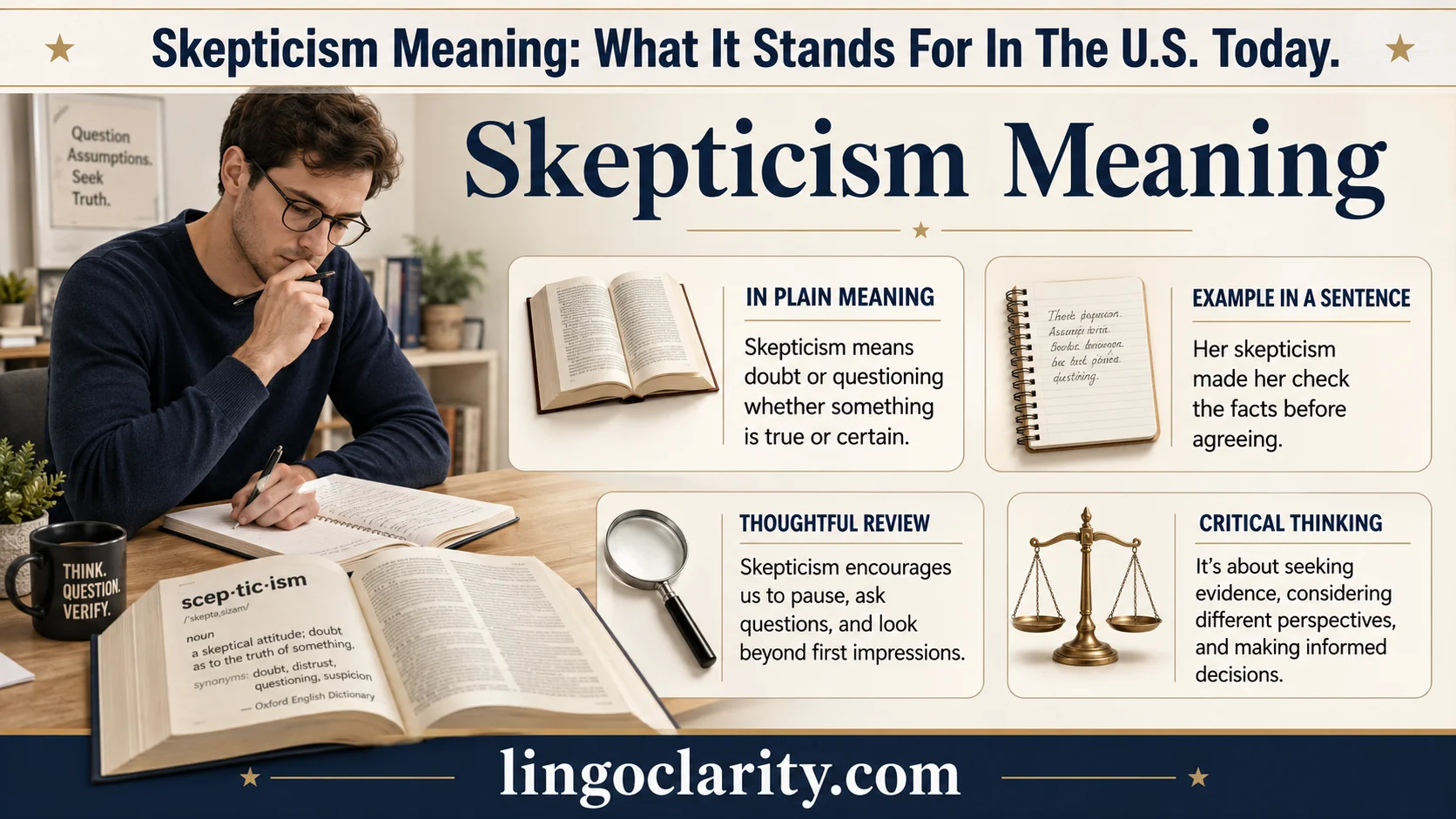
Skepticism meaning is simple: skepticism means doubt or careful questioning before accepting something as true. When a person shows skepticism, they are not fully convinced yet. Instead, they may want better proof, clearer facts, stronger evidence, or a more reasonable explanation.
In everyday American English, skepticism is often a useful word. It can describe a careful reaction to ads, rumors, public promises, product claims, research results, news stories, or bold opinions. It does not always mean someone is negative. Often, it simply means the person is thinking carefully before believing something.
The main idea is simple: skepticism means “I need more reason to believe this.”
Quick Answer
Skepticism is the attitude of doubting, questioning, or not fully accepting a claim without enough evidence. In simple words, skepticism means “I’m not convinced yet.” It is a noun, and it often appears in phrases like healthy skepticism, public skepticism, scientific skepticism, and skepticism about the claim.
What Does Skepticism Mean?
Skepticism means a person is unsure about a claim and wants more reason to believe it. The word usually describes a careful state of mind, not a final rejection.
For example, if a company says its new product will solve every problem overnight, you may respond with skepticism. That means you do not accept the claim right away. You may want reviews, proof, expert opinions, or clear results first.
Skepticism can be mild or strong. Mild skepticism means someone has questions. Strong skepticism means someone finds a claim hard to believe. In both cases, the person is not ready to believe something without stronger support.
Skepticism Definition In Plain English
Skepticism is careful doubt about something that has not been proven well enough.
It can mean:
Skepticism can mean questioning whether a statement is true.
It may also describe doubt about whether a plan will work.
In some cases, the word shows that a person is not convinced by a claim, promise, result, or explanation.
Often, skepticism means wanting stronger evidence before believing something.
The easiest way to understand skepticism is this: skepticism is not always “no.” It is closer to “show me why I should believe this.”
How To Use Skepticism In A Sentence
Skepticism is usually used with words like about, toward, over, or of. It also appears with verbs such as show, express, face, meet, view, regard, and treat.
Common Grammar Patterns
| Pattern | Example | Meaning |
|---|---|---|
| skepticism about | There is skepticism about the new policy. | People doubt whether it will work. |
| skepticism toward | She showed skepticism toward the offer. | She was not fully convinced. |
| met with skepticism | The plan was met with skepticism. | People reacted with doubt. |
| viewed with skepticism | The claim was viewed with skepticism. | People questioned whether it was true. |
| healthy skepticism | A little healthy skepticism can prevent mistakes. | Careful questioning is useful. |
Natural Sentence Examples
There is skepticism about whether the plan will work.
The mayor’s announcement was met with public skepticism.
Her skepticism grew when the salesperson avoided basic questions.
Investors showed skepticism toward the company’s bold forecast.
The teacher welcomed skepticism when students asked thoughtful questions.
A little skepticism can protect people from scams.
Tone, Context, And Formality
Skepticism is neutral to slightly formal. It is not slang. It sounds more serious than “doubt,” but it is still easy to understand in everyday English.
In formal writing, skepticism works well because it sounds precise. You may see it in news articles, school essays, business reports, science writing, product reviews, and public debates.
In casual speech, many people would simply say, “I’m not sure,” “I doubt it,” or “I’m not convinced.”
When Skepticism Sounds Positive
Skepticism can sound positive when it means careful thinking. The phrase healthy skepticism is often a compliment because it suggests that someone does not believe every claim too quickly.
Example: Healthy skepticism helped the team catch the error before launch.
When Skepticism Sounds Negative
Skepticism can sound negative if it becomes too strong, unfair, or closed-minded. If someone rejects every idea before listening, that may sound less like careful skepticism and more like cynicism or distrust.
Example: His constant skepticism made it hard for the group to move forward.
Skepticism Vs. Similar Words
Skepticism is close to words like doubt, cynicism, suspicion, and disbelief, but these words do not always mean the same thing. Each word shows a different level of uncertainty, attitude, or trust. Understanding the difference helps you use skepticism more accurately in writing and conversation.
Skepticism Vs. Doubt
Doubt is the simpler everyday word. It means a person is unsure about something.
Example: I have doubts about the schedule.
Skepticism usually sounds more thoughtful. It often means a person is questioning a claim because they want evidence, proof, or a better explanation.
Example: Her skepticism about the report was fair because the data was incomplete.
The main difference is that doubt can be a general feeling, while skepticism often suggests careful thinking before belief.
Skepticism Vs. Cynicism
Skepticism asks for evidence. Cynicism often expects the worst.
A skeptical person may say, “Can you prove that?”
A cynical person may say, “That is probably dishonest.”
Skepticism can be open-minded. Cynicism is usually more negative.
Skepticism Vs. Suspicion
Suspicion often suggests that something dishonest, hidden, or wrong may be happening.
Example: The missing records raised suspicion.
Skepticism does not always suggest wrongdoing. It may simply mean someone wants better proof.
Example: The bold claim was met with skepticism.
Pronunciation And Word Forms
Pronunciation
Skepticism is pronounced:
SKEP-tuh-siz-um
The first syllable is stressed: SKEP.
Part Of Speech
Skepticism is a noun. It names an attitude, feeling, or state of doubt.
Example: Her skepticism made the team review the numbers again.
Related Word Forms
| Word | Part Of Speech | Example |
| skepticism | noun | His skepticism was understandable. |
| skeptical | adjective | She was skeptical of the offer. |
| skeptic | noun | A skeptic may ask for proof. |
| skeptically | adverb | He looked at the claim skeptically. |
US And British Spelling
In American English, the standard spelling is skepticism.
In British English, you may also see scepticism.
Both spellings refer to the same idea, but for a US audience, skepticism is the correct choice.
Correct for US English: skepticism
Common British spelling: scepticism
Common Phrases With Skepticism
Healthy Skepticism
Healthy skepticism means useful, reasonable questioning. It suggests that someone stays open-minded but does not accept claims too quickly.
Example: Healthy skepticism can help people avoid scams.
Public Skepticism
Public skepticism means many people have doubts about a public claim, policy, announcement, leader, company, or decision.
Example: The new rule created public skepticism.
Scientific Skepticism
Scientific skepticism means questioning claims by looking for evidence, testing, data, and reliable methods.
Example: Scientific skepticism is important when judging health claims.
Investor Skepticism
Investor skepticism means investors are not fully convinced that a company, product, or plan will succeed.
Example: The startup faced investor skepticism after missing its sales goal.
Synonyms And Antonyms Of Skepticism
Synonyms Of Skepticism
The closest synonyms for skepticism include doubt, questioning, uncertainty, disbelief, distrust, suspicion, and caution.
| Synonym | Best Use |
| doubt | Simple uncertainty |
| questioning | Active thinking or inquiry |
| uncertainty | Not knowing what to believe |
| disbelief | Stronger rejection of a claim |
| distrust | Lack of trust |
| suspicion | Doubt with concern about hidden problems |
| caution | Careful behavior before deciding |
Antonyms Of Skepticism
Common opposites include belief, trust, confidence, acceptance, certainty, and faith.
Example: Her skepticism turned into confidence after she saw the evidence.
Use faith mostly in religious, spiritual, or deeply personal contexts. In everyday writing, belief, trust, and confidence are usually more natural.
Common Mistakes With Skepticism
Mistake 1: Using Skepticism To Mean Simple Dislike
Skepticism does not simply mean dislike.
Weak Example
She had skepticism for the movie.
Better Example
She disliked the movie.
Better Example
She was skeptical that the movie would be good.
Mistake 2: Treating Skepticism As Automatic Rejection
Skepticism does not always mean someone refuses to believe something. It often means the person needs more evidence.
Weak Example
His skepticism proved he would never agree.
Better Example
His skepticism showed that he needed stronger evidence.
Mistake 3: Confusing Skepticism With Cynicism
Skepticism and cynicism are not the same.
Skepticism asks for proof.
Cynicism expects the worst.
Weak Example
Her skepticism made her believe everyone was lying.
Better Example
Her cynicism made her believe everyone was lying.
Mistake 4: Using The Wrong Spelling For US English
For American English, use skepticism, not scepticism.
Correct US Spelling
skepticism
British Spelling
scepticism
Mistake 5: Overusing Skepticisms
The plural skepticisms exists, but it is uncommon in normal writing. Most of the time, use skepticism as a general noun.
Natural Example
There was skepticism about the claim.
Unnatural Example
There were many skepticisms about the claim.
Everyday Examples Of Skepticism
Her skepticism grew when the salesperson avoided simple questions.
Many voters showed skepticism about the mayor’s new plan.
The doctor encouraged healthy skepticism toward miracle cures.
His skepticism was fair because the numbers did not match.
The startup faced skepticism from investors at first.
I understand your skepticism, but the report includes strong evidence.
There was public skepticism after the company changed its story.
A little skepticism can protect you from scams.
She listened with skepticism, but she stayed open-minded.
The teacher welcomed skepticism as long as students explained their reasons.
The claim sounded impressive, but it was met with skepticism.
His skepticism faded after he saw the full results.
Skepticism In Real-Life Contexts
In News
Skepticism often appears in news writing when people question public claims, official statements, polls, reports, or explanations.
Example: The announcement was met with skepticism from local residents.
In Business
In business, skepticism can describe doubt from investors, customers, employees, or analysts.
Example: Analysts expressed skepticism about the company’s growth forecast.
In Health And Wellness
Skepticism is common when people discuss dramatic health claims, supplements, miracle cures, or extreme diet promises.
Example: It is wise to approach miracle cures with skepticism.
In School Or Research
In academic settings, skepticism can be positive because it encourages students and researchers to ask better questions.
Example: The professor encouraged skepticism during the class debate.
In Personal Decisions
In personal situations, skepticism may mean someone needs time before trusting a promise, explanation, or plan.
Example: She had skepticism about his apology because he had broken promises before.
Brief Word History
Skepticism has a long connection with philosophy, where it can refer to questioning whether people can truly know certain things with certainty. That deeper meaning still appears in academic writing.
In everyday English, the meaning is much simpler. Skepticism usually means doubt, questioning, or hesitation before accepting something as true.
You do not need to use the word only for philosophy. It works naturally in ordinary sentences about news, ads, promises, plans, research, and personal choices.
FAQ
What does skepticism mean in simple words?
Skepticism means careful doubt. It is the attitude of not fully believing something until you see enough proof, evidence, or good reasons.
Is skepticism a good thing or a bad thing?
Skepticism can be good when it means careful thinking. It can be bad when it becomes unfair, closed-minded, or overly negative. Healthy skepticism keeps a person cautious but still open to evidence.
What is an example of skepticism?
An example of skepticism is not believing a product claim right away. If an ad says a pill works overnight, you may show skepticism by looking for reviews, research, or expert advice before believing it.
What is the difference between skepticism and doubt?
Doubt is a general feeling of uncertainty. Skepticism is often more thoughtful and evidence-focused. Doubt says, “I’m unsure.” Skepticism says, “I need more proof before I believe this.”
What is the difference between skepticism and cynicism?
Skepticism questions claims and looks for evidence. Cynicism is more negative and often assumes people are selfish, dishonest, or wrong. Skepticism can be open-minded. Cynicism is usually less trusting.
Is skepticism the same as disbelief?
Not always. Disbelief is stronger and often means someone does not accept a claim as true. Skepticism may simply mean someone is not convinced yet.
What does healthy skepticism mean?
Healthy skepticism means careful, reasonable questioning. It helps people avoid being fooled while still staying open to facts and good evidence.
Is skepticism formal or informal?
Skepticism is neutral to slightly formal. It works well in essays, news, business writing, academic writing, and serious everyday conversation. In casual speech, people may simply say “I’m not sure” or “I doubt it.”
What is the adjective form of skepticism?
The adjective form is skeptical. For example, “She was skeptical of the claim” means she doubted it or wanted more evidence.
Which spelling is correct: skepticism or scepticism?
For American English, skepticism is the standard spelling. Scepticism is mainly used in British English.
Conclusion
Skepticism means careful doubt before accepting something as true. It is the attitude of asking questions, checking evidence, and not believing a claim too quickly.
The most important point is that skepticism does not always mean rejection. It often means a person is still thinking, checking, and waiting for stronger proof. Used well, skepticism can show good judgment, clear thinking, and a healthy respect for evidence.
