
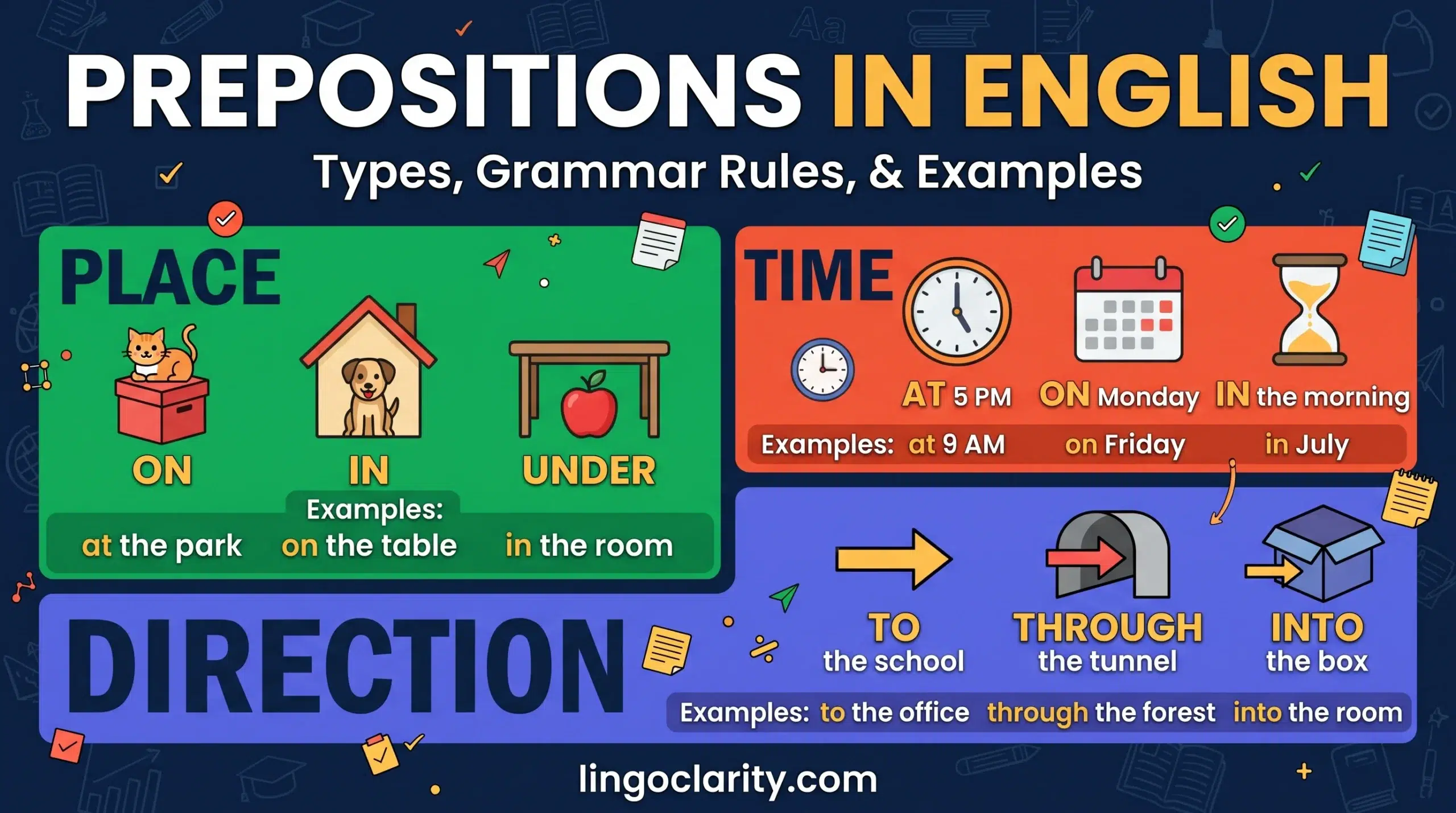
Prepositions are an important part of English grammar. They show relationships between people, places, objects, actions, and ideas. They help explain where something is located, when an event happens, how someone moves, and how different parts of a sentence are connected.
Consider these examples:
- The book is on the table.
- She arrived at the university in the morning.
- The students walked through the corridor.
The words on, at, in, and through are prepositions. Although they are usually short, choosing the correct preposition can be challenging. Some have several meanings, while others appear in fixed combinations with verbs, adjectives, and nouns.
This guide explains preposition types, grammatical functions, common comparisons, usage rules, and mistakes with practical examples and exercises.
1. What Is a Preposition?
A preposition is a word that shows the relationship between a noun, pronoun, or another expression and the rest of a sentence. It is usually followed by a complement, such as a noun phrase, pronoun, or gerund.
The complement is commonly called the object of the preposition.
Examples:
- The keys are on the table.
- She arrived after lunch.
- He is interested in science.
- They traveled by train.
- She is good at swimming.
In these examples, table, lunch, science, train, and swimming are the objects or complements of the prepositions.
A preposition and its complement form a prepositional phrase. This phrase adds information about location, time, direction, manner, and other relationships.
Types of Prepositions
Prepositions of Place and Position
Prepositions of place describe the location or position of a person, animal, or object. They explain where something is in relation to another thing. Common examples include in, on, at, under, above, below, behind, beside, and between.
Examples:
- The students are in the classroom.
- The laptop is on the desk.
- She is waiting at the entrance.
- The cat is under the chair.
- The library is between two buildings.
Some position-related prepositions have similar meanings but different uses.
- Above vs. Over: Above generally indicates a higher position, while over can suggest a position directly higher than something or movement across it.
- Below vs. Under: Below often describes a lower level or measurement, while under commonly describes something directly beneath another object.
- Beside vs. Besides: Beside means next to, while besides means in addition to.
Examples:
- The clock is above the door.
- A bridge extends over the river.
- The shoes are under the bed.
- She sat beside her friend.
- Besides English, he studies Arabic.
Prepositions of Time
Prepositions of time indicate when an event happens or how long it continues. The most common are at, on, and in.
At is used for specific times:
- The class begins at 9:00 a.m.
- She arrived at midnight.
On is used for days and dates:
- The examination is on Monday.
- His birthday is on March 15.
In is used for months, years, seasons, and longer periods:
- She was born in July.
- The university opened in 1995.
- Many students take examinations in winter.
Other useful prepositions include:
- Before: We will meet before lunch.
- After: She arrived after the lecture.
- Since: He has worked here since 2022.
- For: They stayed there for two weeks.
- During: She read a book during the journey.
- By: Finish the assignment by Friday.
- Until: The library will remain open until Friday.
2.3 Prepositions of Direction and Movement
These prepositions show where someone or something is going or how it moves. Common examples include to, into, onto, towards, through, across, and along.
Examples:
- She is going to the university.
- The children ran into the garden.
- He climbed onto the platform.
- We walked through the tunnel.
- They traveled across the river.
- The students walked along the road.
Important distinctions include:
- In vs. Into: In indicates a position, while into shows movement from outside to inside.
- On vs. Onto: On indicates a position on a surface, while onto usually describes movement to that surface.
- Across vs. Through: Across describes movement from one side to another, while through describes movement inside or within something.
- To vs. Towards: To generally indicates a destination, while towards indicates a direction without necessarily reaching it.
Examples:
- She is in the room. / She walked into the room.
- The book is on the table. / He placed it onto the table.
- They walked across the field. / We drove through the tunnel.
Prepositions of Manner and Means
These prepositions explain how an action is performed or which method is used.
Examples:
- She traveled by bus.
- The message was sent by email.
- He wrote the report with a pen.
- They completed the assignment with care.
- The problem was solved through teamwork.
Generally, by identifies a method or means, while with often identifies a tool or instrument.
Prepositions of Agent and Instrument
In passive sentences, by identifies the person or agent responsible for an action. With can introduce the instrument used to perform it.
Examples:
- The novel was written by a famous author.
- The report was prepared by the research team.
- The door was opened with a key.
- The cake was cut with a knife.
The agent performs the action, while the instrument helps perform it.
Prepositions of Cause, Reason, and Purpose
These prepositions and expressions explain why something happens or what causes a particular result.
Common examples include because of, due to, owing to, and for.
Examples:
- The match was canceled because of heavy rain.
- He was absent due to illness.
- The road was closed owing to an accident.
- She received an award for her research.
- They saved money for their education.
Prepositions of Source
Prepositions of source identify where something originates or comes from. Common examples include from, out of, and of.
Examples:
- She received a letter from her friend.
- This information comes from a reliable source.
- He took a book out of his bag.
- The company imports products from Japan.
Simple, Compound, and Multiword Prepositions
Prepositions can also be classified according to their structure.
Simple Prepositions
Simple prepositions consist of one word.
Examples include in, on, at, by, for, from, with, under, and over.
- The children are in the garden.
- She traveled by train.
- He waited for his friend.
Compound Prepositions
Compound prepositions include forms such as inside, outside, within, without, underneath, and throughout.
- The students waited outside the classroom.
- Submit the documents within three days.
- She worked throughout the night.
Multiword Prepositions
These expressions consist of two or more words and function as prepositions.
Examples include because of, in front of, next to, according to, in addition to, and in spite of.
- The car is parked in front of the building.
- She sat next to her friend.
- According to the report, sales increased.
Prepositional Phrases and Their Functions
A prepositional phrase consists of a preposition and its complement, including any words that describe the complement.
Examples:
- The students completed their assignments in the large classroom.
- The meeting was held after the final examination.
- She placed the documents on the manager’s desk.
Prepositional phrases commonly perform two functions.
As adjectives: They describe nouns or pronouns.
- The book on the table belongs to me.
- The students in the classroom are preparing for an examination.
As adverbs: They provide information about an action, such as where, when, or how it happens.
- She works in the library.
- We will meet after lunch.
- He traveled by train.
Object of a Preposition
The object of a preposition is the noun, pronoun, or gerund that completes its meaning.
Examples:
- She sat beside her brother.
- The keys are under the pillow.
- He is interested in learning.
- We talked about the project.
When a pronoun follows a preposition, an object pronoun is normally required.
- Correct: This gift is for him.
- Incorrect: This gift is for he.
Gerunds can also function as objects of prepositions:
- She is interested in reading.
- He left without saying goodbye.
- They succeeded by working together.
Preposition vs. Adverb
Prepositions and adverbs can sometimes look identical, but they perform different grammatical functions.
A preposition introduces a complement, while an adverb can modify a verb without introducing an object.
| Preposition | Adverb |
|---|---|
| She went inside the house. | She went inside. |
| They played outside the school. | They played outside. |
| He walked around the building. | He looked around. |
| The cat jumped over the fence. | The game is over. |
In the first column, the words introduce complements. In the second, they function as adverbs without an object.
Preposition vs. Conjunction
A preposition introduces a complement, while a conjunction connects words, phrases, or clauses.
Some words, including before, after, and since, can perform either function.
| Preposition | Conjunction |
|---|---|
| We left after lunch. | We left after the meeting ended. |
| She has worked here since 2022. | She has worked here since she graduated. |
| He arrived before sunset. | He arrived before the sun set. |
A noun phrase follows the preposition, while a clause containing a subject and verb follows the conjunction.
Commonly Confused Prepositions
Some prepositions have similar meanings or are used in different situations.
| Prepositions | Difference | Example |
|---|---|---|
| Since / For | Starting point / Duration | Since 2022 / For three years |
| Between / Among | Separate individuals / Group | Between two countries / Among students |
| By / Until | Deadline / Continuing up to a time | By Friday / Until Friday |
| During / For | Within an event or period / Length of time | During class / For two hours |
| In time / On time | Early enough / At the scheduled time | In time to catch a train / On time for class |
| Beside / Besides | Next to / In addition to | Beside me / Besides English |
| Across / Through | From one side to another / Inside something | Across a bridge / Through a tunnel |
Understanding these differences helps learners choose appropriate prepositions in everyday communication.
Prepositions After Adjectives, Verbs, and Nouns
Some adjectives, verbs, and nouns are commonly followed by particular prepositions. These combinations are often fixed and should be learned as complete expressions.
Prepositions Following Adjectives
- Interested in research.
- Good at mathematics.
- Responsible for the project.
- Proud of my students.
- Satisfied with the results.
- Afraid of spiders.
After Verbs
- Depend on someone.
- Apply for a scholarship.
- Listen to music.
- Participate in a competition.
- Apologize for a mistake.
- Believe in hard work.
After Nouns
- A need for communication.
- Experience in teaching.
- A reason for the delay.
- Interest in linguistics.
- A solution to the problem.
- Confidence in the team.
Prepositions in Questions, Relative Clauses, and at the End of Sentences
Prepositions can appear at the end of questions and relative clauses or before question words and relative pronouns.
In questions:
- Who are you talking to?
- What are you looking for?
- To whom are you speaking?
The first two examples are natural in everyday English. The third is more formal.
In relative clauses:
- This is the person who I spoke to.
- This is the person to whom I spoke.
- The company that she works for is expanding.
- The company for which she works is expanding.
Both positions can be correct. Placing a preposition before a relative pronoun generally creates a more formal structure.
Ending a sentence with a preposition is not grammatically incorrect in modern English.
- This is the book I was looking for.
- Which university did she graduate from?
However, avoid unnecessary prepositions. For example:
Incorrect: We discussed about the problem.
Correct: We discussed the problem.
Common Mistakes in Using Prepositions
Preposition errors often happen because learners translate expressions directly from another language or confuse fixed grammatical combinations.
| Incorrect sentence | Correct sentence |
|---|---|
| She is interested on science. | She is interested in science. |
| We discussed about the problem. | We discussed the problem. |
| I have lived here since five years. | I have lived here for five years. |
| She is good in mathematics. | She is good at mathematics. |
| This gift is for she. | This gift is for her. |
| They arrived to the station. | They arrived at the station. |
| He depends of his parents. | He depends on his parents. |
| I slept during two hours. | I slept for two hours. |
To avoid these mistakes, learn common word combinations, review incorrect sentences, and practice using prepositions in context.
Practical Tips for Learning Prepositions
The following techniques can help improve preposition usage:
- Learn complete expressions: Memorize phrases such as interested in, good at, and depend on rather than individual words.
- Compare similar prepositions: Practice distinctions such as in vs. into and since vs. for.
- Read regularly: Notice prepositions in books, articles, and everyday English.
- Write your own examples: Create sentences using new prepositions and expressions.
- Review mistakes: Record incorrect and corrected sentences to recognize patterns.
- Practice speaking: Use prepositions in conversations, descriptions, and everyday writing.
Prepositions Practice Test
Test your knowledge of English prepositions. Choose the correct answer for each question. Total Marks: 20
Your Quiz Result
Conclusion
Prepositions are small but important words that connect ideas and show relationships between people, places, objects, and events. They express location, time, direction, movement, manner, cause, and purpose. They also form useful combinations with adjectives, verbs, and nouns.
To use prepositions correctly, learners should understand their main functions, recognise common word combinations, and practise important distinctions such as in, on, and at, or since and for. Reading regularly and learning prepositions in complete expressions can also improve accuracy.
The goal is not to memorise every possible combination at once. It is to understand how prepositions work in real sentences and use them naturally in speaking and writing.
