
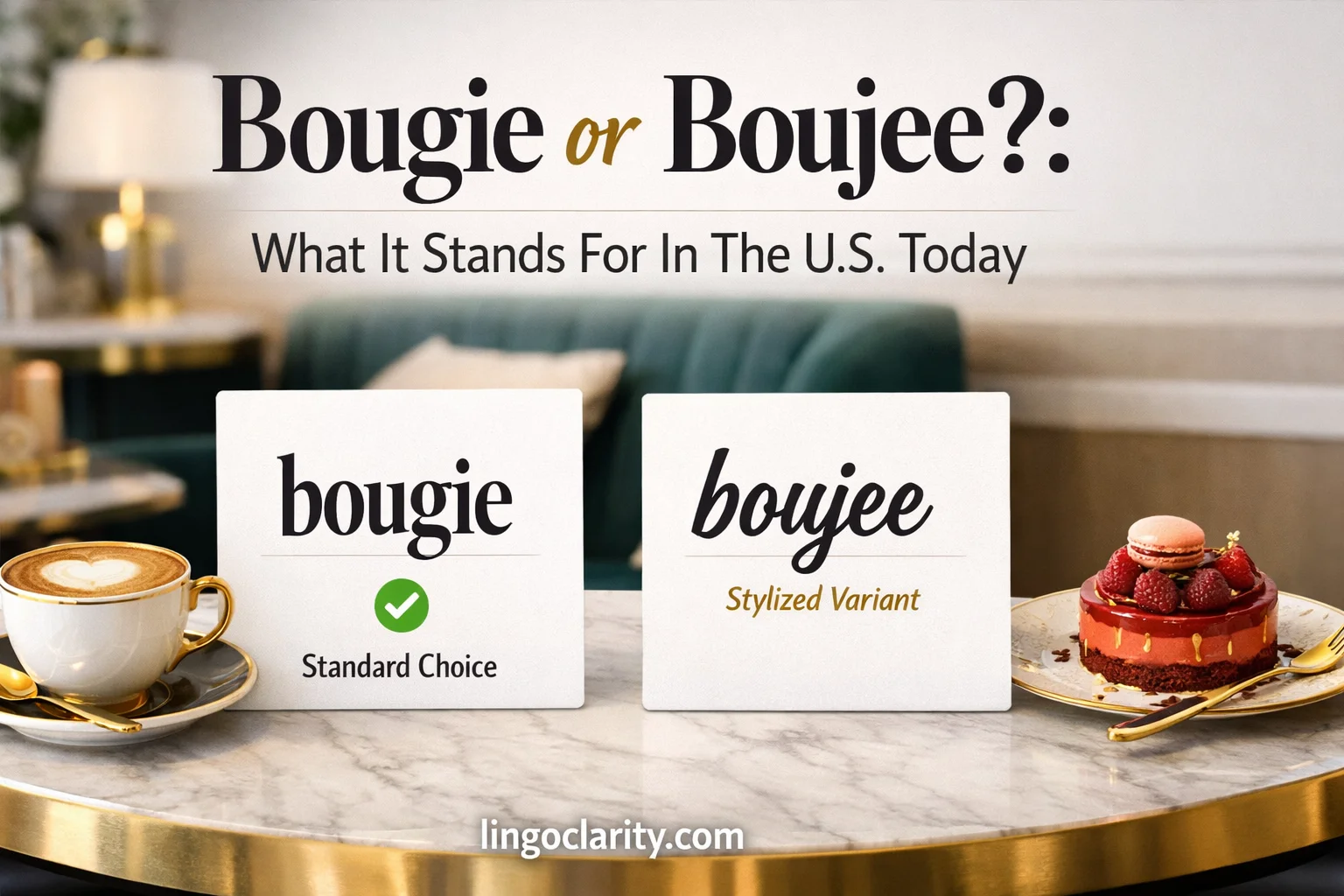
If you have seen bougie and boujee online, in captions, in comments, or in song lyrics, you are not alone in wondering which spelling is actually correct. At first glance, they look like two versions of the same slang word. In everyday use, they usually are. Still, they do not land the same way on the page.
The clearest answer is this: bougie is the safer default spelling in US English. Major dictionary sources list bougie as the main form, while boujee is treated as an alternate spelling or a slang-styled variant. Merriam-Webster lists boujee as a less common variant under bougie, and Dictionary.com notes that bougie is the most common spelling.
That does not mean boujee is fake. It is real, recognizable, and widely used in very casual writing. But it usually looks more playful, more pop-culture shaped, and more voice-driven. So if your goal is clarity, consistency, and broad reader trust, bougie is usually the better pick.
Quick Answer
Choose bougie for most US writing.
Use boujee only when you want a more stylized, slang-heavy, or pop-culture tone.
Simple Definition
Bougie is an informal slang word that describes someone or something as fancy, upscale, status-conscious, or a little too concerned with wealth, taste, or appearances. Major dictionaries also note that the word can be teasing or critical, not always flattering.
Boujee usually points to the same general idea, but it more often feels like a stylized spelling used for mood, attitude, or cultural flavor. Merriam-Webster’s slang entry defines boujee as “fancy, swanky, associated with wealth or indulgence” and explicitly says it is also spelled bougie.
Why People Confuse Them
People mix up these spellings for a few very understandable reasons.
First, the word comes from bourgeois and bourgeoisie, which are not easy spellings for many English speakers. Second, the pronunciation does not point neatly to one obvious spelling. Merriam-Webster gives bougie as the headword and shows boujee as a less common variant, while Dictionary.com notes that writers also produce other alternate spellings by sound.
Third, music and internet culture helped push boujee into wider public view. Merriam-Webster’s slang note says boujee is an alternate spelling of bougie and ties its popularity to Migos’ “Bad and Boujee,” which helped spread the word more broadly.
So the confusion is real, but the writing decision is still simple: when in doubt, write bougie.
Key Differences At A Glance
| Context | Best Choice | Why |
|---|---|---|
| General US writing | bougie | Safest and most standard-looking choice |
| Blog posts and articles | bougie | Better dictionary support as the main entry |
| School or workplace writing | bougie | Less distracting for broad audiences |
| Casual captions | bougie or boujee | Both can work, depending on voice |
| Pop-culture tone | boujee | Feels more stylized and playful |
| Older noun meaning like candle or medical instrument | bougie | Standard spelling for those unrelated senses |
Are They The Same Word?
Most of the time, yes. In modern US slang, bougie and boujee usually overlap. Both can describe a person, outfit, brunch spot, apartment, routine, or mood that feels expensive, polished, or a little extra.
Still, there is a nuance worth mentioning. Some slang-focused references draw a distinction between the two. Dictionary.com’s slang entry says boujee can carry a more specific hip-hop or Black slang shade tied to luxury without losing touch with one’s roots, while bougie can lean more toward “pretentious” or “middle-class status-conscious.” Merriam-Webster’s slang entry also notes that boujee may be positive or negative depending on context. That said, major dictionary treatment still shows heavy overlap rather than a strict rule.
That is why you should not force a hard difference that many readers will not recognize. In practical writing, the safer editorial move is to treat them as near-equivalent spellings with different tone effects.
Which Spelling Is Correct In US English?
If your question is, “Which spelling should I trust in normal US English?” the answer is bougie.
Merriam-Webster uses bougie as the main entry and labels boujee as less common. Dictionary.com says bougie is the most common spelling. Cambridge also includes bougie as a US informal word. Taken together, that is strong support for bougie as the better default in edited US writing.
So while both forms are seen in real life, bougie is the one that looks more standard, more defensible, and less likely to distract readers.
Is This A US Vs UK Difference?
No. This is not a pair like color/colour or organize/organise.
The available dictionary evidence does not present boujee as the standard British version of bougie. Instead, the pattern is much simpler: bougie is the main form, and boujee is an alternate informal spelling. Cambridge labels bougie as a US informal word, which supports the idea that the distinction is about slang style, not a clean US-versus-UK spelling split.
When To Use Bougie
Use bougie when you want your writing to feel clear, polished, and broadly readable.
That includes:
- articles
- blog posts
- newsletters
- school writing
- workplace writing
- brand copy
- product descriptions
- general social posts where you want the safest spelling
Examples:
- Their kitchen looks bougie, but they bought half the decor on clearance.
- He ordered the bougie version of iced coffee with lavender syrup and cold foam.
- The hotel lobby felt bougie without feeling cold or unfriendly.
In each example, bougie sounds natural and easy to trust.
When To Use Boujee
Use boujee only when voice matters more than standard form.
It can fit:
- playful captions
- quoted speech
- lyric references
- culture-heavy social content
- brand language that intentionally leans trendy
- writing that wants a flashy, highly casual tone
Examples:
- She planned a boujee birthday dinner with candles, velvet booths, and tiny desserts.
- We stayed in and still managed a boujee movie night.
- That reel is so boujee, and it knows it.
Here, boujee works because the voice is doing extra work. The spelling becomes part of the mood.
Real-Life Example
Imagine two editors working on the same sentence:
The rooftop event had a very bougie/boujee vibe.
Editor one is writing a magazine-style article for a general audience. They choose bougie because it reads more cleanly and has stronger dictionary backing.
Editor two is writing an Instagram caption for a fashion brand. They choose boujee because the word itself helps create a playful, trend-aware voice.
Both writers may be understood. But only one spelling is the safer all-purpose choice. That is bougie.
Why Bougie Is Usually The Safer Choice
A good spelling choice does not just reflect what exists. It reflects what works best for the reader.
Bougie is safer because it:
- has stronger mainstream dictionary support
- looks less like a phonetic or invented spelling
- fits more situations without calling attention to itself
- works in both playful and semi-formal writing
- avoids making readers wonder whether the spelling was accidental
That last point matters. A word can be real and still look too casual for certain contexts. That is exactly what happens with boujee. It is valid, but it signals attitude more strongly than bougie does.
Tone, Meaning, And Social Context
This word can be funny, playful, approving, teasing, or insulting depending on who says it and how they say it. Dictionary.com notes that bougie can be disparaging and that the slang term originated in the African American community before broadening into more general use. Merriam-Webster’s slang page similarly explains that boujee grew out of African American English and that the term can be either complimentary or critical depending on context.
That means tone matters.
Compare these:
- Her place is bougie in the best way.
- He acts bougie every time the bill arrives.
- They threw a boujee girls’ night and leaned all the way into the theme.
Same word family. Very different feeling.
So when you use either spelling, pay attention to audience, tone, and context.
Pronunciation
Most readers say these words in a way that sounds close to BOO-zhee or BOO-jee, which helps explain why multiple spellings keep appearing. Dictionary.com shows pronunciations that support both sound patterns, and Merriam-Webster lists bougie with boujee as a less common written variant.
In other words, pronunciation does not settle the spelling question. Usage does.
Word History
The modern slang form is connected to bourgeois. Merriam-Webster traces the adjective bougie to bourge(ois) + -y and dates the adjective sense to 1968. The same entry also shows that bougie has an older, unrelated noun history meaning a wax candle or a medical instrument, with much earlier use. Merriam-Webster’s slang note on boujee says it is an alternate spelling of bougie and explains that its modern spread was boosted by pop culture.
That older noun history matters because it explains one easy mistake: people sometimes assume every use of bougie is slang. It is not. The spelling also exists in older standard noun senses unrelated to modern slang.
Synonyms
The best synonym depends on the tone you want.
Possible synonyms for bougie or boujee include:
- fancy
- upscale
- swanky
- luxe
- posh
- flashy
- pretentious
- high-end
- polished
Use fancy or upscale when you want a neutral tone.
Choose pretentious for a more critical meaning.
To keep the tone playful, try swanky or luxe.
ne.
Opposites
True opposites depend on context, but these often work:
- simple
- plain
- modest
- down-to-earth
- unpretentious
- low-key
- basic
Examples:
- The restaurant looks bougie, but the menu is simple and affordable.
- Her style is not bougie at all. It is more low-key and practical.
Sentence Usage
Here are clean sentence models you can use right away:
Bougie As An Adjective
- That café is small, but the pastries feel surprisingly bougie.
- He bought a bougie candle that cost more than dinner.
- Their wedding was elegant without becoming too bougie.
Boujee As An Adjective
- She posted a boujee brunch photo with gold flatware and pink lattes.
- We made the apartment look boujee on a budget.
- That caption is extra boujee, but it fits the vibe.
Bougie As A Noun
- He jokes that he became a bougie after switching to artisanal bread and sparkling water.
That noun use appears in dictionary coverage, but it is far less common than the adjective use.
Common Mistakes
1. Treating Bougie And Boujee As Totally Different Words
This is too strong. They often overlap. Some users hear a nuance, but most readers still understand them as close variants.
2. Assuming Boujee Is The Modern Correct Form
It is modern and common in casual spaces, but it is not the safest standard spelling. Bougie still has stronger dictionary support.
3. Using Boujee In Formal Or Edited Writing Without A Reason
This can make the spelling look accidental or overly trendy. Unless you want that effect, choose bougie.
4. Confusing Bougie With Boogie
These are completely different words. Dictionary.com explicitly warns that boogie is a different word altogether.
5. Ignoring Tone
Both forms can sound playful or insulting depending on context. Do not assume the word is always flattering.
How To Remember The Difference
Use this quick memory rule:
Bougie = better default
Boujee = extra style
That is not a dictionary definition, but it is a very useful writing shortcut.
Phrases You May See
Common modern phrases include:
- bougie brunch
- bougie coffee
- bougie taste
- bougie on a budget
- boujee vibe
- boujee dinner
- boujee weekend
- bad and boujee
The last phrase is especially recognizable because of pop culture and music visibility.
FAQs
Is boujee wrong?
No. Boujee is not wrong. It is a real alternate spelling used in modern slang. But bougie is usually the safer and more standard-looking choice for broad US writing.
Is bougie more formal than boujee?
Neither word is truly formal. Both are informal slang. Still, bougie looks more standard and is easier to use in edited writing without distracting the reader.
Do bougie and boujee always mean the same thing?
Not always in every community or context, but they overlap heavily. Some users hear a subtle difference in tone, especially around pop culture and self-made luxury. In general writing, though, they are close enough that spelling choice is mostly about voice.
Which spelling should I use in an article or blog post?
Use bougie. It is the clearer editorial choice.
Can bougie be an insult?
Yes. It can be teasing, critical, or dismissive depending on context. Some dictionary sources explicitly label it as often or usually disparaging.
Is boujee only used because of the song?
No, but the song helped popularize the spelling for a much wider audience. Merriam-Webster’s slang note directly connects the spread of boujee to Migos’ “Bad and Boujee.”
Conclusion
If you need one spelling to trust, choose bougie.
It is the stronger default in US English, the clearer option for general readers, and the form with the best mainstream dictionary support. Boujee is still real, recognizable, and useful, but it works best when you want a more stylized, more playful, or more pop-culture-driven voice.
So the final rule is simple:
For most writing, go with bougie.
For extra attitude, you can reach for boujee.
