
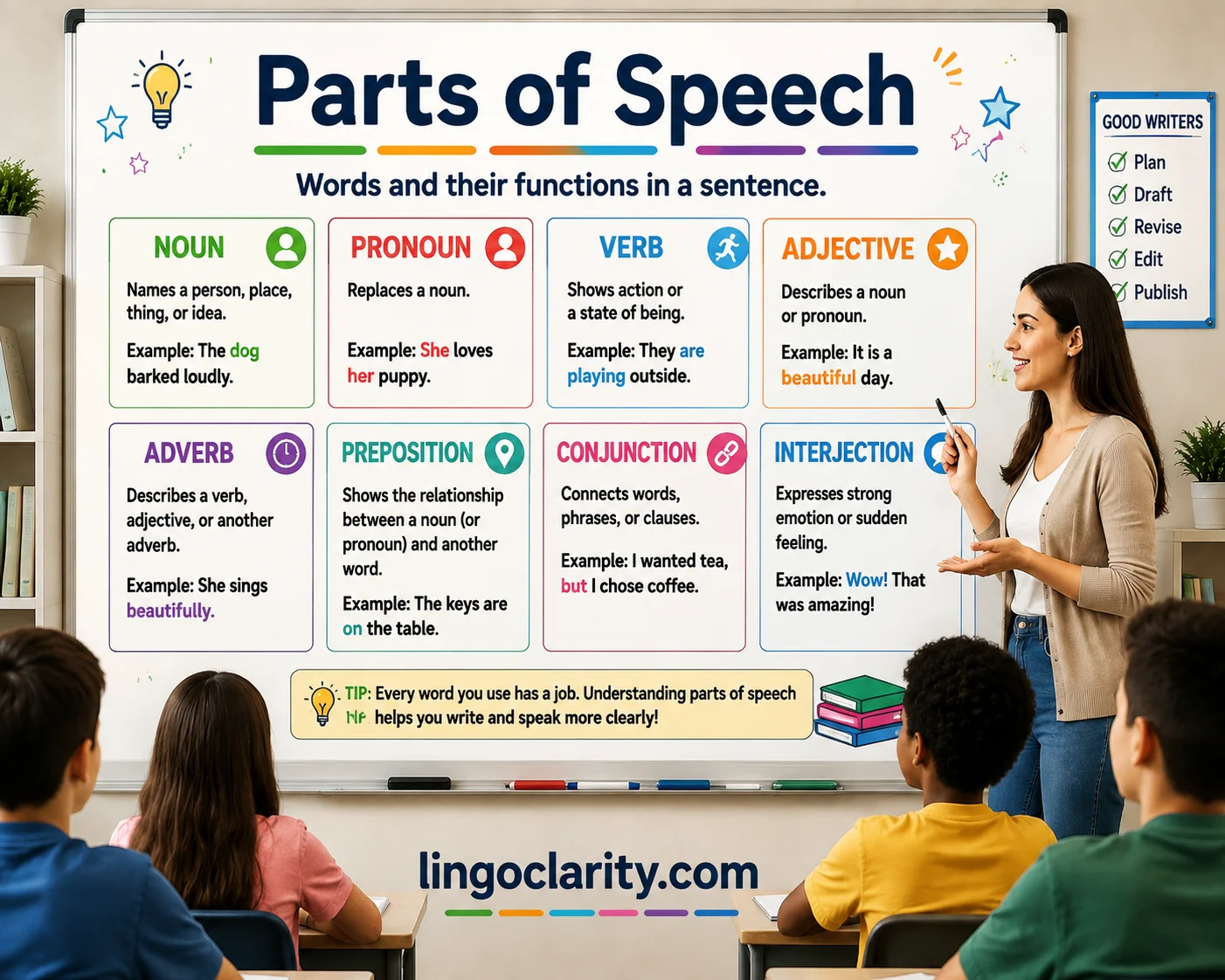
Parts of speech are the building blocks of English grammar. They explain how words function in a sentence and help readers understand how ideas are organized. Every word in a sentence has a role, whether it names something, shows an action, describes a detail, connects ideas, or expresses emotion.
In traditional English grammar, there are eight main parts of speech: nouns, pronouns, verbs, adjectives, adverbs, prepositions, conjunctions, and interjections. Modern grammar resources may also include determiners as a separate category because words like a, an, and the have a specific grammatical function.
Learning parts of speech is important because it improves writing, reading comprehension, and sentence accuracy. Instead of memorizing random grammar rules, understanding word functions helps you recognize why sentences work the way they do.
For example, the word “light” can have different roles depending on the sentence:
- The light is bright. → Noun
- Please light the candle. → Verb
- This bag is light. → Adjective
The spelling stays the same, but the grammatical function changes.
Quick Answer
Parts of speech are categories that describe the job a word performs in a sentence. The eight traditional parts of speech are nouns, pronouns, verbs, adjectives, adverbs, prepositions, conjunctions, and interjections.
A word’s part of speech depends on how it is used. For example, “run” is a verb in “I run every morning,” but it is a noun in “That was a long run.”
What Are The Eight Parts Of Speech?
The eight parts of speech explain the different roles words play in English sentences.
| Part Of Speech | Function | Examples |
|---|---|---|
| Noun | Names a person, place, thing, or idea | teacher, city, happiness |
| Pronoun | Replaces a noun | he, she, they, it |
| Verb | Shows action or state | run, think, become |
| Adjective | Describes a noun or pronoun | beautiful, large, smart |
| Adverb | Modifies a verb, adjective, or adverb | quickly, very, often |
| Preposition | Shows relationships between words | in, on, under |
| Conjunction | Connects words or ideas | and, but, because |
| Interjection | Expresses emotion or reaction | wow, hey, oh |
Each category has a different purpose, but together they create complete and meaningful sentences.
Nouns: Words That Name People, Places, Things, And Ideas
A noun is a word that identifies a person, place, object, animal, or idea. Nouns are often the subject of a sentence, but they can also act as objects.
Types Of Nouns
Common Nouns
Common nouns refer to general people, places, or things.
Examples:
- teacher
- restaurant
- phone
- mountain
Sentence:
The teacher explained the lesson.
Proper Nouns
Proper nouns name specific people, places, organizations, or brands and usually begin with a capital letter.
Examples:
- Sarah
- California
- Monday
Sentence:
Sarah moved to Texas.
Abstract Nouns
Abstract nouns describe ideas, feelings, or qualities that cannot be physically touched.
Examples:
- love
- honesty
- freedom
- knowledge
Sentence:
Honesty builds trust.
Collective Nouns
Collective nouns describe groups.
Examples:
- team
- family
- audience
- class
Sentence:
The team won the championship.
Pronouns: Words That Replace Nouns
A pronoun replaces a noun to avoid repetition. Instead of repeating the same name or object, pronouns make sentences smoother.
Example:
Without pronoun:
Maria told Maria’s friend that Maria was leaving.
With pronouns:
Maria told her friend that she was leaving.
Common Types Of Pronouns
Personal Pronouns
Examples:
- I
- you
- he
- she
- it
- we
- they
Sentence:
They are studying grammar.
Possessive Pronouns
These show ownership.
Examples:
- mine
- yours
- his
- hers
- ours
- theirs
Sentence:
This book is mine.
Reflexive Pronouns
These refer back to the subject.
Examples:
- myself
- yourself
- himself
- themselves
Sentence:
She taught herself Spanish.
Verbs: Words That Show Actions Or States
A verb expresses an action, event, or condition. Every complete sentence usually needs a verb.
Examples:
- run
- write
- learn
- become
- seem
Sentence:
They learn English grammar.
Types Of Verbs
Action Verbs
Action verbs show physical or mental activities.
Examples:
- jump
- write
- think
- create
Sentence:
He writes every day.
Linking Verbs
Linking verbs connect the subject with information about it.
Examples:
- is
- are
- seem
- become
Sentence:
The soup is hot.
Helping Verbs
Helping verbs work with main verbs to show tense, possibility, or meaning.
Examples:
- can
- have
- will
- should
Sentence:
She can speak French.
Adjectives: Words That Describe Nouns
An adjective provides information about a noun or pronoun. It can describe size, color, quality, number, or condition.
Examples:
- small
- blue
- intelligent
- three
Sentence:
She bought a new laptop.
Common Types Of Adjectives
Descriptive Adjectives
Describe qualities.
Examples:
- beautiful
- difficult
- friendly
Sentence:
He lives in a quiet neighborhood.
Comparative Adjectives
Compare two things.
Examples:
- faster
- smaller
- better
Sentence:
This car is faster than mine.
Superlative Adjectives
Compare three or more things.
Examples:
- fastest
- smallest
- best
Sentence:
She is the best student in the class.
Adverbs: Words That Modify Actions And Descriptions
An adverb gives more information about a verb, adjective, or another adverb.
Adverbs often answer questions like:
- How?
- When?
- Where?
- How often?
- How much?
Examples:
- quickly
- yesterday
- very
- always
Sentence:
He completed the work quickly.
Types Of Adverbs
Adverbs Of Manner
Explain how something happens.
Example:
She spoke quietly.
Adverbs Of Time
Show when something happens.
Example:
We arrived yesterday.
Adverbs Of Frequency
Show how often something happens.
Examples:
- always
- often
- never
Sentence:
I always drink coffee in the morning.
Prepositions: Words That Show Relationships
A preposition connects a noun or pronoun to another word by showing relationships involving location, time, direction, or position.
Common prepositions include:
- in
- on
- at
- under
- between
- beside
Examples:
The keys are on the table.
She arrived at noon.
Conjunctions: Words That Connect Ideas
A conjunction joins words, phrases, or clauses together.
Types Of Conjunctions
Coordinating Conjunctions
Connect equal ideas.
Examples:
- and
- but
- or
- so
Sentence:
I wanted tea, but I chose coffee.
Subordinating Conjunctions
Connect dependent and independent clauses.
Examples:
- because
- although
- while
Sentence:
I stayed home because it was raining.
Interjections: Words That Express Emotion
An interjection shows sudden feelings, reactions, or emotions.
Examples:
- wow
- oh
- hey
- congratulations
Sentences:
Wow! That painting is amazing.
Oops! I dropped my phone.
Interjections are common in conversations and informal writing.
How To Identify Parts Of Speech In A Sentence
The easiest way to identify a part of speech is to look at the word’s function.
Ask these questions:
1. Is The Word Naming Something?
If yes, it is probably a noun.
Example:
The dog barked.
Dog = noun
2. Is The Word Showing An Action Or Condition?
If yes, it is probably a verb.
Example:
The dog barked.
Barked = verb
3. Is The Word Describing Something?
It may be an adjective or adverb.
Example:
The happy dog ran quickly.
Happy = adjective
Quickly = adverb
4. Is The Word Connecting Ideas?
It may be a conjunction.
Example:
I called him because I needed help.
Because = conjunction
Common Parts Of Speech Mistakes
Mistake 1: Assuming A Word Always Has One Category
A word can change its part of speech depending on context.
Example:
I need a drink. → Noun
I will drink water. → Verb
Mistake 2: Confusing Adjectives And Adverbs
Incorrect:
She sings beautiful.
Correct:
She sings beautifully.
“Beautifully” describes the action of singing, so it is an adverb.
Mistake 3: Identifying Words By Their Endings Only
Many adverbs end in -ly, but not every word ending in -ly is an adverb.
Example:
Friendly
“Friendly” is an adjective, not an adverb.
Traditional Grammar Vs Modern Grammar Categories
Traditional grammar usually teaches eight parts of speech.
However, many modern grammar systems separate determiners as their own category.
Determiners include:
- a
- an
- the
- this
- those
- some
- many
Example:
The book is interesting.
“The” tells us which book we mean, so many modern grammarians classify it as a determiner.
Why Are Parts Of Speech Important?
Understanding parts of speech helps you:
- write clearer sentences
- avoid grammar mistakes
- improve vocabulary
- understand sentence structure
- communicate ideas more effectively
Writers, students, teachers, and language learners use parts of speech to analyze and improve English.
FAQ
The eight traditional parts of speech are nouns, pronouns, verbs, adjectives, adverbs, prepositions, conjunctions, and interjections. Each category describes a different job a word performs in a sentence.
Yes. Many English words can function as different parts of speech depending on how they are used. For example, “email” can be a noun in “I sent an email” and a verb in “I will email you.”
Grammar systems differ. Traditional grammar often includes articles with adjectives, while modern grammar commonly treats articles such as “a,” “an,” and “the” as determiners.
Start by learning the basic question each category answers. Nouns name things, verbs show actions, adjectives describe nouns, adverbs describe actions, and conjunctions connect ideas.
Parts of speech help writers create correct sentence structures and choose words accurately. They are the foundation of clear communication.
Look at the word’s role in the sentence. Do not focus only on spelling. A word’s function determines whether it acts as a noun, verb, adjective, or another category.
Conclusion
Parts of speech are the foundation of English grammar because they explain how words work together to create meaningful sentences. The traditional system includes eight categories: nouns, pronouns, verbs, adjectives, adverbs, prepositions, conjunctions, and interjections.
The most important rule is simple: a word’s function in a sentence determines its part of speech. Once you understand how each category works, grammar becomes easier to recognize, learn, and apply in everyday writing and communication.

1 thought on “Parts Of Speech Explained: Complete Grammar Rules, Types, And Examples”
Comments are closed.