
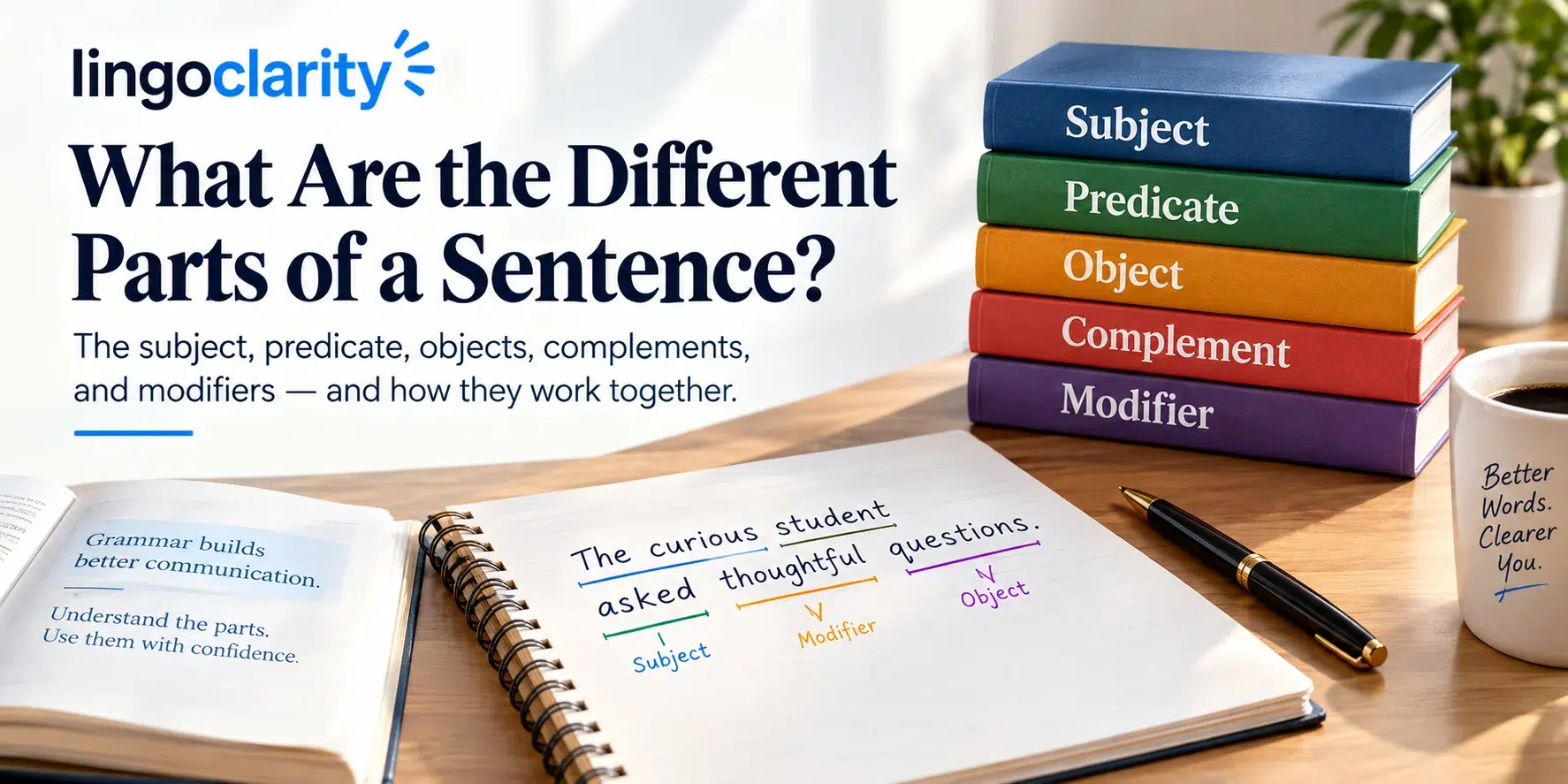
Quick answer: The different parts of a sentence are the subject, the predicate, objects, complements, and modifiers. Only the subject and predicate are required, so everything else just adds detail. Longer sentences use the same five parts, grouped into phrases and clauses.
If you searched for the different parts of a sentence, you probably landed on a page listing nouns and verbs instead. Those are parts of speech, which is a separate system. This page covers the parts of a sentence, in other words the jobs words do once they’re arranged into a statement.
What Are the Different Parts of a Sentence in English Grammar?
Traditional English grammar sorts sentence parts by function. That is, by what each piece is doing rather than what kind of word it is.
| Part | Its job | Example (part in bold) |
|---|---|---|
| Subject | Names who or what the sentence is about | The dog barked. |
| Predicate | Says what the subject does or is | The dog barked all night. |
| Object | Receives the action of the verb | Maya emailed the landlord. |
| Complement | Renames or describes the subject or object | My sister is a paramedic. |
| Modifier | Adds detail to another part | Two tired hikers arrived late. |
Subject
The subject is the noun, pronoun, or noun phrase the sentence is built around. So ask who or what is doing the verb, and you have it.
A subject can be simple (one noun: Rain fell), compound (two or more joined: Rain and hail fell), or complete (the noun plus its modifiers: A cold October rain fell).
In commands, though, the subject is understood rather than written. For example, Close the door has an implied you.
Predicate
Everything that isn’t the subject belongs to the predicate. At its center sits the verb, which is why some grammar books call this part the verb phrase. Merriam-Webster’s entry for predicate gives both the grammar sense and the everyday one.
- Simple predicate: the verb alone — She laughed.
- Complete predicate: the verb plus objects, complements, and modifiers — She laughed at the sign for a full minute.
- Compound predicate: two verbs sharing one subject — She read the menu and ordered.
Objects
Verbs that pass action along take objects. There are two kinds, and the order matters.
- Direct object — receives the action. Devon threw the ball.
- Indirect object — receives the direct object. Devon threw his brother the ball.
Here’s a quick test. First, find the verb, then ask what? The answer is your direct object. Next, ask to whom or for whom, and you’ve found the indirect object. Linking verbs like be, seem, and become, however, take no object at all.
Complements
A complement completes the meaning of a subject or object instead of receiving action.
- Subject complement, after a linking verb: The soup tasted salty. (adjective) / Her father was a machinist. (noun)
- Object complement, which renames or describes the direct object: The committee named her chair.
If the term keeps sliding around on you, the Merriam-Webster entry for complement is worth a look.
Modifiers
Modifiers are the optional layer. Single words do most of the work, especially adjectives modifying nouns and adverbs modifying verbs. Still, phrases and clauses modify too.
The barista in the green apron remade my drink without being asked.
Now strip both modifiers, and the sentence still stands: The barista remade my drink. That’s the test for a modifier.
Parts of a Sentence vs. Parts of Speech: What’s the Difference?
This is the mix-up that sends most people searching twice, because the two systems describe the same words from different angles.
| Parts of a sentence | Parts of speech | |
|---|---|---|
| What it labels | The job a word or group does | The category a word belongs to |
| How many | 5 main functions | 8 or 9, depending on the source |
| The list | Subject, predicate, object, complement, modifier | Noun, pronoun, verb, adjective, adverb, preposition, conjunction, interjection (and determiners, in newer grammars) |
| Changes by sentence? | Yes — the same word shifts roles | Rarely — a noun stays a noun |
Watch one word do two jobs. In Frost damaged the crop, frost is a noun acting as the subject. By contrast, in The crop survived the frost, that same noun is now the direct object. Its part of speech didn’t change, yet its sentence role flipped. For the full word-category list, see our guide to the parts of speech.
Where Did the Subject-Predicate Model Come From?
Splitting a sentence into subject and predicate is an old idea. It’s usually traced back to Aristotle’s logic, and it reached English classrooms through the Latin grammar tradition.
The version most American readers were taught arrived much later. In 1877, Alonzo Reed and Brainerd Kellogg published Higher Lessons in English, which spread the branching sentence diagram, and as a result their subject-predicate split shaped US schoolbooks for a century. Today, linguists more often say “noun phrase” and “verb phrase” for the same divide. Even so, the functional labels above are still standard in style guides and classrooms, including the grammar section of the Purdue OWL.
What Are the Five Basic Sentence Patterns?
Nearly every English clause follows one of five patterns. Learn these, and sentence analysis gets much faster.
| Pattern | Structure | Example |
|---|---|---|
| 1 | Subject + Verb | The engine stalled. |
| 2 | Subject + Verb + Direct Object | Priya fixed the engine. |
| 3 | Subject + Verb + Indirect Object + Direct Object | Priya sold him the engine. |
| 4 | Subject + Verb + Subject Complement | The engine was ancient. |
| 5 | Subject + Verb + Direct Object + Object Complement | She called the engine a relic. |
Long sentences aren’t a sixth pattern. Instead, they’re the same parts of a sentence stacked. A phrase is a word group with no subject-verb pair (after the storm), while a clause has both. Independent clauses stand alone, but dependent clauses can’t, and joining them is how compound and complex sentences get built. Our breakdown of independent and dependent clauses covers that next step.
How Do You Identify the Parts of a Sentence?
Work in this order, and you’ll rarely misread a sentence:
- Find the verb first. It’s the anchor, since everything else is defined against it.
- Ask who or what is doing that verb. That’s your subject.
- Ask the verb “what?” An answer means you have a direct object. No answer usually points to a linking verb, so look for a complement instead.
- Ask “to whom or for whom?” If the answer sits before the direct object, then it’s the indirect object.
- Label what’s left as modifiers. Finally, delete each one and check that the sentence survives.
Try it on this: The inspector handed my neighbor a citation on Tuesday. Verb: handed. Subject: the inspector. Direct object: a citation. Indirect object: my neighbor. Modifier: on Tuesday. In short, that’s .
Common Mistakes People Make With Sentence Parts
Calling Nouns and Verbs “Parts of a Sentence”
They’re parts of speech. A noun can serve as a subject, an object, or a complement, so the label always depends on the sentence.
Assuming the Subject Always Comes First
It usually does, but not always. In There are three options, for instance, the real subject is three options, while there is only a placeholder. Similarly, in Down the hall walked the principal, the subject trails the verb.
Mistaking a Prepositional Phrase for the Subject
The box of screws was heavy takes was, not were, because the subject is box. Nothing inside a prepositional phrase can be the subject. Most style guides state that rule plainly, and our page on subject-verb agreement walks through the tricky cases.
Confusing an Object With a Complement
After a linking verb, the word that follows describes the subject rather than receiving action. He became a lawyer, therefore, has no object at all.
Treating Fragments as Full Sentences
Because the road flooded is a dependent clause. It has a subject and a predicate, yet it can’t stand alone. Fragments work fine in a text message or in dialogue, but they’re risky in a cover letter or a research paper. See sentence fragments and run-ons for the repair patterns.
Related Terms Worth Knowing
- Verb phrase — the linguist’s term for the complete predicate. Same ground, different label.
- Noun phrase — a noun plus its modifiers, which can fill the subject, object, or complement slot.
- Adjunct — close to “modifier,” but used when grammarians want to stress that cutting it leaves the sentence whole.
- Argument — a part the verb requires. Subjects and objects are arguments, while modifiers are not.
- Sentence diagram — the visual map of these parts, and still the fastest way to see structure at a glance.
Frequently Asked Questions
What are the 5 parts of a sentence?
The five parts are the subject, the predicate, objects, complements, and modifiers. The subject names what the sentence is about, and the predicate says something about it. Objects receive the verb’s action, complements rename or describe, and modifiers add optional detail.
What are the two main parts of every sentence?
Every complete sentence needs a subject and a predicate. The subject names who or what the sentence concerns, while the predicate holds the verb and says something about that subject. In a command, however, the subject you is understood rather than written.
Are parts of a sentence the same as parts of speech?
No. Parts of speech are word categories, such as noun, verb, and adjective. Parts of a sentence are functions, like subject or direct object. So the same noun can be a subject in one sentence and an object in the next without changing its part of speech.
Can a sentence be just one word?
Yes. Stop. and Go. are complete sentences, because each has an understood subject (you) and a stated predicate. In casual writing and speech, one-word replies like Absolutely. also read as sentences, though a strict grammar test would call them fragments.
Is the predicate always the verb?
The verb is the core of the predicate, but the complete predicate covers everything after the subject, including objects, complements, and modifiers. In The cat slept on the warm windowsill, for example, only slept is the verb, while the whole phrase slept on the warm windowsill is the predicate.
Final Takeaway
Once you can name the parts of a sentence and spot the verb on sight, subject-verb agreement, comma placement, and run-on repair all get easier. Try it on the next email you write: find the verb, find the subject, then see which of the five patterns you just used.
