
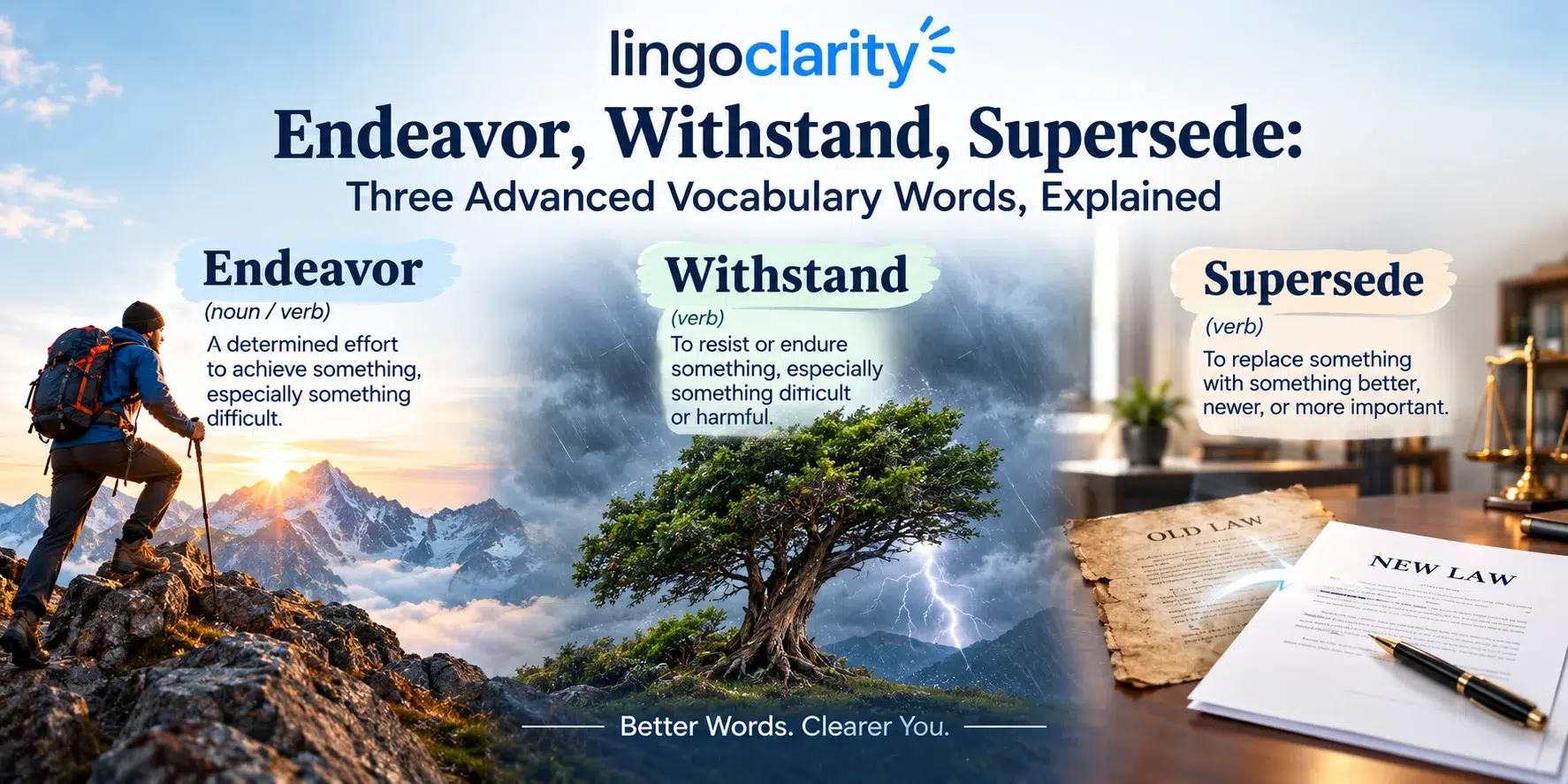
Quick answer: Endeavor means to make a serious effort at something demanding. Withstand means to hold up successfully against force or pressure. Supersede means to replace something and make the older version obsolete. All three are formal verbs. Endeavor also works as a noun, and supersede is the one almost everyone misspells.
Three words, three very different jobs. Most advanced vocabulary lists give you a one-line gloss for each and move on, which is exactly why people still write supercede in a contract and withstanded in a lab report. This page does the opposite: full meanings, stress patterns, origins, register, and the specific error attached to each word.
What do endeavor, withstand, and supersede mean?
Here’s the fast version before the detail.
| Word | Part of speech | Core meaning | Examples |
|---|---|---|---|
| endeavor | verb; also a noun | to try hard at something difficult | I will endeavor to complete the project on time. She endeavored to improve her English skills. |
| withstand | transitive verb | to hold up against force or pressure without giving way | This building can withstand strong earthquakes. He managed to withstand the pressure of the competition. |
| supersede | transitive verb | To replace something because it is newer, better, or more effective. | The new law will supersede the old one. Digital cameras have largely superseded film cameras. |
And the pronunciation, since two of the three trip people up:
| Word | Say it | Stressed syllable |
|---|---|---|
| endeavor | en-DEV-er | second |
| withstand | with-STAND | second |
| supersede | soo-per-SEED | third |
Endeavor: serious effort, usually toward something hard
As a verb, endeavor is intransitive and nearly always followed by an infinitive: you endeavor to do something. It carries a note of obligation that plain try doesn’t — a sense that the effort is owed, not optional. Merriam-Webster defines it as to attempt by exertion of effort [link to Merriam-Webster entry].
As a noun, it means the effort itself or the project it’s aimed at: a scientific endeavor, a joint endeavor, her latest creative endeavor. The noun is far more common in casual American writing than the verb, and it’s the reason the word shows up in company names and mission statements.
Register: formal-leaning. Nobody says “I’ll endeavor to text you back.” Use it in a cover letter, a policy statement, or an essay; use try when you’re speaking. American English spells it endeavor; British English spells it endeavour, and the British spelling also survives in a few fixed legal phrases like best endeavours.
Withstand: holding up when something pushes back
Withstand is transitive — it needs an object. Something withstands something else. Two senses matter:
- Physical resistance. To be proof against a force: the housing withstands salt spray, the beam withstood the load.
- Moral or social resistance. To resist successfully: she withstood two hours of hostile questioning.
The word carries an implication most synonyms lack: success. Resist leaves the outcome open — you can resist and still lose. Withstand usually means you held. That’s why product copy and engineering specs lean on it so heavily.
The past tense is withstood. It’s an irregular verb built on stand, so it inflects the same way: stand/stood, withstand/withstood. Withstanded isn’t a word.
Register: neutral. This is the least formal of the three and the one you can use almost anywhere without sounding stiff.
Supersede: replacing something and retiring it
To supersede something is to take its place and push it out of use. A new contract supersedes the old one — meaning the old one no longer has force. Version 4 supersedes version 3. Merriam-Webster’s senses run from “to cause to be set aside” to “to force out of use as inferior” to “to take the place or position of.”
The key nuance: supersede doesn’t just mean “come after.” It means the earlier thing is now void, obsolete, or inferior. A sequel doesn’t supersede the first film. A revised style rule supersedes the rule it replaced.
Register: firmly formal. You’ll meet it in legal documents, agency policy, software release notes, and academic writing. In a text message it would read as a joke.
The spelling. Supersede is the only common English word ending in -sede. Everything that sounds similar ends in -cede (precede, concede, recede) or -ceed (exceed, proceed, succeed), which is why the misspelling supercede is so persistent — Merriam-Webster notes it turns up often, and most style guides still treat it as an error [link to AP Stylebook].
Where do these three words come from?
Etymology is what makes the supersede spelling stick, so it’s worth two minutes.
- Endeavor grew out of the Middle English phrase put (oneself) in dever — a partial rendering of Old French mettre en deveir, “to put in duty.” Dever traces back to Latin debere, “to owe.” The verb is attested from around 1400. The duty in the etymology is still audible in how the word feels today.
- Withstand is the homegrown one: Old English wiðstandan, from wið (“against,” the same element buried in withhold) plus standan. Etymologists widely believe it was modeled on Latin resistere. Related forms survive across Germanic languages, including German widerstehen.
- Supersede comes from Latin supersedere, literally “to sit above” (super + sedere, “to sit”). In the mid-15th century it meant “postpone” — a sense now gone. The modern “set aside as inferior” reading appears in the early 17th century, and “take the place of” by the 1650s.
That Latin sedere is your spelling mnemonic. Supersede sits above; it doesn’t cede ground.
How do you use them in a real sentence?
Different registers, same three words:
- Text message: “Rain held off — the tent withstood it, we’re dry.” (Withstand is casual enough for this. The other two aren’t.)
- Professional email: “We’ll endeavor to have the revised figures to you before Thursday’s close.”
- Product specification: “The enclosure withstands temperatures from −40°F to 185°F.”
- Contract clause: “This agreement supersedes all prior understandings between the parties, whether written or oral.”
- Dialogue in fiction: “She endeavored to look unsurprised, and failed.”
- Release notes: “Build 12.4 supersedes 12.3; update before running any migration.”
Notice how the noun form behaves differently: “The whole endeavor collapsed by March” is far more conversational than the verb ever gets.
What mistakes do people make with these words?
| The mistake | Why it’s wrong | The fix |
|---|---|---|
| supercede | The Latin root is sedere, “to sit” — not cedere, “to yield” | supersede |
| withstanded | Withstand is irregular, built on stand | withstood |
| endeavour in US writing | That’s the British spelling | endeavor for a US audience |
| “We endeavored finding a solution” | The verb takes an infinitive, not a gerund | “We endeavored to find a solution” |
| “Her score superseded mine” | Supersede means replace, not outperform | “Her score beat mine” |
| “The rope endeavored the strain” | Endeavor isn’t transitive and isn’t about force | “The rope withstood the strain” |
The fifth one is the sneakiest. Supersede looks like a fancy cousin of exceed, and writers reach for it when they want to say something outdid something else. It doesn’t mean that. Keep it for cases where the old thing is genuinely retired.
Which word should you pick? Advanced vocabulary vs. the plain word
| If you mean… | Use | Not |
|---|---|---|
| serious effort, formal tone | endeavor | strive (implies struggle against resistance), attempt (neutral, hints at possible failure) |
| held up and didn’t break | withstand | resist (outcome open), endure (suffering over time), weather (came through a rough stretch) |
| replaced and made obsolete | supersede | supplant (displacement, often with a whiff of scheming), override (temporary, not permanent), replace (neutral, no obsolescence implied) |
A quick test: if you can swap in try, survive, or swap out without losing meaning, you probably want the plain word. Advanced vocabulary earns its place when the simpler word would blur something — the certainty in withstood, the finality in superseded, the sense of duty in endeavor.
Quick FAQ
Is it endeavor or endeavour?
Both are correct, in different places. Endeavor is standard American spelling; endeavour is British and Commonwealth. For a US audience, write endeavor and stay consistent through the document.
Is supercede a real word?
No — treat it as a misspelling. Supersede is the accepted spelling in American dictionaries and style guides. Supercede appears often enough that dictionaries record it as a variant, but editors will still mark it wrong.
What is the past tense of withstand?
Withstood. The verb is irregular because it’s built on stand, so it follows stand/stood. Withstanded is never correct.
Are endeavor, withstand, and supersede formal words?
Supersede is the most formal and belongs in legal, policy, or technical writing. Endeavor is formal as a verb but relaxed as a noun. Withstand is the most flexible of the three and fits ordinary conversation.
What’s the difference between supersede and replace?
Replace is neutral — one thing takes another’s spot. Supersede adds that the earlier version is now void, obsolete, or without force. A replaced part might be identical; a superseded document no longer applies.
Final Thoughts
Three words like these are worth learning as a set because they cover three separate moves you make in careful writing: pushing forward, holding firm, and clearing out what’s no longer valid. Get the spelling of supersede right and the past tense of withstand right, and you’ve cleared the two errors that most often mark otherwise strong writing as careless.
