Have you ever said something in English that was grammatically correct but sounded too direct?
Many English learners experience this problem. A sentence like “Send me the document” may communicate your meaning clearly, but in many situations, it can sound like a command. A small change such as “Could you please send me the document?” creates a warmer and more respectful tone.
Polite English vocabulary is not about making every sentence longer or sounding overly formal. It is about understanding how native speakers soften requests, express opinions, disagree respectfully, and show appreciation.
In American English, polite communication often depends on tone, word choice, and sentence structure. Words such as please, thank you, could, would, appreciate, and excuse me help create a more positive interaction.
Whether you are writing a professional email, speaking with coworkers, talking to customers, or having everyday conversations, the right vocabulary can make you sound more confident and considerate.
This guide covers practical polite English vocabulary upgrades, including everyday phrases, workplace expressions, email language, polite disagreements, and common mistakes to avoid.
Quick Answer
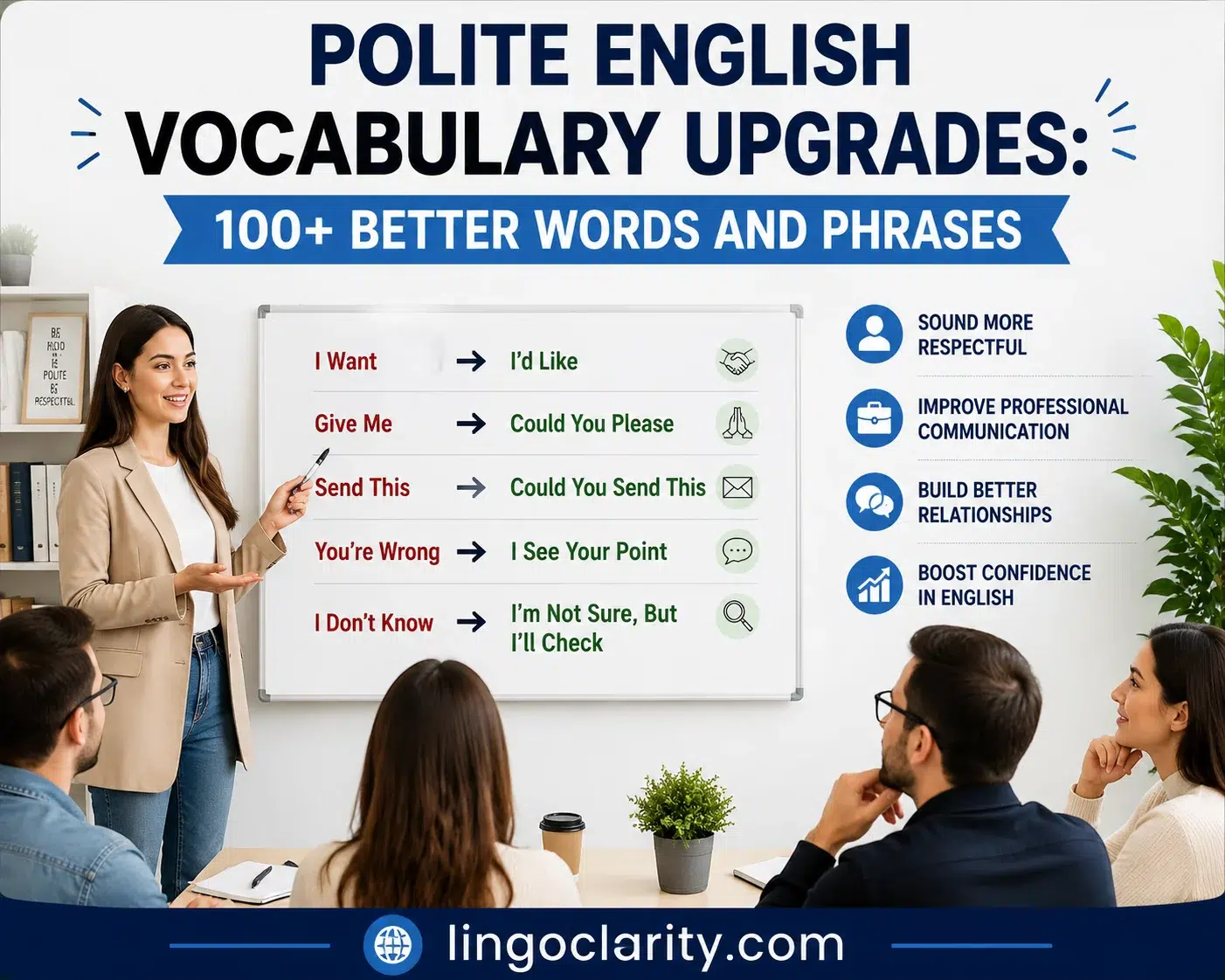
Polite English vocabulary upgrades help you communicate with more respect, confidence, and professionalism by replacing direct or harsh phrases with softer alternatives. Simple changes like using “Could you please…?” instead of “Do this,” “I’d like…” instead of “I want,” and “I see your point…” instead of “You’re wrong” can make your English sound more natural and friendly.
Politeness in English is often created through softer sentence structures, modal verbs like could, would, and may, appreciation phrases, and respectful disagreement.
TL;DR
- Polite English is about choosing respectful words, not using complicated vocabulary.
- Small upgrades can completely change how your message sounds.
- “Could,” “would,” “please,” and “appreciate” are powerful polite words.
- Professional English requires softer requests and constructive feedback.
- Native speakers often avoid commands by turning them into questions.
- Polite vocabulary improves conversations, emails, interviews, and workplace communication.
Why Polite English Vocabulary Matters
Polite vocabulary helps you communicate your ideas without sounding aggressive, impatient, or disrespectful.
Good word choices can help you:
- Build stronger relationships
- Sound professional at work
- Make better first impressions
- Handle disagreements calmly
- Ask for help more effectively
- Create a friendly conversation style
Compare these examples:
Direct:
Give me the information.
Polite:
Could you please provide the information?
Both sentences request the same thing, but the second version sounds more cooperative.
Politeness does not mean being less confident. In fact, skilled communicators often use respectful language because it creates better cooperation.
The Most Important Polite English Words
Please
“Please” is one of the simplest ways to make requests sound respectful.
Examples:
- Please send the updated file.
- Could you please check this?
- Please let me know your thoughts.
However, “please” alone does not always make a command polite.
Compare:
Less natural:
Please do this immediately.
Better:
Could you please take care of this when you have a moment?
Thank You
Showing appreciation makes conversations warmer.
Examples:
- Thank you for your help.
- Thank you for your time.
- I really appreciate your support.
Could
“Could” is commonly used to make requests softer.
Instead of:
Help me with this.
Use:
Could you help me with this?
More examples:
- Could you explain this?
- Could you send me the details?
- Could you check this document?
Would
“Would” is useful when making more formal or careful requests.
Examples:
- Would you mind checking this?
- Would it be possible to reschedule?
- Would you like some assistance?
Appreciate
“Appreciate” adds gratitude and professionalism.
Examples:
- I appreciate your feedback.
- I appreciate your patience.
- I would appreciate your help with this matter.
100+ Polite English Vocabulary Upgrades
Everyday English Upgrades
| Instead Of | Say This |
|---|---|
| Give me that | Could you please give me that? |
| I want this | I’d like this, please |
| Wait | Could you wait a moment, please? |
| Move | Excuse me, could I get through? |
| What? | Could you repeat that, please? |
| Tell me | Could you let me know? |
| Stop | Could you please stop? |
| Hurry up | Could you please do this when possible? |
| I don’t care | I don’t have a preference |
| That’s bad | That may need improvement |
Polite Ways To Make Requests
Direct requests can sometimes sound demanding. Turning them into questions usually creates a friendlier tone.
Instead Of “Do This”
Use:
- Could you please do this?
- Would you mind helping with this?
- Would it be possible to complete this?
- I was wondering if you could help.
Examples:
Direct:
Check my work.
Polite:
Could you please review my work?
Professional English Vocabulary Upgrades
Workplace communication requires clarity and respect.
Instead Of “I Need”
Use:
- I would appreciate
- I would like to request
- Could you please provide
Examples:
Direct:
I need the report today.
Professional:
I would appreciate receiving the report today.
Instead Of “Tell Me”
Use:
- Could you let me know?
- Would you mind explaining?
- I would appreciate your feedback.
Example:
Direct:
Tell me your opinion.
Professional:
Could you let me know your thoughts?
Polite English For Emails
Emails often require careful wording because readers cannot hear your tone.
Common Email Upgrades
| Simple Phrase | Professional Alternative |
|---|---|
| Send this | Could you please send this? |
| Check this | Could you please review this? |
| I disagree | I have a different perspective |
| Explain this | Could you clarify this? |
| Fix this | Could we make some improvements here? |
Polite Email Openings
Examples:
- I hope you are doing well.
- I am reaching out regarding…
- I wanted to ask about…
- I would appreciate your guidance on…
Polite Email Closings
Examples:
- Thank you for your time.
- I appreciate your assistance.
- I look forward to hearing from you.
- Please let me know if you have any questions.
Polite Ways To Disagree
Disagreement does not need to sound negative.
Avoid:
You are wrong.
Better options:
- I see your point, but I have a different view.
- That is an interesting perspective. I think…
- I understand your concern; however…
- Perhaps we could consider another approach.
Polite Ways To Say No
Saying no politely shows respect.
Instead of:
No, I cannot.
Use:
- I’m afraid I won’t be able to.
- Unfortunately, I’m not available at that time.
- I appreciate the offer, but I’ll have to decline.
- Thank you for asking, but I cannot commit right now.
Polite Vocabulary For Customer Service
Customer communication requires patience and empathy.
Useful phrases:
- How may I help you?
- I understand your concern.
- Let me look into that for you.
- Thank you for your patience.
- I apologize for the inconvenience.
Common Polite English Mistakes
Using Too Many Formal Words
Polite does not mean complicated.
Too formal:
I kindly request your immediate cooperation.
Natural:
Could you please help me with this?
Using Commands Too Often
Commands can sound harsh.
Instead of:
Send the file.
Use:
Could you please send the file?
Overusing “Sorry”
“Sorry” is useful, but it should match the situation.
Use:
- Sorry for the delay.
- Sorry, could you repeat that?
Avoid apologizing unnecessarily for normal situations.
How To Practice Polite English Vocabulary
Replace One Phrase Every Day
Practice upgrades like:
- I want → I’d like
- Give me → Could you please give me
- Tell me → Could you let me know
- You’re wrong → I see it differently
Practice Real Situations
Create examples for:
- Emails
- Meetings
- Job interviews
- Customer conversations
- Daily conversations
Frequently Asked Questions
The most common polite words in English include please, thank you, excuse me, sorry, appreciate, could, and would. These words help requests and conversations sound more respectful.
“I want” is not always rude, but it can sound demanding when asking for something. In many situations, “I’d like” sounds more polite and natural.
Use respectful requests, appreciation phrases, and softer expressions. For example, replace “Send me the report” with “Could you please send me the report?”Use respectful requests, appreciation phrases, and softer expressions. For example, replace “Send me the report” with “Could you please send me the report?”
Both can make requests, but “could you” often sounds slightly more polite or careful, especially in professional situations.
Americans often soften disagreement with phrases like “I see your point,” “I understand your perspective,” or “I have a different opinion.”
Focus on common upgrades, practice speaking them daily, and pay attention to how native speakers make requests and express opinions.
Conclusion
Polite English vocabulary is a practical communication skill that helps you sound respectful, confident, and professional.
You do not need advanced words to improve your English. Simple upgrades such as “Could you please…,” “I’d like…,” “I appreciate…,” and “I see your point…” can completely change the way people understand your message.
By practicing these phrases in real conversations, emails, and workplace situations, you can develop a more natural and effective English communication style.

5 thoughts on “Polite English Vocabulary: 100+ Words And Phrases To Sound More Respectful”
Comments are closed.