
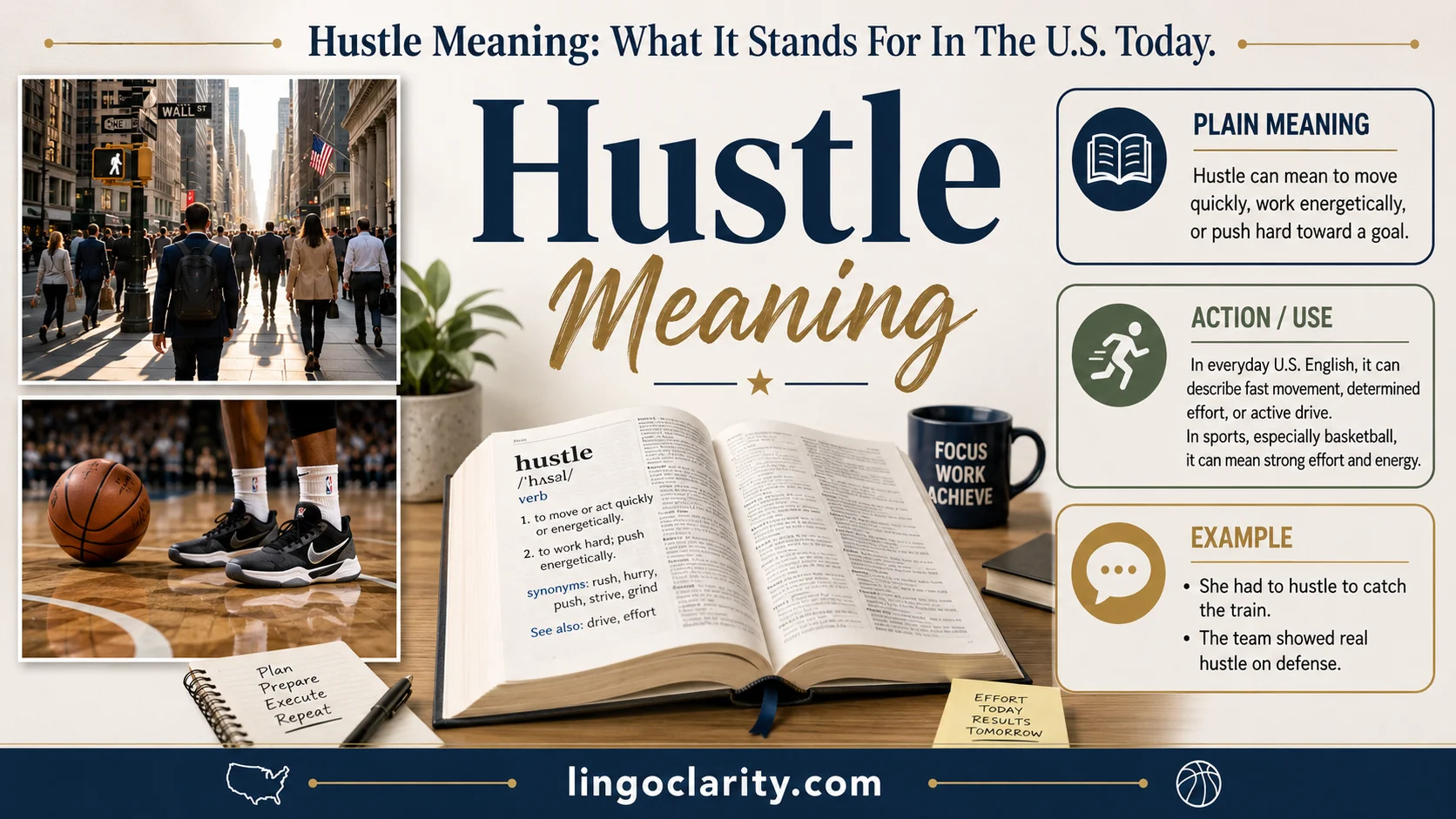
Hustle meaning is not limited to “working hard.” In US English, hustle can mean moving quickly, working with strong effort, showing energy in sports, earning money through extra work, or sometimes tricking someone for money.
That is why the word can sound positive, neutral, or negative.
A coach might praise a player’s hustle. A manager might tell a team to hustle before a deadline. A friend might talk about a side hustle that brings in extra income. However, a suspicious deal can also be called a hustle if it feels like a scam.
The safest way to understand hustle is to look at the situation around it. Is the person moving fast? Working hard? Trying to earn money? Pressuring someone? Cheating someone? The answer tells you which meaning fits.
Quick Answer
The simplest hustle meaning is to move, act, or work with speed and energy. It can describe quick movement, strong effort, sports determination, business ambition, or a way to make money. In some contexts, especially when money or pressure is involved, hustle can also mean a scam, trick, or dishonest plan.
What Does Hustle Meananing?
In everyday English, hustle meaning depends on context.
Hustle usually means fast, energetic action toward a goal.
In a simple sentence like “We need to hustle,” it means “We need to hurry.” The person is not talking about business or ambition. They simply mean move faster.
In sports, hustle means active effort. A player shows hustle by running hard, staying alert, chasing the ball, defending with energy, and refusing to give up.
In work or business, hustle can mean determined effort to get results. Someone who “has hustle” works hard, takes initiative, and keeps pushing toward a goal.
In money-related contexts, the meaning can shift. A side hustle is usually an honest way to earn extra income. A hustle, by itself, can sometimes mean a dishonest scheme.
Hustle Meaning In Plain English
A clear hustle meaning is fast, energetic effort toward a goal.
The word often combines two ideas:
- speed
- effort
For example, if someone says, “Hustle before the store closes,” they mean move quickly. If someone says, “I admire her hustle,” they mean they respect her effort, drive, or determination.
However, hustle can also include pressure. If a salesperson hustles someone into buying something, the meaning is not simply “works hard.” It means the salesperson pushed too hard.
When the sentence involves cheating, scams, or dishonest money, hustle becomes negative.
Example: “That investment pitch was a hustle.”
That means the pitch seemed like a scam or dishonest money-making plan.
Main Meanings Of Hustle
| Context | Meaning | Example |
|---|---|---|
| Everyday movement | To hurry or move quickly | “We need to hustle or we’ll miss the bus.” |
| Work | To work hard and fast | “She hustled to finish the report.” |
| Sports | To show active effort | “The coach praised his hustle.” |
| Money | A way to earn income | “He has a weekend side hustle.” |
| Sales | To sell aggressively | “They hustled the crowd after the show.” |
| Dishonesty | A scam or trick | “The deal turned out to be a hustle.” |
| City life | Busy activity | “I like the hustle and bustle of Chicago.” |
Is Hustle Positive Or Negative?
Hustle can be positive, neutral, or negative.
It is positive when it means effort, ambition, or determination.
Example: “She built her business through patience and hustle.”
It is neutral when it means hurry.
Example: “Hustle, the train leaves in five minutes.”
It is negative when it means pressure, manipulation, or dishonesty.
Example: “He tried to hustle customers into paying extra fees.”
This is why context matters. The same word can praise someone’s work ethic or warn that someone is being tricked.
Hustle As A Verb
As a verb, hustle can mean to hurry, move quickly, work energetically, push someone along, sell aggressively, or cheat someone.
Examples:
“I had to hustle across the street before the light changed.”
“The staff hustled to serve everyone during the lunch rush.”
“The guards hustled the celebrity out of the building.”
“She hustled all week to prepare for the launch.”
“The vendor tried to hustle tourists into buying fake tickets.”
In these examples, the meaning changes based on the action. move quickly. By contrast, “hustle tourists” suggests pressure, aggressive selling, or dishonesty.
Hustle As A Noun
As a noun, hustle can mean effort, busy activity, a money-making activity, or a dishonest scheme. In sports, it often describes energy and determination. In city descriptions, it can point to movement, noise, and activity. When money or suspicious deals are involved, the word may suggest a scam.
Examples:
“Her hustle helped the team win.”
“I miss the hustle of the city.”
“His photography side hustle brings in extra cash.”
“That online offer looked like a hustle.”
The noun is common in casual US speech. It often sounds energetic and informal. In polished formal writing, a clearer word may work better.
For example, instead of “The project required hustle,” a business report might say, “The project required sustained effort and quick execution.”
Pronunciation Of Hustle
Hustle is pronounced HUHS-uhl.
It has two syllables:
hus + tle
The first syllable sounds like “huhs.” The second syllable is soft, like “uhl.”
Is Hustle Slang?
Hustle is partly informal, but it is not always slang.
The basic meaning “to hurry” is common in everyday English.
Example: “Hustle up. We’re late.”
The sports meaning is also common.
Example: “That player shows a lot of hustle.”
The money and ambition meanings are more casual.
Example: “She turned her baking hobby into a side hustle.”
The dishonest meaning can sound slangy or informal.
Example: “That whole thing was a hustle.”
In formal writing, choose a more exact word when clarity matters. Use hurry, effort, initiative, side job, pressure, fraud, or scam depending on the meaning.
Common Phrases With Hustle
Side Hustle
A side hustle is paid work someone does in addition to a main job, school, or primary responsibility.
Examples:
“She has a side hustle designing logos.”
“He drives on weekends as a side hustle.”
“My tutoring side hustle helps pay for books.”
Today, side hustle usually sounds neutral or positive. It often suggests extra income, independence, or entrepreneurship. However, the word can still feel casual, so side job or part-time work may be better in formal writing.
Hustle And Bustle
Hustle and bustle means busy movement, noise, and activity, especially in a city, market, office, or crowded place.
Examples:
“I love the hustle and bustle of downtown New York.”
“After a quiet weekend, the hustle and bustle of Monday felt overwhelming.”
This phrase does not usually mean hard work or scams. It describes a lively, busy environment.
Hustle Up
Hustle up can mean to find, gather, or get something quickly through effort.
Examples:
“I’ll try to hustle up a few chairs before the meeting.”
“They hustled up enough volunteers for the event.”
It can also mean “hurry up” in casual speech.
Example: “Hustle up. We need to leave.”
Respect The Hustle
Respect the hustle means “I respect the effort, ambition, or hard work.”
Examples:
“She works two jobs and still studies at night. I respect the hustle.”
“He started small, but he kept showing up. Respect the hustle.”
This phrase is usually positive, but it can sound too casual for formal writing.
Hustle Culture
Hustle culture means a work mindset that praises constant productivity, ambition, and grinding toward success.
The phrase can be positive when people use it to describe discipline and drive. However, it is often used critically today because constant work can lead to stress, burnout, and poor work-life balance.
Example:
“She used to admire hustle culture, but now she believes rest is part of success.”
A healthy version of hustle means focused effort. An unhealthy version means never stopping.
Hustle In Sports
In sports, hustle means effort that shows energy, alertness, and determination.
A player shows hustle by running hard, defending actively, diving for a loose ball, backing up a teammate, or staying engaged even when tired.
Examples:
“The rookie earned minutes because of his hustle.”
“The team lacked size, but it made up for it with hustle.”
“Coaches notice hustle because it shows attitude and effort.”
In sports, hustle is usually praise. It does not mean cheating or scamming in this context.
Hustle In Work And Business
In work and business, hustle often means working with energy, urgency, and initiative.
Examples:
“She hustled to close the deal before the deadline.”
“He has the hustle to build something from scratch.”
“They spent the summer hustling for new clients.”
This use can sound motivational, especially in entrepreneurship, sales, freelancing, and creative work.
Still, be careful. If hustle involves pressuring customers, exaggerating claims, or tricking people, the meaning becomes negative.
Good hustle means effort with integrity. Bad hustle means pressure, manipulation, or dishonesty.
Hustle Vs. Hustler
Hustle is the action or the effort. Hustler is the person.
However, hustler can sound very different depending on context.
Positive:
“She’s a hustler” can mean she works hard, finds opportunities, and does not give up.
Negative:
“He’s a hustler” can mean he cheats people, runs scams, or manipulates others for money.
Because hustler can sound risky or insulting, use it carefully. If you mean something positive, phrases like hard worker, go-getter, self-starter, or entrepreneurial person may be clearer.
Hustle Vs. Work Hard
Hustle and work hard are close, but they are not identical.
Work hard focuses on effort.
Hustle adds speed, urgency, ambition, or pressure.
Example:
“She worked hard on the project.”
This means she put in effort.
“She hustled to finish the project.”
This means she worked hard and quickly, probably under time pressure.
Use work hard when you want a neutral phrase. Use hustle when you want a more energetic, casual, or urgent tone.
Synonyms For Hustle
The best synonym depends on the meaning.
For moving fast:
hurry, rush, move quickly, speed up, get moving
Example: “We need to hustle” = “We need to hurry.”
For strong effort:
effort, drive, determination, energy, initiative, grit
Example: “Her hustle impressed me” = “Her drive impressed me.”
For money-making work:
side job, gig, freelance work, small business, extra income project
Example: “He has a side hustle” = “He has a side job.”
For dishonest action:
scam, con, fraud, trick, swindle
Example: “That deal was a hustle” = “That deal was a scam.”
Antonyms For Hustle
There is no single perfect opposite of hustle because the word has several meanings.
For “move fast,” the opposite is:
slow down, take your time, move slowly
For “show effort,” the opposite is:
slack off, coast, give up, avoid effort
For “busy activity,” the opposite is:
calm, quiet, stillness, peace
For “a scam,” the opposite is:
honest deal, fair transaction, legitimate offer
Choose the opposite that matches the sentence.
Common Mistakes With Hustle
Mistake 1: Thinking Hustle Is Always Positive
Hustle can be positive, but not always.
Positive: “I admire her hustle.”
Negative: “That offer was a hustle.”
The first sentence praises effort. The second warns about a possible scam.
Mistake 2: Using Hustle When You Only Mean Work
Sometimes work hard is clearer than hustle.
Less clear: “The employees hustled all year.”
Clearer: “The employees worked hard all year.”
Use hustle when speed, pressure, ambition, or urgency matters.
Mistake 3: Ignoring The Money Context
When hustle appears near money, selling, deals, or strangers, check the tone carefully.
“She has a side hustle” usually means extra work.
“He ran a hustle” may mean he ran a scam.
Mistake 4: Using Hustler Too Casually
Calling someone a hustler can sound like praise or an insult.
Safer positive choices include:
hard worker
go-getter
self-starter
entrepreneur
driven person
Everyday Examples Of Hustle
“I had to hustle to make it to work on time.”
“Come on, hustle. The movie starts in ten minutes.”
“She hustled all week to finish the launch.”
“The rookie made the team because of his hustle.”
“Marcus runs a lawn-care side hustle after school.”
“The vendor tried to hustle tourists into buying fake souvenirs.”
“I love the hustle and bustle of downtown Chicago.”
“He lost money because he fell for a hustle.”
“You can be talented, but you still need hustle.”
“The restaurant staff hustled during the lunch rush.”
“She respects people who hustle without stepping on others.”
“That pitch sounded less like a business plan and more like a hustle.”
Word History Of Hustle
Hustle is commonly traced to Dutch roots connected with shaking or jostling. That early idea helps explain the word’s rough, energetic feeling.
Over time, English speakers used hustle for hurried movement, pushing through a crowd, working with energy, selling aggressively, and getting money through questionable methods.
That history also explains why the word has mixed tone today. It can suggest drive and effort, but it can also suggest pressure or dishonesty.
Modern US English keeps both sides of the word. Hustle can praise a hard worker, describe a busy city, or warn about a scam.
When To Use Hustle
Use hustle when you want to describe fast, energetic, informal action.
Good uses:
“We need to hustle.”
“She showed real hustle.”
“He turned his hobby into a side hustle.”
“I miss the hustle and bustle of the city.”
Be more careful in formal or serious writing.
Instead of:
“The company hustled customers.”
Use:
“The company pressured customers.”
Instead of:
“The investment was a hustle.”
Use:
“The investment appeared to be a scam.”
The clearer word is often better when legal, financial, academic, or professional precision matters.
FAQ
What does hustle mean in simple words?
Hustle means to move or work with speed, energy, and effort. It can mean hurry, work hard, show determination, earn money through a side job, or sometimes trick someone for money.
Is hustle a good word or a bad word?
It depends on context. Hustle is good when it means effort or determination. It is neutral when it means hurry. It is negative when it means pressure, cheating, or a scam.
What does “I respect your hustle” mean?
“I respect your hustle” means “I respect your effort, ambition, or hard work.” It is usually a compliment in casual US English.
What does side hustle meaning?
A side hustle is extra paid work someone does outside a main job, school, or primary responsibility. It can be freelancing, tutoring, selling products, driving, designing, writing, or another income activity.
What does hustle mean in sports?
In sports, hustle means active effort, energy, and determination. A player with hustle runs hard, stays alert, helps teammates, and keeps trying.
Can hustle mean scam?
Yes. In some contexts, hustle can mean a scam, con, or dishonest plan to get money. Example: “That deal was a hustle.”
Is hustle formal or informal?
Hustle is usually informal or conversational. It sounds natural in speech, sports, business talk, and online writing. In formal writing, use a clearer word like hurry, effort, initiative, pressure, or scam.
What is hustle culture?
Hustle culture is a mindset that praises constant work, ambition, and productivity. Some people use the phrase positively, but many use it critically because nonstop work can lead to stress and burnout.
What is another word for hustle?
Another word for hustle depends on the meaning. When it refers to speed, hurry or rush works well. For effort, better choices include drive, energy, or determination. In a dishonest context, use scam, con, swindle, or trick.
What is the opposite of hustle?
The opposite of hustle also depends on the meaning. When hustle means hurry, the opposite is slow down or take your time. If it means strong effort, the opposite is slack off, coast, or give up. When it means a scam, the opposite is an honest deal or fair transaction.
Conclusion
The best way to remember hustle meaning is this: the word usually shows speed, effort, energy, or urgency. It can describe hurrying, working hard, showing sports effort, earning extra money, selling aggressively, or tricking someone through a scam.
Use hustle when you want a casual word with energy and urgency. Use a more exact word, such as hurry, effort, drive, side job, pressure, or scam, when clarity matters most.
