
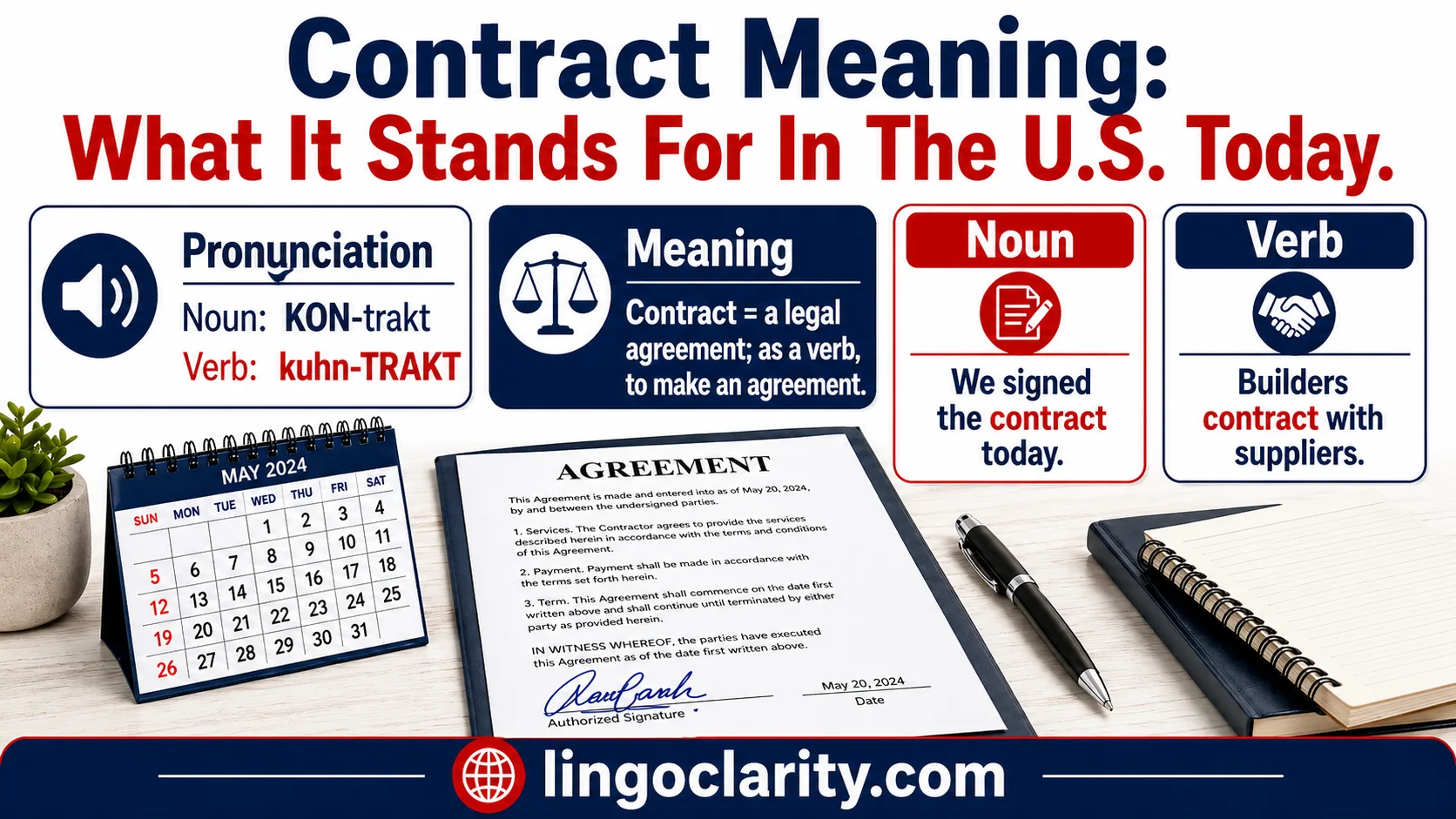
Contract meaning refers to the definition and use of contract as both a noun and a verb. As a noun, a contract is a formal agreement between two or more people, companies, or groups. Most often, it describes a written legal agreement that explains what each side promises to do. For example, a lease, job agreement, service agreement, sales agreement, or business deal can all be contracts.
However, contract can also work as a verb. As a verb, it may mean to make an agreement, become smaller, tighten, catch an illness, or shorten a word or phrase. Therefore, the meaning depends on how the word is used in the sentence.
In simple terms, a contract is an agreement with clear terms. In legal and business contexts, it usually creates duties, rights, and responsibilities for the people or organizations involved.
Quick Definition Of Contract
A contract is an agreement that sets rules, promises, or duties between two or more sides. Usually, it is written and signed, although the word can also refer to the agreement itself rather than only the paper or digital file.
In legal use, a contract is more serious than a casual promise. It often needs clear terms, mutual agreement, and something of value exchanged between the parties. Because of this, a contract may be enforceable if one side fails to follow it.
For example, if you sign a lease for an apartment, the lease is a contract. It explains how much rent you must pay, how long you can live there, and what rules both you and the landlord must follow.
How To Pronounce Contract
The pronunciation of contract changes depending on whether the word is a noun or a verb.
| Use | Pronunciation | Stress | Example |
|---|---|---|---|
| Noun | KAHN-trakt | First syllable | “She signed the contract.” |
| Verb | kun-TRAKT | Second syllable | “Metal can contract in cold weather.” |
As a noun, contract usually stresses the first syllable. As a verb, it usually stresses the second syllable. This pattern also appears in other English words, such as record, permit, and present.
For instance, you would say, “I reviewed the KAHN-trakt.” However, you would say, “Muscles kun-TRAKT during exercise.”
Contract As A Noun
As a noun, contract means a formal agreement or the document that records that agreement. It is commonly used in law, business, employment, housing, sports, construction, insurance, publishing, and freelance work.
For example:
- “She signed a contract with the company.”
- “The rental contract begins next month.”
- “His contract includes health benefits.”
- “The team offered the player a new contract.”
- “Please read the contract before paying the deposit.”
In these sentences, contract refers to an agreement with specific terms. Also, it often suggests that the agreement is official, important, or legally meaningful.
A contract can be short or long. It may be one page, or it may include many sections, schedules, and attachments. However, the main purpose is the same: to make the agreement clear.
Contract As A Verb
As a verb, contract has several meanings. Therefore, context is important.
To Make A Formal Agreement
To contract with someone means to make an agreement with that person or company. This use is common in business, government, education, healthcare, and professional services.
Examples:
- “The school contracted with a bus company.”
- “The city contracted with a repair firm.”
- “The hospital contracted with a security provider.”
- “The company was contracted to design the website.”
In US English, contract with a company often sounds more natural than contract a company when you mean to hire or make an agreement with another party.
To Become Smaller Or Tighter
Contract can also mean to shrink, tighten, or draw inward. This meaning is common in science, medicine, economics, and everyday description.
Examples:
- “Metal contracts in cold weather.”
- “The muscle contracts during movement.”
- “The economy contracted last quarter.”
- “The fabric may contract after washing.”
In this sense, contract is the opposite of expand. For example, heat may cause some materials to expand, while cold may cause them to contract.
To Catch An Illness
In health contexts, to contract an illness means to catch it or become infected with it. This use is more formal than catch.
Examples:
- “He contracted pneumonia while traveling.”
- “She contracted a virus at work.”
- “Patients can contract infections after exposure.”
- “The doctor said he likely contracted the flu.”
Although people use catch in casual conversation, contract is common in medical, public health, and formal writing.
To Shorten A Word Or Phrase
In grammar, contract can mean to shorten a word or phrase. As a result, the shortened form is called a contraction.
Examples:
- “Do not” contracts to “don’t.”
- “I am” contracts to “I’m.”
- “They are” contracts to “they’re.”
- “We have” contracts to “we’ve.”
This meaning is especially useful for English learners because contractions are common in speech and informal writing.
Contract Meaning In Legal And Business English
In legal and business English, a contract is an agreement that can create enforceable obligations. In other words, it does not simply express an idea. Instead, it usually states what each side must do.
A business contract may identify the parties, describe the work, list payment terms, set deadlines, explain ownership rights, and state what happens if someone breaks the agreement. Additionally, it may include rules about confidentiality, cancellation, dispute resolution, and liability.
For example, a freelance contract may say that a designer will deliver a logo package by a certain date. In return, the client must pay a specific fee. If the client refuses to pay after receiving the work, the designer may point to the contract.
Similarly, a lease contract may say that a tenant can live in an apartment for one year. In exchange, the tenant must pay rent, follow property rules, and give proper notice before leaving.
What Makes A Contract Legally Binding?
The exact legal rules can vary by place and situation. However, many enforceable contracts include several basic elements.
First, there is usually an offer. One side proposes clear terms. Next, there is acceptance, which means the other side agrees to those terms. Then, there is often consideration, meaning each side exchanges something of value, such as money, services, goods, or promises.
Also, the parties usually need capacity, which means they are legally able to enter the agreement. The contract must have a lawful purpose as well. Finally, both sides generally need to intend to create a real agreement, not just make a casual statement.
For example, “I might sell you my bike someday” is not usually a contract because the terms are unclear. By contrast, “I will sell you my bike for $300, and you will pay me on Friday” is much more specific.
Agreement Vs. Contract
An agreement and a contract are related, but they are not always the same.
An agreement is any shared understanding between two or more sides. A contract is a specific kind of agreement that may be legally enforceable. Therefore, all contracts are agreements, but not all agreements are contracts.
For example, if two friends agree to meet for coffee at 3 p.m., that is an agreement. However, it is not usually a legal contract. On the other hand, if a company agrees to pay a contractor $5,000 for completed work by a set deadline, that may be a contract.
The difference matters because the word contract suggests clearer terms, stronger obligations, and possible legal consequences.
Common Types Of Contracts
Contracts appear in many parts of daily life. Some are simple, while others are detailed and highly technical.
Employment Contract
An employment contract explains the relationship between an employer and an employee. It may include salary, job duties, benefits, start date, confidentiality terms, noncompete rules, termination procedures, and workplace expectations.
Lease Contract
A lease contract sets the terms for renting property. It usually covers rent, deposit, lease length, repairs, utilities, property rules, late fees, and move-out requirements.
Service Contract
A service contract explains the work one person or company will perform for another. For instance, it may cover cleaning, consulting, marketing, design, maintenance, coaching, repairs, or software support.
Sales Contract
A sales contract records the purchase of goods, property, vehicles, equipment, or business assets. Usually, it states the price, item description, delivery date, payment method, and warranty terms.
Freelance Contract
A freelance contract protects both the freelancer and the client. It may include project scope, deadlines, revision limits, payment schedule, ownership rights, and cancellation terms.
Sports Contract
A sports contract sets the terms between an athlete and a team, league, sponsor, or agent. It may include salary, bonuses, length of employment, performance terms, and restrictions.
Common Phrases With Contract
Sign A Contract
To sign a contract means to formally agree to its terms.
Example: “She signed a contract with the publisher.”
Under Contract
To be under contract means to be bound by an existing agreement.
Example: “The player is still under contract for two more seasons.”
Breach Of Contract
A breach of contract happens when one side fails to do what the contract requires.
Example: “The contractor claimed breach of contract after the client refused to pay.”
Contract Terms
Contract terms are the rules, promises, deadlines, prices, and conditions inside the agreement.
Example: “The contract terms require payment within 30 days.”
Contract With
To contract with someone means to make a formal agreement with that person or organization.
Example: “The university contracted with a food service company.”
Contract Out
To contract out means to hire an outside person or company to do work.
Example: “The business contracts out its payroll services.”
Synonyms Of Contract
The best synonym depends on the meaning of contract in the sentence. When contract means a formal agreement, useful alternatives include agreement, legal agreement, deal, arrangement, pact, covenant, and commitment.
However, these words are not always interchangeable. Deal sounds more casual, while agreement is broader. Contract, by contrast, sounds more official and often suggests clear legal or business duties.
When contract means to shrink, better synonyms include shrink, tighten, narrow, compress, and draw together. In health contexts, closer alternatives include catch, acquire, become infected with, and come down with. Meanwhile, when the verb means to make an agreement, possible synonyms include agree, hire, engage, retain, and arrange by contract.
Antonyms Of Contract
There is no single perfect antonym for contract as a noun. Instead, the opposite depends on how the word is being used.
When contract means to shrink, strong antonyms include expand, grow, enlarge, stretch, and widen. In health contexts, the opposite idea may be recover from, avoid, or remain healthy. Meanwhile, when the word relates to making an agreement, opposite ideas include cancel, reject, terminate, withdraw, and refuse.
Common Mistakes With Contract
One common mistake is using contract for every promise. A contract usually has clearer terms than a casual promise. Therefore, “I promise to call you later” is not normally called a contract.
Another mistake is thinking a contract must always be a physical paper document. In reality, the word can refer to the agreement itself. Still, written contracts are easier to prove because the terms are recorded.
Also, do not ignore pronunciation. The noun is usually KAHN-trakt, while the verb is usually kun-TRAKT.
Additionally, be careful with contract with and contract out. To contract with a company means to make an agreement with it. To contract out work means to give that work to an outside provider.
Finally, do not confuse contract with contraction. A contraction can mean a shortened word form, such as “can’t,” or a tightening action, such as a muscle contraction.
Examples Of Contract In Sentences
Noun Examples
- “I reviewed the contract before signing it.”
- “The rental contract begins on May 1.”
- “Her contract includes paid vacation.”
- “The company won a government contract.”
- “The contract explains the payment deadline.”
- “He is under contract with a professional team.”
- “The lawyer revised the contract terms.”
- “Both parties agreed to the contract.”
Verb Examples
- “Metal contracts when it gets cold.”
- “The patient contracted a mild infection.”
- “The city contracted with a local construction firm.”
- “Her muscles contract during the exercise.”
- “The phrase ‘I am’ can contract to ‘I’m.’”
- “The economy contracted after consumer spending dropped.”
- “The company contracted out its delivery services.”
- “He contracted the flu during the winter.”
Word History Of Contract
The word contract comes from a root connected with the idea of drawing together. That history helps explain its modern meanings.
In an agreement, two or more sides are brought together by shared terms. Similarly, when something physically contracts, it draws inward or becomes smaller. Because of this shared idea, the word can describe both legal agreements and physical shrinking.
Over time, contract became common in law, business, medicine, grammar, and everyday English. Today, it remains useful because it covers several related ideas with one word.
FAQ
What does contract mean in simple words?
A contract is a formal agreement between two or more people, companies, or groups. Usually, it explains what each side promises to do. In business and legal settings, it may also create rights and duties that can be enforced.
Is a contract always written?
No, a contract is not always written. However, written contracts are usually clearer and easier to prove. Because of that, important agreements are often put in writing and signed by the parties.
What is the difference between a contract and an agreement?
An agreement is any mutual understanding. A contract is an agreement that has stronger legal meaning when it meets the required elements. Therefore, every contract is an agreement, but not every agreement is a contract.
How do you pronounce contract?
As a noun, pronounce it KAHN-trakt. As a verb, pronounce it kun-TRAKT. For example, say “I signed a KAHN-trakt,” but say “muscles kun-TRAKT.”
What does contract mean in health?
In health contexts, to contract an illness means to catch it or become infected with it. For example, “She contracted pneumonia” means she became sick with pneumonia.
What does contract mean in grammar?
In grammar, to contract a phrase means to shorten it. For example, “do not” contracts to “don’t,” and “I am” contracts to “I’m.”
What is an example of a contract?
A lease is a common example of a contract. It usually says that a tenant can live in a property for a set time in exchange for rent. It also explains the rules both the tenant and landlord must follow.
Final Meaning
Contract most often means a formal agreement with clear terms. It is common in law, business, employment, housing, sports, services, and everyday life.
However, the word also works as a verb. It can mean to make an agreement, shrink, tighten, catch an illness, or shorten a word or phrase. Therefore, the best way to understand contract is to look at the context.
Use KAHN-trakt when the word is a noun, as in “sign a contract.” Use kun-TRAKT when it is a verb, as in “muscles contract,” “contract a virus,” or “contract with a company.”
