
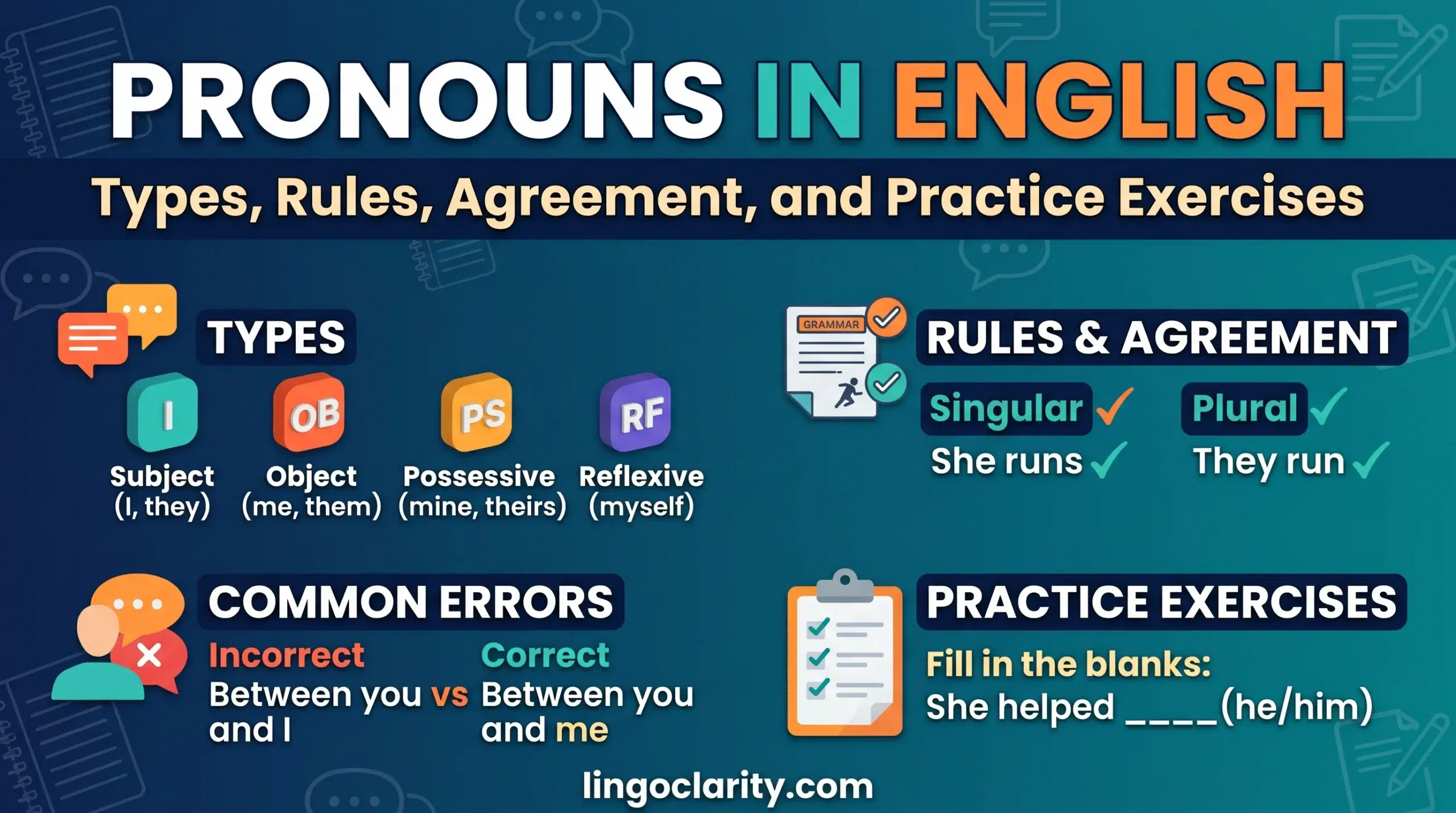
Pronouns are an essential part of English grammar. They make sentences clearer, smoother, and less repetitive by replacing nouns and noun phrases. Without pronouns, everyday communication would often sound awkward.
Consider the following examples:
Without pronouns: Sarah is a university student. Sarah studies linguistics. Sarah wants to become a researcher.
With pronouns: Sarah is a university student. She studies linguistics and wants to become a researcher.
The second version sounds more natural because she replaces the repeated noun Sarah.
However, using pronouns correctly involves more than replacing nouns. Writers must understand their different types, grammatical functions, agreement rules, and appropriate use. An incorrectly chosen pronoun can make a sentence confusing or change its meaning.
This guide explains the main types of pronouns, their grammatical rules, common mistakes, and practical exercises to help improve academic, professional, and everyday writing.
What Is a Pronoun?
A pronoun is a word that replaces a noun or noun phrase to avoid repetition or refer to someone or something already understood from the context.
Examples:
- Ahmed is a teacher. He works at a university.
- The students submitted their assignments.
- This is my notebook.
- Someone has left a phone in the classroom.
In the first example, he refers to Ahmed. The word their shows possession in the second example. Finally, this identifies something, while someone refers to an unidentified person.
The noun or noun phrase to which a pronoun refers is called its antecedent.
For example:
The researcher presented her findings.
Here, her refers to the researcher. A pronoun should have a clear antecedent so that readers can understand exactly whom or what it represents.
Personal Pronouns
Personal pronouns refer to specific people or things. They change according to person, number, and grammatical function. They are commonly divided into subject and object pronouns.
Subject Pronouns
Subject pronouns perform an action or act as the subject of a sentence. They include:
I, we, you, he, she, it, and they.
Examples:
- I teach English.
- We attend university regularly.
- She writes academic articles.
- They work for a software company.
- It looks expensive.
Object Pronouns
Object pronouns receive the action of a verb or follow a preposition. They include:
Me, us, you, him, her, it, and them.
Examples:
- The teacher praised him.
- The manager invited us.
- Sara called me yesterday.
- The students listened to her.
- The university offered them admission.
Subject and Object Pronouns
| Subject Pronoun | Object Pronoun | Example |
|---|---|---|
| I | Me | She helped me. |
| We | Us | The teacher guided us. |
| He | Him | I called him. |
| She | Her | They invited her. |
| It | It | I found it. |
| You | You | We invited you. |
| They | Them | We supported them. |
A common mistake is using an object pronoun as a subject or a subject pronoun as an object.
Incorrect: Me and Ahmed completed the assignment.
Correct: Ahmed and I completed the assignment.
Incorrect: The teacher gave the certificates to Sara and I.
Correct: The teacher gave the certificates to Sara and me.
A useful test is to remove the other person’s name and check the sentence. You would say I completed the assignment, not Me completed the assignment. Similarly, you would say gave the certificates to me, not gave the certificates to I.
Possessive Pronouns and Possessive Determiners
Possessive forms indicate ownership or a relationship between people and things. They are divided into possessive determiners and possessive pronouns.
Possessive Determiners
Possessive determiners come before nouns and show ownership.
Examples:
- My book
- Your phone
- His computer
- Her assignment
- Its purpose
- Our classroom
- Their project
Possessive Pronouns
Possessive pronouns stand independently and replace a noun phrase.
They include:
Mine, yours, his, hers, ours, and theirs.
Examples:
- This is my notebook.
- This notebook is mine.
- Their classroom is larger than ours.
- Is that your laptop or hers?
- The students completed their work, and we completed ours.
The difference is simple: my is followed by a noun, whereas mine stands independently.
| Possessive Determiner | Possessive Pronoun |
|---|---|
| My book | The book is mine. |
| Your car | The car is yours. |
| His computer | The computer is his. |
| Her bag | The bag is hers. |
| Our classroom | The classroom is ours. |
| Their project | The project is theirs. |
Remember that possessive pronouns do not take apostrophes. Write yours, hers, ours, and theirs, not your’s, her’s, our’s, or their’s.
Reflexive and Intensive Pronouns
Reflexive pronouns refer back to the subject of a sentence. They are formed using -self or -selves.
The main reflexive pronouns are:
Myself, yourself, himself, herself, itself, ourselves, yourselves, and themselves.
Examples:
- I taught myself basic computer skills.
- She prepared herself for the interview.
- He blamed himself for the mistake.
- They introduced themselves to the new teacher.
- We enjoyed ourselves at the event.
A reflexive pronoun is appropriate when the subject and object refer to the same person or thing.
Compare:
- She blamed herself. (She and herself refer to the same person.)
- She blamed her. (She blamed another female person.)
Intensive Pronouns
Intensive pronouns have the same forms as reflexive pronouns, but their purpose is different. They emphasize a noun or pronoun.
Examples:
- The principal herself welcomed the guests.
- I myself checked the final report.
- The students themselves organized the event.
In these sentences, the pronouns add emphasis. They can be removed without changing the basic meaning.
For example:
The principal herself welcomed the guests.
The principal welcomed the guests.
Both sentences are grammatically correct, but the first emphasizes the principal’s personal involvement.
Demonstrative Pronouns
Demonstrative pronouns identify or point to particular people, objects, or ideas. The four main demonstrative pronouns are this, that, these, and those.
Their use depends on number and, typically, distance.
| Pronoun | Number | Typical Use |
|---|---|---|
| This | Singular | Something nearby |
| That | Singular | Something farther away |
| These | Plural | Several things nearby |
| Those | Plural | Several things farther away |
Examples:
- This is my favorite book.
- That belongs to the department.
- These are useful research materials.
- Those were excellent presentations.
The same words can also function as determiners when they come before nouns.
Compare:
- This is expensive. (This is a pronoun.)
- This laptop is expensive. (This is a determiner.)
The grammatical function depends on how the word is used in the sentence.
Relative Pronouns
Relative pronouns introduce relative clauses and connect additional information to a noun or pronoun.
The main relative pronouns are who, whom, whose, which, and that.
Examples:
- The teacher who delivered the lecture is experienced.
- The student whom we interviewed was confident.
- The researcher whose article was published received recognition.
- The book which I purchased is useful.
- The software that we developed is easy to use.
Their functions differ:
- Who: Refers to people and usually functions as the subject of a relative clause.
- Whom: Refers to people and functions as the object.
- Whose: Indicates possession.
- Which: Generally refers to things and animals.
- That: Can refer to people or things in defining relative clauses.
In everyday English, who is often used instead of whom, particularly in conversation. However, whom remains useful in formal writing and after certain prepositions.
For example:
- To whom did you send the email?
- Who did you send the email to?
Both are correct, but the first is more formal.
Interrogative Pronouns
Interrogative pronouns are used to ask questions. The main examples are who, whom, whose, which, and what.
Examples:
- Who is your English teacher?
- Whom did you invite?
- Whose is this notebook?
- Which is your favorite subject?
- What happened during the meeting?
These pronouns help us ask about people, ownership, choices, and things.
Some of these words can also function as determiners.
Compare:
- Which is yours? (Which is a pronoun.)
- Which book is yours? (Which is a determiner.)
Indefinite Pronouns
Indefinite pronouns refer to people or things without identifying them specifically.
Common examples include:
Someone, somebody, anyone, anybody, everyone, everybody, nobody, no one, something, anything, everything, nothing, many, few, and several.
Examples:
- Someone is waiting outside.
- Everybody needs support.
- Nothing was missing.
- Several have applied for the position.
- Many were interested in the program.
Indefinite pronouns require attention to subject–verb agreement.
Words such as everyone, everybody, someone, anybody, and nobody generally take singular verbs.
Examples:
- Everyone is ready.
- Somebody has called.
- Nobody knows the answer.
Words such as many, few, and several generally take plural verbs.
Examples:
- Many are absent.
- Few understand the instructions.
- Several have completed the task.
Words such as some, all, most, and none can take singular or plural verbs depending on what they refer to.
Examples:
- Some of the information is incorrect.
- Some of the students are absent.
- Most of the research is complete.
- Most of the researchers are experienced.
The important point is to identify the noun or idea to which the pronoun refers.
Distributive Pronouns
Revised version:
Distributive pronouns refer to people or things individually rather than as a group. They help identify separate members of a group.
The three main distributive pronouns are each, either, and neither.
Each
The pronoun each refers to every person or thing in a group separately. For example:
Each has a different opinion.
Each of the students received a certificate.
Examples:
- Each of the students received a certificate.
- Each has a different responsibility.
- Each of them was invited to the event.
Either
Either refers to one of two people or things.
Examples:
- Either of the two answers is correct.
- You can choose either of these options.
- Either is suitable for the project.
Neither
Neither means not one and not the other of two people or things.
Examples:
- Neither of the students was absent.
- Neither is suitable for this position.
- Neither of the answers is correct.
Distributive Pronouns and Verb Agreement
Distributive pronouns such as each, either, and neither generally take singular verbs when used as pronouns.
| Pronoun | Example |
|---|---|
| Each | Each has a separate assignment. |
| Either | Either is acceptable. |
| Neither | Neither was available. |
Remember that distributive pronouns focus on individual members rather than the group as a whole.
Reciprocal Pronouns
Reciprocal pronouns express a mutual or shared action or relationship between two or more people or things.
The two main reciprocal pronouns are:
Each other and one another.
They show that people perform an action toward one another.
Each Other
Each other is commonly used when referring to two people or things.
Examples:
- Sara and Ahmed help each other.
- The two friends respect each other.
- The students congratulated each other.
One Another
One another is traditionally used when referring to more than two people or things.
Examples:
- The team members supported one another.
- The students shared their ideas with one another.
- The neighbors helped one another during the emergency.
In modern English, each other and one another are often used interchangeably.
Difference Between Reflexive and Reciprocal Pronouns
These two categories may look similar, but they have different meanings.
| Reflexive Pronoun | Reciprocal Pronoun |
|---|---|
| They blamed themselves. | They blamed each other. |
| The children dressed themselves. | The children helped one another. |
| We introduced ourselves. | We introduced each other. |
Reflexive pronouns show that someone performs an action on themselves. Reciprocal pronouns show that people perform an action mutually.
Types of Pronoun Cases in English
Pronoun case refers to the grammatical form a pronoun takes depending on its function in a sentence. English has three main pronoun cases: subjective, objective, and possessive.
Subjective Case
Subjective pronouns function as the subject of a sentence. They perform an action or identify who or what the sentence is about.
Examples:
- I study English.
- She works at a university.
- They completed the assignment.
- We attended the meeting.
Common subjective pronouns include:
I, we, you, he, she, it, and they.
Objective Case
Objective pronouns function as the object of a verb or preposition. They receive an action or follow a preposition.
Examples:
- The teacher helped me.
- Sara invited him.
- The manager spoke to us.
- The professor praised them.
Common objective pronouns include:
Me, us, you, him, her, it, and them.
Possessive Case
Possessive pronouns and possessive determiners show ownership or relationships.
Examples:
- This is my book.
- The book is mine.
- Their house is large.
- The house is theirs.
Common possessive forms include:
My, your, his, her, its, our, their, mine, yours, hers, ours, and theirs.
Comparison of the Three Pronoun Cases
| Subjective Case | Objective Case | Possessive Forms |
|---|---|---|
| I | Me | My / Mine |
| We | Us | Our / Ours |
| You | You | Your / Yours |
| He | Him | His |
| She | Her | Her / Hers |
| It | It | Its |
| They | Them | Their / Theirs |
Understanding pronoun cases helps prevent common errors, especially when choosing between I and me, he and him, or she and her.
Pronoun–Antecedent Agreement
A pronoun should agree with its antecedent in number and person. In other words, the pronoun must refer appropriately to the noun it replaces.
Examples:
- The student submitted her assignment.
- The students submitted their assignments.
- The company changed its policy.
- The teachers shared their experiences.
A singular antecedent generally requires a singular pronoun, while a plural antecedent generally requires a plural pronoun.
However, singular they is widely accepted in modern English when a person’s gender is unknown, irrelevant, or when the person uses they as a personal pronoun.
Examples:
- Every student should bring their notebook.
- Someone has left their phone in the classroom.
- A researcher should acknowledge their sources.
Singular they is common in contemporary academic and professional English. It can also help writers avoid making unnecessary assumptions about a person’s gender.
Common Pronoun–Antecedent Agreement Rules
- Singular antecedents: Use an appropriate singular pronoun when referring to one person or thing.
- The teacher explained her decision.
- Plural antecedents: Use plural pronouns when referring to multiple people or things.
- The teachers explained their decisions.
- Indefinite pronouns: Words such as everyone, someone, and nobody generally take singular verbs.
- Everyone is ready.
- Singular they: Use singular they when appropriate for an individual whose gender is unknown or who uses this pronoun.
- Every employee should bring their identification.
Unclear Pronoun Reference
A pronoun must have a clear antecedent. If readers cannot identify the noun to which it refers, the sentence becomes confusing.
Consider:
Unclear: When Sara spoke to Ayesha, she was upset.
Who was upset: Sara or Ayesha? The sentence does not provide enough information.
Clearer: Sara was upset when she spoke to Ayesha.
Another example:
Unclear: The manager told the employee that he needed to improve.
Who needed to improve: the manager or the employee?
Clearer: The manager told the employee, “You need to improve.”
Alternatively:
The manager told the employee that the employee needed to improve.
Writers should avoid pronouns with multiple possible antecedents. Repeating a noun is sometimes better than using an unclear pronoun.
Common Pronoun Mistakes
The following examples show errors frequently found in academic assignments, emails, and everyday writing.
| Incorrect | Correct | Explanation |
|---|---|---|
| Me and Ali attended the meeting. | Ali and I attended the meeting. | Use subject pronouns as subjects. |
| The teacher helped Ahmed and I. | The teacher helped Ahmed and me. | Use object pronouns as objects. |
| This book is her’s. | This book is hers. | Possessive pronouns do not take apostrophes. |
| He prepared hisself. | He prepared himself. | Use the correct reflexive form. |
| Everyone have their own opinion. | Everyone has their own opinion. | Everyone takes a singular verb. |
| The students submitted his work. | The students submitted their work. | The pronoun should agree with its antecedent. |
| Myself completed the report. | I completed the report. | Use a subject pronoun as the subject. |
| The student which I met was helpful. | The student whom I met was helpful. | Use whom as the object form when referring to a person in formal writing. |
Remember that not every formal-looking pronoun needs correction. For example, whom is appropriate when it functions as the object of a verb or preposition in formal English.
Practical Tips for Using Pronouns Correctly
Correct pronoun use becomes easier when writers develop a few simple habits.
- Identify the antecedent. Before using a pronoun, make sure readers can identify the noun it replaces.
- Check its grammatical function. Decide whether the pronoun is a subject, object, possessive form, or reflexive form.
- Check agreement. Ensure that the pronoun agrees with its antecedent in number and person.
- Avoid unnecessary repetition. Use pronouns to make sentences smoother, but do not replace every noun if doing so makes the meaning unclear.
- Use reflexive pronouns carefully. Do not use myself or yourself simply because they sound more formal than me or you.
- Read from the reader’s perspective. Ask whether someone unfamiliar with the subject can understand exactly whom or what each pronoun refers to.
- Choose the correct pronoun case. Use subject pronouns for subjects and object pronouns for objects and after prepositions.
For example:
Unclear: The department informed the students that they had changed the examination schedule.
The pronoun they could refer to the department or the students.
Clearer: The department informed the students that the examination schedule had changed.
The revised sentence removes the unclear reference and communicates the message directly.
Pronoun Practice Quiz
Test your knowledge with these 12 multiple-choice questions.
Total Questions: 12 | Total Marks: 12Select one answer for each question and submit to check your results.
Your Quiz Results
✓ Correct | ✗ Incorrect
Conclusion
Pronouns make English communication more natural, concise, and effective. They replace nouns, show possession, ask questions, connect clauses, and refer to people or things without unnecessary repetition. However, correct usage requires an understanding of their types, grammatical functions, agreement, and antecedents.
The most important principle is clarity. A pronoun should have a clear reference, follow the appropriate grammatical form, and agree with the noun it replaces. By applying these rules, understanding different pronoun cases, and practicing common examples, writers can produce more accurate and professional English in academic, workplace, and everyday communication.
